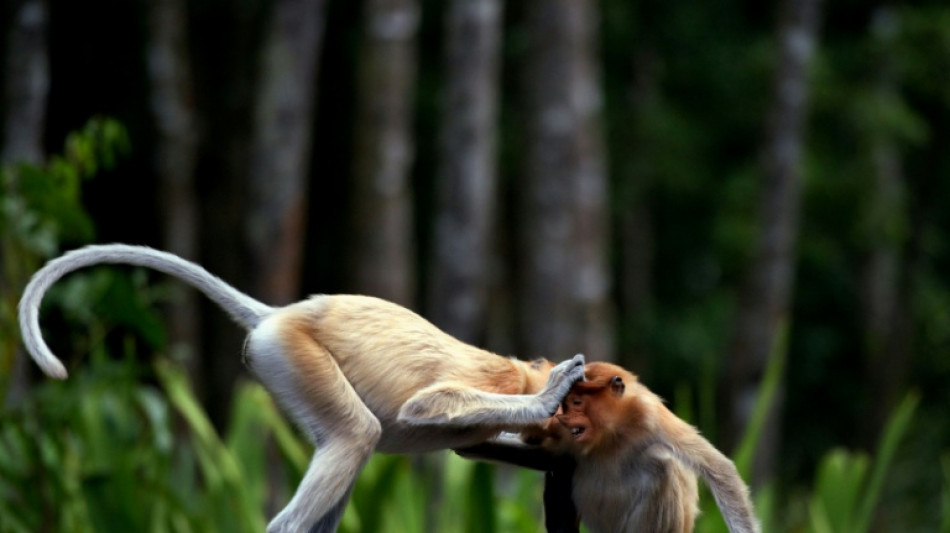
'People could get hurt': Conservationists decry AI wildlife visuals / Photo: Alex Ogle - AFP/File
 Libya's pay strike rallies teachers across divided nation
 Four-member crew blasts off for International Space Station

 i-payout Expands True Local Payment Capabilities to Help Enterprises Pay Recipients Globally
 Botched US execution prompts global calls to scrap death penalty

 Algeria adopts law imposing death penalty on forest arsonists

 France unveils cost-cutting 2027 budget as borrowing costs rise

 Brazil court orders removal of fake posts amid patron saint election row

 Italy's firefighting planes return home after scorching summer
 How airlines try to make sure pilots are safe to fly

 Bolivia's attorney general arrested for alleged money laundering and drug trafficking

 Zverev beats Norrie to kick off Sinner-less China Open

 Wall Street stocks rise after bond yield spike eases

 Finland investigates suspected break-ins at MPs homes

 London's Bayeux Tapestry show to offer audio tour for blind people

 Smouldering bins, halted trams as French pupils protest

 Malone Life and Pensions Expands Internationally Beyond the European Union

 England paceman Archer rested for ODI tri-series

 Queiroz exits Ghana as Black Stars crisis deepens

 ALEX BODI VE ALMAN ŞİRKETLER GRUBUNDAN HALLE’DE 166 DAİREYE YATIRIM

 อเล็กซ์ โบดี และกลุ่มบริษัทจากเยอรมนีลงทุนในอพาร์ตเมนต์ 166 ยูนิตที่เมืองฮัลเลอ

 ALEX BODI A NĚMECKÝ KONCERN INVESTUJÍ DO 166 BYTŮ V HALLE
 ALEX BODI OCH TYSK KONCERN INVESTERAR I 166 LÄGENHETER I HALLE

 England forward Toney pleads not guilty to nightclub assault

 Tom Kim finishes marathon Asian Games second round under floodlights

 Work on migrant return hubs progressing well, EU countries say

The black-and-white image appears to show the unlikeliest of interactions: an orangutan cradling endangered leopard cubs deep in the jungles of Malaysia's Sabah state.
But the viral image is not just unlikely, it is fake, part of a trend of wildlife images generated by artificial intelligence that experts warn endanger animals and people.
AFP fact-checkers have debunked scores of similar synthetic visuals, from an elephant climbing a tree to escape flooding in Myanmar to a pink dolphin leaping out of water in the Philippines.
The images are often accompanied by heartwarming anecdotes and have circulated widely in multiple languages on platforms such as Facebook, TikTok and X.
They may seem more like feel-good fiction than dangerous misinformation, but experts warn hyper-realistic visuals of wild animals behaving like pets, or even like humans, can distort public perceptions of wildlife and harm conservation efforts.
"This misunderstanding can lead people to approach animals too closely or interact with them in unsafe ways," Jose Guerrero-Casado, a zoology professor at Spain's University of Cordoba, told AFP.
He cited a widely reported incident in China's northwest Xinjiang region in January, where a woman was attacked by a rare snow leopard after trying to get closer for a photo.
China's forestry department said it stepped up patrols after the incident and warned the public to maintain a safe distance when encountering wild animals.
- Sowing doubt -
Conservationists say AI visuals portraying wild animals as cute or cuddly make it harder for social media users to discern what is real and can fuel exploitation.
They increase demand for certain species "to be used in the tourism industry as photo props, exploited to make social media content or to be kept as pets", said Chris Lewis, a researcher at the international wildlife charity Born Free.
And while the visuals could encourage some people to support animal protection, "the negative impacts outweigh that completely," said Jenny Roberts of conservation group WWF.
"People could get hurt," she told AFP.
WWF uses real images for its fundraising efforts, but fake content online "desensitises" people to even the most incredible original visuals, she said.
"When you do have something remarkable, people question it," Roberts said, recounting an incident where a camera trap set up by her charity captured a tiger with five cubs in China.
Such footage had never been filmed before in the East Asian country, she said.
"But when we put the content out there, we were questioned on social media: 'Is this AI-generated?'"
- 'Major threat' -
A September study in the journal Conservation Biology, co-authored by Guerrero-Casado, concluded that the rapid spread of AI misinformation and its potential to harm environmental efforts is a "major threat" to society.
The researchers highlighted another challenge for those working in conservation: AI images "could affect the ability of people to identify species" and cause misunderstandings about the abundance and distribution of wildlife.
Scientists often mine data from citizen science platforms that accept photos and recordings of wildlife submitted by users.
But AI generation and manipulation could lead to flawed research, several experts warned in a recent commentary in the journal Nature.
They called for more robust authentication of submissions, and education of users about the risks of manipulating images and recordings.
Meta, Facebook's parent company, and TikTok require users to label realistic visuals that have been generated or significantly altered using AI. They also say their platforms have tools that automatically label content as AI-generated.
However, AFP fact-checkers spotted multiple wildlife posts without clear labels -- even when users had already said in their captions that they were fake.
Meta and TikTok pay AFP to fact-check posts with potentially false information.
"Conservation depends on a well-informed society that understands the ecological and conservation needs of wild species," Guerrero-Casado said.
"AI-generated fake content does not contribute to this goal."
C.Garcia--AMWN