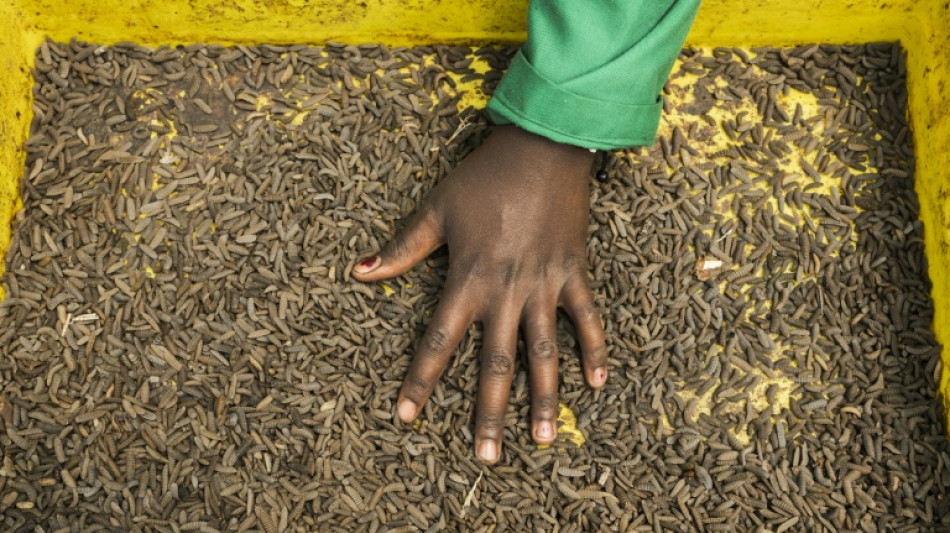
Kenyan farmers turn to bugs as organic demand grows / Photo: Tony KARUMBA - AFP
 Sherilyn Smith Encourages Women to Embrace Scars as Symbols of Resilience

 Belgium Signs Contract for 20 Rheinmetall Skyranger Air Defence Systems

 Spectrocell Strengthens Product Discovery and Customer Engagement with Bioz Badges

 InterContinental Hotels Group PLC Announces Transaction in Own Shares - November 10

 RBI Data Reveals Divergence in Credit Card Spending and Debit Card Cash Withdrawals

 Panthers expected to begin 2027 NRL season away from new stadium

 Sweet As app launches restaurant discovery platform

 Phoenix Restaurants Offer Thanksgiving Dinner to Go for Pickup

 Mayo school appeals for information after convent and chapel vandalism

 Virginia overwhelms Arkansas 91-72 behind balanced scoring

 Second major storm brings destructive winds and outages to British Columbia

 Godzilla Minus Zero leads North American box office with $31.6m

 Advocate calls for coordinated support for children facing trafficking

 Medicare Open Enrollment Ends Dec. 7: Review Your Coverage Options

 US Treasury order targets bank transfers linked to crypto exchange MEXC

 Nvidia CEO Controversy Sparks Fears of Tighter U.S. AI Chip Curbs for Samsung and SK hynix

 Villeneuve teases James Bond casting at Los Angeles museum gala

 Nottinghamshire launches specialist rural crime policing team

 China confirms talks over possible Xi-Putin-Trump summit

 Rail journey offers a slower route to a Berlin city break

 Arsenal control title race as Manchester United fall into bottom three

 Suspected Krakow gunman dies after attack that killed six

 Carrick backs Dalot after hostile reception from Manchester United fans

Kenyan farmer George Muturi says the stinky wooden shack teeming with redworms has helped rescue his land from the soil degradation caused by chemical fertilisers.
Agriculture is vital to east Africa's economy, but a 2025 soil report by the Heinrich Boll Foundation, a German think tank, found that more than 40 percent of the region's soils were degraded -- in part by overuse of chemical fertilisers -- costing more than $65 billion a year in lost productivity.
Fertiliser prices have also increased this year due to the war in the Middle East, driving a search for alternatives.
In Kenya, 32 percent of cropland was classified as strongly acidic in the soil report. Changing climatic conditions and overly intensive farming practices are among the causes, but Muturi says moving away from chemical fertilisers has boosted his harvests at his farm in Lari, about 50 kilometres (30 miles) from the capital, Nairobi.
He switched to "vermicompost" -- using redworms that turn food and crop waste into a natural, nutrient-rich form of fertiliser.
"Vermicomposting was a breakthrough for us... our soil is much better in a way that we can be able to plant and sustain the crop even during dry season," the 31-year-old farmer told AFP during a visit to his farm.
About 70 beds, each filled with at least 5,000 redworms, hold layers of food and crop waste mixed with cow dung that the worms break down over six weeks, to create vermicompost.
Multiple studies have shown that vermicompost can improve soil structure, organic matter and water retention.
Muturi acknowledges that it is some way off being used on an industrial scale, since very large quantities are needed to match the effects of synthetic fertilisers.
But he says he has seen positive results on his vegetables and has started selling the compost to other farmers around the country.
- Circular agriculture -
About 200 kilometres away in Nakuru County, Robert Mwangi has taken a similar approach with the larvae of black soldier flies.
He collects waste from the city's main market and feeds it to the larvae, which break it down into frass, an organic fertiliser. The mature larvae are dried and used as animal feed.
In a nylon structure, a pungent smell hangs over drums of shredded food waste, which are emptied into plastic boxes where the larvae feed for about two weeks before the frass is harvested.
"With conventional fertilisers, the more you use it, the more the productivity of the soil goes down, because (it) creates an acidic environment which is not good for the microbes that are responsible for maintaining and improving the soil fertility," Mwangi said.
"The organic fertiliser is a very good soil amendment so farmers are able to experience increased productivity over time and improved soil fertility which reduces their cost of production," he said, adding that it also helps deal with food waste.
As global and domestic demand for organic food grows, Kenyan farmers are seeking alternatives to chemical fertilisers.
Mwangi processes about 10 tonnes of food waste per week, selling the resulting compost to farmers across the country.
"The demand has overwhelmed what we can produce," Mwangi said.
Y.Kobayashi--AMWN