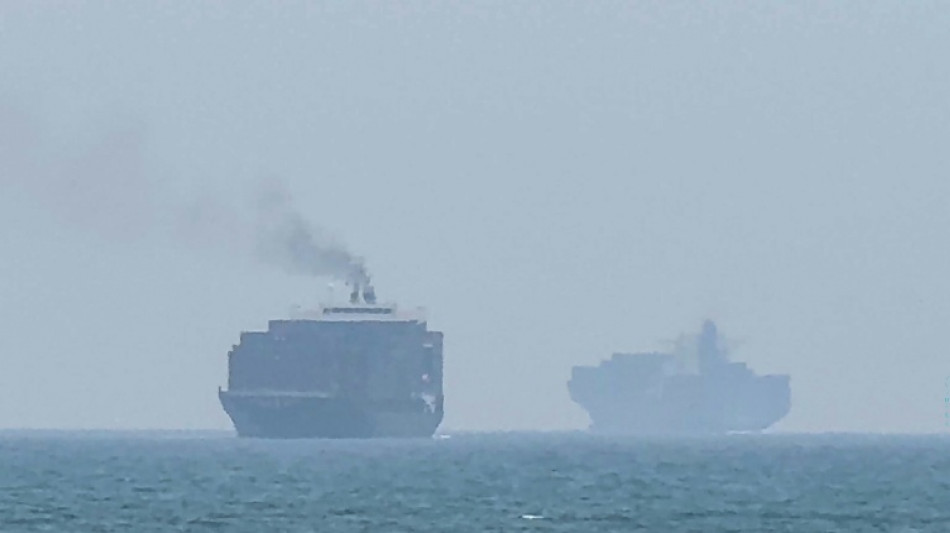
Six months into Iran war, Hormuz traffic way down, sailors stranded / Photo: - - AFP/File
 Sherilyn Smith Encourages Women to Embrace Scars as Symbols of Resilience

 Belgium Signs Contract for 20 Rheinmetall Skyranger Air Defence Systems

 Spectrocell Strengthens Product Discovery and Customer Engagement with Bioz Badges

 InterContinental Hotels Group PLC Announces Transaction in Own Shares - November 10

 RBI Data Reveals Divergence in Credit Card Spending and Debit Card Cash Withdrawals

 Panthers expected to begin 2027 NRL season away from new stadium

 Sweet As app launches restaurant discovery platform

 Phoenix Restaurants Offer Thanksgiving Dinner to Go for Pickup

 Mayo school appeals for information after convent and chapel vandalism

 Virginia overwhelms Arkansas 91-72 behind balanced scoring

 Second major storm brings destructive winds and outages to British Columbia

 Godzilla Minus Zero leads North American box office with $31.6m

 Advocate calls for coordinated support for children facing trafficking

 Medicare Open Enrollment Ends Dec. 7: Review Your Coverage Options

 US Treasury order targets bank transfers linked to crypto exchange MEXC

 Nvidia CEO Controversy Sparks Fears of Tighter U.S. AI Chip Curbs for Samsung and SK hynix

 Villeneuve teases James Bond casting at Los Angeles museum gala

 Nottinghamshire launches specialist rural crime policing team

 China confirms talks over possible Xi-Putin-Trump summit

 Rail journey offers a slower route to a Berlin city break

 Arsenal control title race as Manchester United fall into bottom three

 Suspected Krakow gunman dies after attack that killed six

 Carrick backs Dalot after hostile reception from Manchester United fans

Six months since the start of the Middle East war, the strategic Strait of Hormuz remains largely paralysed, with thousands of sailors still stranded in the Gulf and commodity carrier traffic way below its normal level.
- Only a few transits per day -
Before Iran blocked the strait in response to joint US-Israeli strikes in February, around one fifth of the world's oil and liquefied natural gas exports passed through the waterway.
Iran's Guards have also warned of a "danger zone" covering 1,400 square kilometres where mines may be present.
After Iran closed the strait on March 1, commodity carrier traffic plummeted to an average of 10 transits per day, compared with a daily average of 95 in February, according to an AFP analysis of data from maritime tracker Kpler.
An agreement signed by the United States and Iran in June led to a temporary rebound to 36 transits per day, before they dropped back to an average of 15 between the resumption of hostilities on July 8 and August 22.
- New routes, 'dark' transits -
Before the war, vessels crossed the strait freely via a route through the centre of the waterway adopted by the International Maritime Organization (IMO).
There are now two distinct routes: one to the north, near the Iranian coast -- the only one approved by Tehran -- and another to the south, between the Omani coast and potentially mined areas.
During the relatively calm period between June 17 and July 7, an average of nine ships per day used the Iranian route and eight the Omani one. The rest transited via unidentified routes or the traditional IMO corridor.
Ever since the ceasefire collapsed on July 8, two-thirds of transits have become "dark", or unknown, compared with less than one percent before the war, according to Kpler.
These transits involve vessels whose exact route cannot be confirmed due to insufficient data stemming from disabled transponders, jammed signals or missing satellite imagery.
- Thousands of sailors stranded -
Some 6,000 sailors and 500 ships have remained stuck in the Gulf since the beginning of the conflict, the IMO told AFP.
The organisation said there were "ongoing discussions" to ensure a secure maritime route, adding that their outcome "depends on de-escalation in the region".
The IMO had begun an initiative in June to evacuate more than 11,000 seafarers stuck in the Gulf, but the effort was soon suspended following an attack on a vessel.
Over the past six months, at least 20 sailors and dockworkers have been killed in incidents or attacks in the region, according to the IMO.
M.A.Colin--AMWN