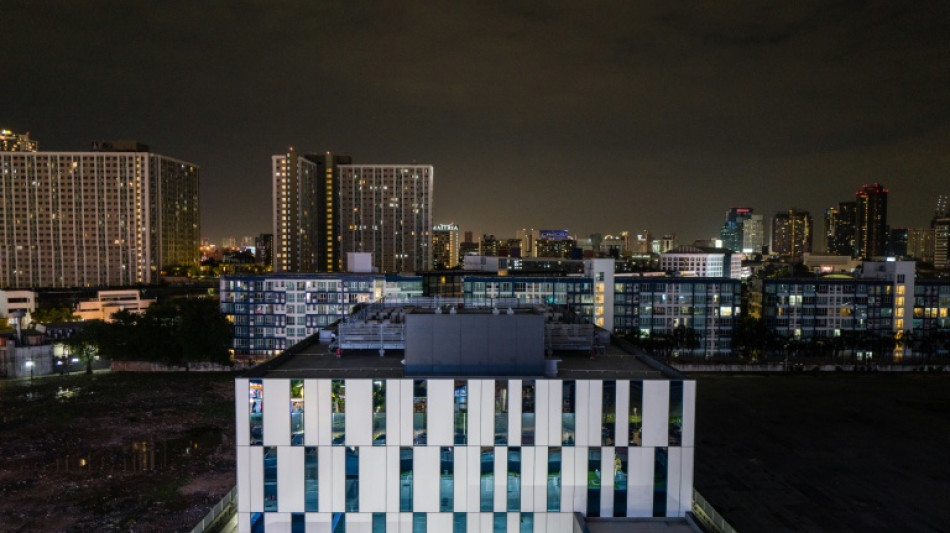
AI data centers are less thirsty now, tech giants say / Photo: Anthony WALLACE - AFP
 Sherilyn Smith Encourages Women to Embrace Scars as Symbols of Resilience

 Belgium Signs Contract for 20 Rheinmetall Skyranger Air Defence Systems

 Fulcrum Metals PLC Announces Fulcrum to Increase Shareholding in Loyalist

 New Gold IRA Investing Guide Explains How to Buy Gold in an IRA for American Consumers

 First-time boat buyers advised to assess full ownership costs

 Planning and preparation can reduce stress of interstate relocation

 Two more arrested in Carrie Mullane suspected murder investigation

 MLA seeks inquiry into reported sectarian gestures on Ormeau Road

 Louise O’Reilly attacks Simon Harris over unemployment remarks

 Canadian soldier Aidan Goulding remembered at Vancouver funeral

 Tayyab Arif hits 57 on Pakistan Test debut against Sri Lanka

 Robert Trujillo discusses literacy and social justice children’s books

 Civil rights advocate William Bill Tucker dies aged 98

 Pennsylvania Democrats secure state trifecta in midterm elections

 Godzilla Minus Zero sets foreign-language box-office opening record

 Eagles record six sacks as rushing attack struggles against Giants

 Thames Water seeks to delay £12bn in debt repayments

 Newark boxing gym expands alternative education programme

 Democrats consider impeachment drive against Defence Secretary Hegseth

 Energy bill plan could use HMRC income data to target support

 Business owner earning £6,000 a month tackles £70,000 debt

 Nvidia chief faces inquiry after disclosing affair with suspected Chinese agent

 Comet returns as online electrical marketplace 14 years after collapse
Data centers are running into a wall of public anger in the United States over their thirst for water and power.
The tech giants spending billions of dollars on them say the water part, at least, is solvable.
Data centers are the warehouses full of computer servers that run the internet and increasingly artificial intelligence.
The computers get hot, and keeping them cool takes water.
American chip giant Nvidia said in a June report that it can eliminate water consumption almost entirely at some facilities when deploying DSX, its newest system for designing and managing AI data centers.
It's a bold claim, and one the industry is under mounting pressure to make good on.
In 2025, data centers consumed 222 billion liters (59 billion gallons) of water worldwide for cooling, according to consultancy Rystad Energy.
Without adaptive measures, the figure could nearly triple to 644 billion liters by 2030, Rystad estimates. Steps to limit the growth could keep it under double.
Nvidia's new method uses a closed-loop cooling system in which liquid flows directly through the servers, as close as possible to the chips, whose temperature can rise above 80C (176F).
The problem is that "there's a pretty direct trade-off between how much water is used and how much energy is used" for temperature control, said Andy Masley, an independent researcher who covers AI and data centers.
Cutting back on water use usually means more power as the liquid in those sealed pipes still has to be cooled down somehow, usually by blowing air over it -- and that takes electricity.
Nvidia gets around some of this by letting the liquid enter the servers warmer than usual, at 45C.
Most other closed-loop systems ran at about 32C in 2024, according to the Uptime Institute, which certifies data centers.
By starting with warmer water, Nvidia does not need to pump in cooled air year-round.
"Simple fans circulating the air" are often enough, though sometimes a mix of methods is needed, said Josh Parker, Nvidia's head of sustainability.
At sites in extreme climates, or during a heat wave, chill airflow or water evaporation is still necessary.
- Public relations -
Microsoft, Amazon Web Services (AWS) and Meta told AFP that they also use closed-loop systems, which they said involve no net water loss.
The two cloud computing giants, which have been expanding their already huge data center footprints, used more water overall between 2022 and 2025, but their water use efficiency improved by 25 percent at Microsoft and 37 percent at AWS, according to their most recent sustainability reports.
There is no industry-wide consistency, however, in how companies report data on so-called environmental, social and governance (ESG) efforts.
Elon Musk's SpaceX, now a major player in data centers after it acquired his artificial intelligence company xAI, has never published an ESG report.
In June, ratings agency MSCI gave SpaceX its lowest ESG score.
"Because water is generally much cheaper than electricity," companies have less incentive to cut water use on cost grounds alone, said Shaolei Ren, an engineering professor at the University of California, Riverside.
"There are incentives," Ren said, but they have more to do with public relations amid the growing backlash to data centers across the United States.
Another obstacle is that upgrading an older data center to newer, less thirsty technology is expensive.
That may matter less than it sounds.
Older data centers are smaller and less powerful than the enormous new ones being built now, so they need less cooling in the first place, said Minh K. Le, who leads data center and hydrogen research at Rystad.
And the water a data center uses directly is only part of the story.
Water is used to generate the electricity that powers the data center, and to manufacture its chips and servers.
In the United States, that hidden water use can be twice the amount a data center consumes on its own.
Ch.Havering--AMWN