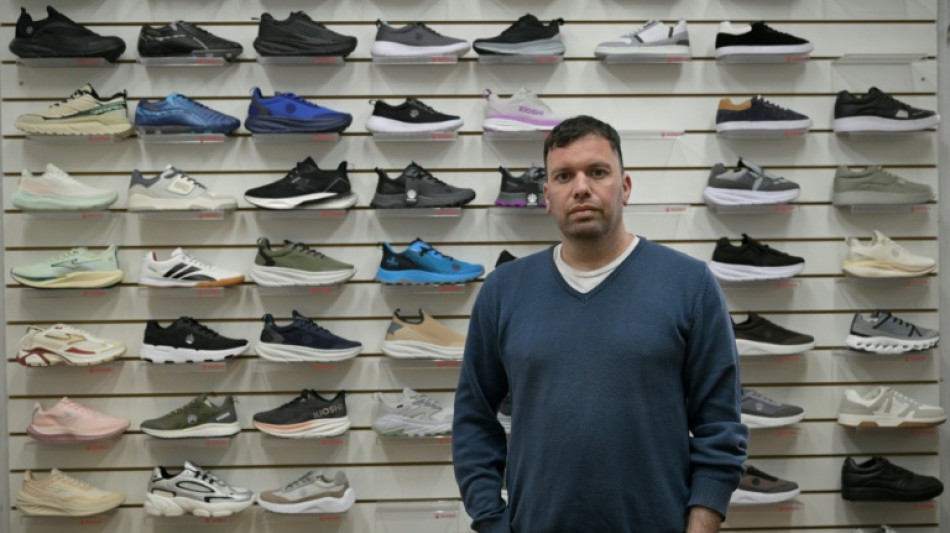
Argentine industry reels from Milei's free-market revolution / Photo: JUAN MABROMATA - AFP
 Sherilyn Smith Encourages Women to Embrace Scars as Symbols of Resilience

 Belgium Signs Contract for 20 Rheinmetall Skyranger Air Defence Systems

 Fulcrum Metals PLC Announces Fulcrum to Increase Shareholding in Loyalist

 New Gold IRA Investing Guide Explains How to Buy Gold in an IRA for American Consumers

 First-time boat buyers advised to assess full ownership costs

 Planning and preparation can reduce stress of interstate relocation

 Two more arrested in Carrie Mullane suspected murder investigation

 MLA seeks inquiry into reported sectarian gestures on Ormeau Road

 Louise O’Reilly attacks Simon Harris over unemployment remarks

 Canadian soldier Aidan Goulding remembered at Vancouver funeral

 Tayyab Arif hits 57 on Pakistan Test debut against Sri Lanka

 Robert Trujillo discusses literacy and social justice children’s books

 Civil rights advocate William Bill Tucker dies aged 98

 Pennsylvania Democrats secure state trifecta in midterm elections

 Godzilla Minus Zero sets foreign-language box-office opening record

 Eagles record six sacks as rushing attack struggles against Giants

 Thames Water seeks to delay £12bn in debt repayments

 Newark boxing gym expands alternative education programme
 Democrats consider impeachment drive against Defence Secretary Hegseth

 Energy bill plan could use HMRC income data to target support

 Business owner earning £6,000 a month tackles £70,000 debt

 Nvidia chief faces inquiry after disclosing affair with suspected Chinese agent

 Comet returns as online electrical marketplace 14 years after collapse
In the gloom of a vast warehouse in Argentina, the machines lying idle next to boxes of unsold merchandise represent the collapse of manufacturing under President Javier Milei.
Just three years ago, Kioshi employed nearly 120 people and produced 40,000 pairs of sneaker and flip-flops a month in the south of Buenos Aires.
Today, there are just 14 workers turning out a quarter of that amount as Milei's decision to throw open Argentina to global competition has left local manufacturing on the ropes.
"The domestic market is dead, there are people who go into debt to buy food so just imagine trying to buy shoes," Kioshi director Emmanuel Fernandez explained.
In 2024, Milei began dismantling the protectionist policies introduced by the left in the name of driving down prices.
The elimination of import quotas, taxes and other trade restrictions has led to an "avalanche" of imports that have been like a body blow to Kioshi, Fernandez said.
"We are industrial people, it's our passion, so when you only hear 10 percent of the machines in operation, it hurts," he added.
In June, around 40 percent of Argentina's industrial capacity lay idle.
Manufacturing output fell 5 percent between June and July, the sharpest drop in 16 months.
The influential Argentine Industrial Union last demanded government action in the face of the loss of some 90,000 industrial jobs and closure of nearly 30,000 companies in the past three years.
- 'Creative destruction' -
Inflation, a major issue when Milei took power and which has plunged drastically since he reduced public spending, has been displaced by unemployment as Argentines' biggest concern, according to recent polling.
The government has dimissed the job losses and decline in output as mere growing pains on the path to what Milei has portrayed as a more prosperous future.
"Companies disappear in the same way they appear, it's a natural phenomenon," he said breezily.
The self-described "anarcho-capitalist" invokes the "creative destruction" theory of US-Austrian economist Joseph Schumpeter to describe how old industries inevitably fold in the face of innovation.
But while waiting for new businesses and jobs to materialize, "what we see is people losing their job and going to work for (delivery) apps," said Fernandez.
Most of the businesses going under are small, like a subsidiary of Swiss chemicals group Clariant, situated around 90 kilometers (55 miles) from Buenos Aires, which closed last year after half a century.
Weeds are now pushing up through cracks in the empty parking lot.
Only two of the 42 staff members have found work in the formal sector, according to Miguel Marquez, a 62-year-old lab technician, who served the company for 20 years.
He and the rest have been left to try eke out a living doing "any kind of work, like an Uber driver," he said, standing outside the factory gates.
- Skewed playing field -
Economy Minister Luis Caputo says his job is "to defend the interests of 48 million Argentines, not those of certain business owners."
"For Argentines to have to pay for lower-quality goods at two, four, ten times their value strikes me as immoral and unfair," he said in defense of opening up national industry to foreign competition.
Industrialists say the playing field is uneven.
They argue that an artificially strong Argentine peso that makes local products less competitive, coupled with high interest rates and taxes, make it impossible to compete with cheap imports.
Job losses and falling purchasing power have added to industry's woes by depressing consumer spending.
Martin Blunt, a small company that manufactures strings for muscial instruments in the northern suburbs of Buenos Aires, has had to shift to a four-day week in the face of falling demand.
Job security is a top of "huge anxiety" among workers, the company's co-director Gloria Aparicio said.
"Everytime we make a staff announcement they panic."
O.Johnson--AMWN