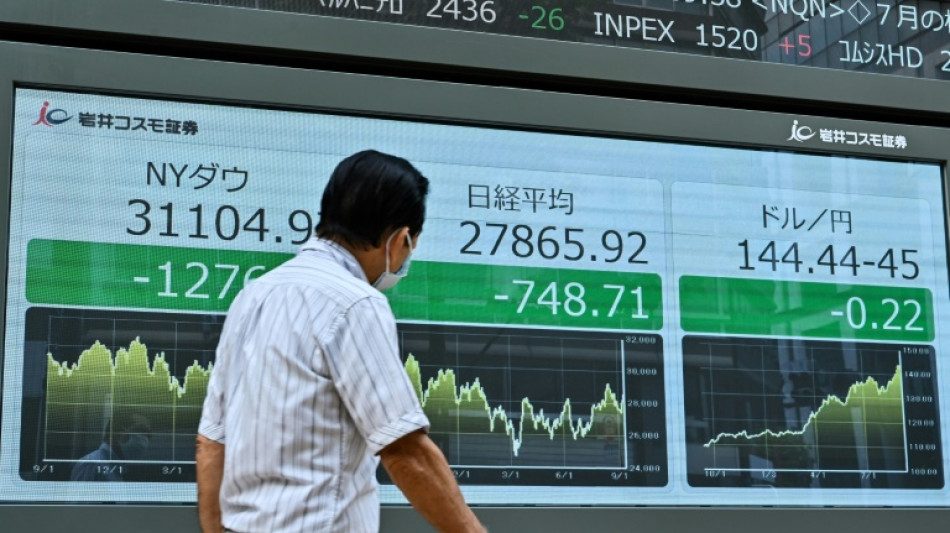
Japan central bank conducts 'rate check' as yen sinks: reports / Photo: Richard A. Brooks - AFP
 Thukukile Zuma Resigns from ANC Johannesburg Leadership Amid Disciplinary Dispute

 CM Mohan Yadav Meets Bohra Spiritual Leader to Discuss Simhastha 2028 and Development

 Eli Crane Defeats Jonathan Nez in Tight Arizona Congressional Race

 Sherilyn Smith Encourages Women to Embrace Scars as Symbols of Resilience

 Belgium Signs Contract for 20 Rheinmetall Skyranger Air Defence Systems

Japan's central bank on Wednesday conducted an operation often seen as a precursor to currency intervention, local media said, as the yen continues to crater against a strengthening dollar.
The financial daily Nikkei and other local media said the Bank of Japan (BoJ) carried out a "rate check". A Bank spokesman contacted by AFP declined to comment.
A rate check involves asking market participants about their foreign exchange trading, said Toshikazu Horiuchi of IwaiCosmo Securities.
"Basically it's a warning, which is the next best thing to an intervention when the exchange rate is fluctuating," he told AFP.
The yen has tumbled from around 115 per dollar in March to lower than 140 in recent weeks, as the BoJ maintains its monetary easing policies despite sometimes sharp rate hikes elsewhere, including from the Federal Reserve, to tackle inflation.
In early Tokyo trade, a dollar fetched 144.94 yen, after worse-than-expected US inflation data raised the prospect of even steeper US rate hikes to tame prices.
The rate check reports saw the yen strengthen quickly, with the dollar touching a low of 143.53 within an hour.
Earlier Wednesday, Japanese government officials sought to calm the waters by insisting they were monitoring the currency swings and would not rule out any option to prevent further falls.
Masato Kanda, vice finance minister for international affairs, told reporters that the yen's move was "rapid" and "concerning".
"When a rate check is conducted, sometimes it evolves into an intervention, so that's why the market reacts very sensitively," Horiuchi said.
"But its actual impact hinges on whether an intervention is really possible."
A weaker yen can help Japanese companies to sell products overseas, but the levels seen in recent weeks are starting to put pressure on households and businesses due to higher import prices.
Inflation more broadly has risen to seven-year highs in Japan, partly due to the impact of the war in Ukraine on energy prices, though it is still less severe than in many major economies.
Japan's central bank has been in no hurry to shift course on its ultra-loose monetary policy, viewing the measures as necessary to achieve its long-standing goal of sustained two percent inflation.
The bank sees recent price increases as temporary, and linked to exceptional factors like the Ukraine conflict and pandemic-related supply chain issues.
D.Moore--AMWN