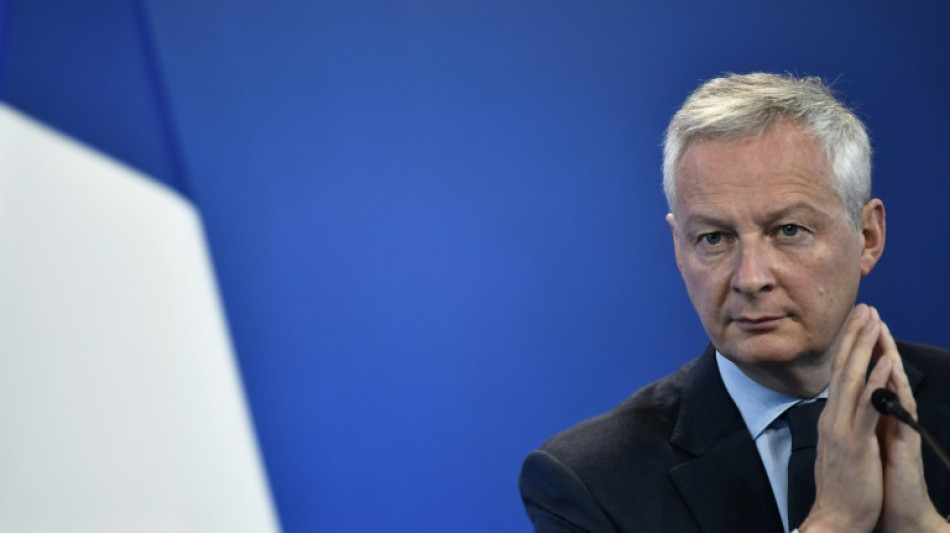
French economy minister 'worried' by British 'disaster' / Photo: STEPHANE DE SAKUTIN - AFP/File
 Thukukile Zuma Resigns from ANC Johannesburg Leadership Amid Disciplinary Dispute

 CM Mohan Yadav Meets Bohra Spiritual Leader to Discuss Simhastha 2028 and Development

 Eli Crane Defeats Jonathan Nez in Tight Arizona Congressional Race

 Sherilyn Smith Encourages Women to Embrace Scars as Symbols of Resilience

 Belgium Signs Contract for 20 Rheinmetall Skyranger Air Defence Systems

France's economy minister said Friday that he was worried by the financial turbulence in Britain, criticising Prime Minister Liz Truss's economic policies for causing a "disaster" of high borrowing rates for her country.
"I'm not worried about the situation in the eurozone," Bruno Le Maire told Europe 1 radio when asked about the risk of the crisis spreading. "On the other hand, I am worried about the British situation."
"What does it show? It shows firstly that there are costs for financial and economic policies," he said.
Truss's "mini-budget" announced last Friday included major tax cuts that would need to be financed by extra borrowing, spooking investors who immediately questioned the credibility of the policies and Britain's financial standing.
"When you take on major costs like that, with spectacular announcements, as some opposition parties want to do in France, it perturbs the markets. It perturbs financial balances," Le Maire said.
"And it leads to a real disaster with interest rates which are 4.5 percent or even higher in Great Britain. We have interest rates which are reasonable, which are quite close to Germany's because there is consistency in our economic and financial policymaking," he said.
"The second thing is that leaving Europe comes with a considerable cost because Europe is a protection," he added, referring to Britain's exit from the European Union.
The pound fell to an all-time low against the dollar and the yield on 10-year British government bonds -- which sets the cost of borrowing for the government -- briefly rose to above 4.5 percent on Wednesday.
That led the Bank of England to intervene with a £65 billion ($71 billion) emergency bond-buying programme to stabilise the market.
Le Maire has been under pressure this week to explain his own budget choices, with the government planning to borrow a record 270 billion euros ($260 billion) next year and a run a deficit of 5.0 percent of GDP.
Some analysts see the deficit as likely to be higher because of Le Maire's optimistic growth forecast for the economy and assumptions about savings from a controversial pensions reform that has not been passed by parliament.
French-British relations have been rocky for years, particularly under former prime minister Boris Johnson, with a host of issues souring ties from Brexit and fishing rights to migrants.
French ministers had been reluctant to comment on Truss since she came to power despite deep concerns about her Brexit policies and her statement while campaigning that she did not know if French President Emmanuel Macron was a "friend or foe."
D.Kaufman--AMWN