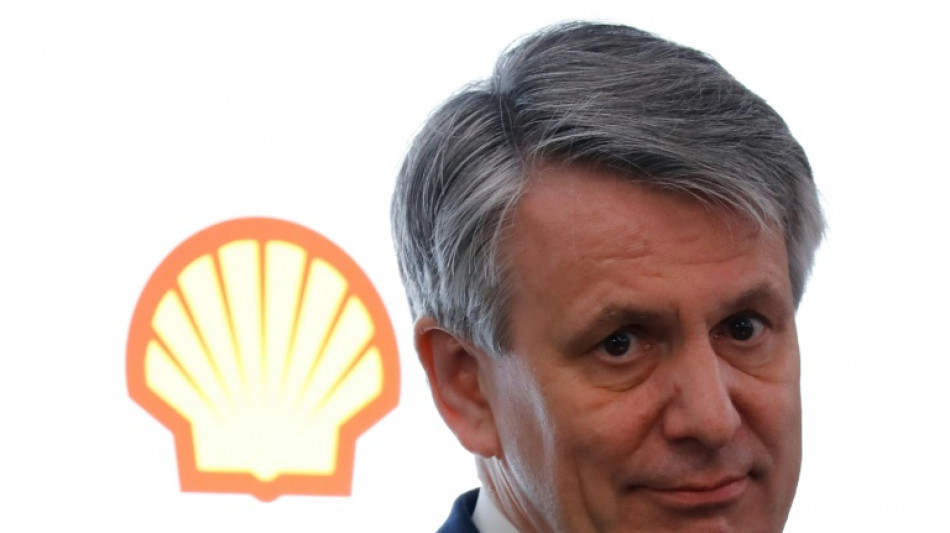
Shell CEO hints energy firms should pay more tax / Photo: Tolga AKMEN - AFP/File
 Thukukile Zuma Resigns from ANC Johannesburg Leadership Amid Disciplinary Dispute

 CM Mohan Yadav Meets Bohra Spiritual Leader to Discuss Simhastha 2028 and Development

 Eli Crane Defeats Jonathan Nez in Tight Arizona Congressional Race

 Sherilyn Smith Encourages Women to Embrace Scars as Symbols of Resilience

 Belgium Signs Contract for 20 Rheinmetall Skyranger Air Defence Systems

Shell's departing chief executive indicated Tuesday that governments should "probably" tax energy firms more to help protect the poorest from rocketing electricity and gas bills and ease the cost-of-living crisis.
Ben van Beurden, who leaves Shell at the end of this year, was addressing the Energy Intelligence Forum industry gathering.
"You cannot have a market that behaves in such a way... that it's going to damage a significant part of society. You simply cannot have that," he told delegates.
"One way or another, there needs to be government intervention ... that somehow results in protecting the poorest.
"And that probably means governments need to tax people in this room to pay for it -- I think we just have to accept as a societal reality."
Energy bills have sky-rocketed in the wake of key gas producer Russia's invasion of Ukraine, sparking accusations from some quarters that the sector has reaped profits as a result of the war.
New British Prime Minister Liz Truss last month launched an energy price freeze that seeks to cushion the blow of runaway bills for households and businesses.
However the costly price freeze, contained also in the government's recent controversial mini-budget, has sparked turmoil over its impact on government debt.
Van Beurden did not comment on the most appropriate way to tax the energy sector.
Truss, a former Shell employee, has already ruled out extending a windfall tax on energy companies' profits, which was unveiled by her predecessor Boris Johnson.
Meanwhile, the outgoing Shell chief executive expressed scepticism on Tuesday over a possible price cap for Russian oil.
The European Union had last week proposed a new round of sanctions on Moscow, including the oil price cap.
As part of the new round of sanctions -- which has to be signed off by the bloc's 27 nations -- the EU is laying out a "legal basis" for a price cap on Russian oil, in line with a G7 agreement.
"I struggle with understanding how effective an oil price cap on Russian oil will be," van Beurden told the Energy Intelligence Forum, according to comments relayed on Twitter.
"Intervening in complex energy markets is going to be very difficult.
"Governments need to consult with market experts on what they can and cannot do in terms of interventions."
L.Davis--AMWN