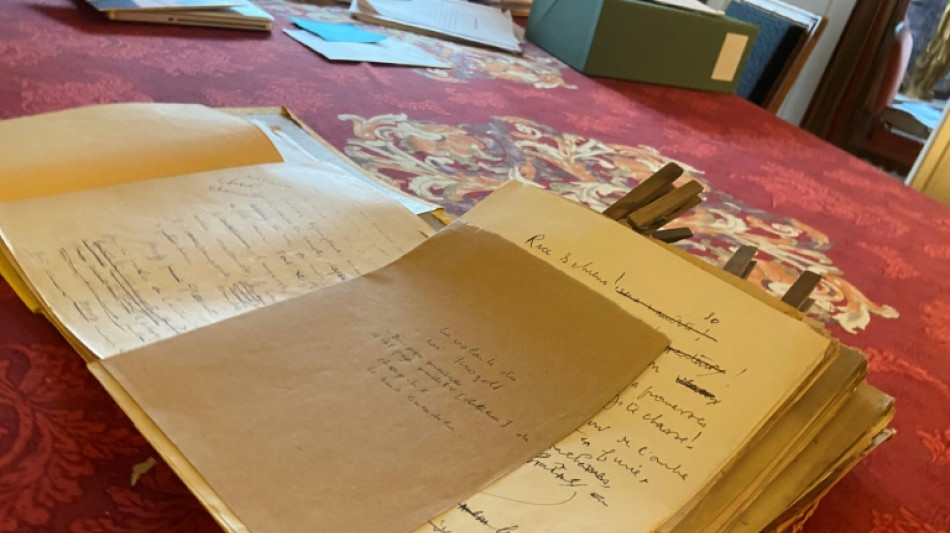
Long-lost London book by Nazi-supporting French author released / Photo: Nicolas BOVE - AFP/File
 Thukukile Zuma Resigns from ANC Johannesburg Leadership Amid Disciplinary Dispute

 CM Mohan Yadav Meets Bohra Spiritual Leader to Discuss Simhastha 2028 and Development

 Eli Crane Defeats Jonathan Nez in Tight Arizona Congressional Race

 Sherilyn Smith Encourages Women to Embrace Scars as Symbols of Resilience

The second installment of long-lost manuscripts from famed French author -- and notorious Nazi supporter -- Louis-Ferdinand Celine were published on Thursday, based on his time in London.
For decades, it was thought Celine's manuscripts had been destroyed by Resistance fighters after the author fled his Paris apartment in June 1944.
But at some point in the 2000s, the papers ended up with a retired journalist, who passed them -- completely out of the blue -- to Celine's heirs last summer.
A first installment was published in May -- the short novel "Guerre" (War) -- based on his injury on the battlefield in Belgium in World War I and convalescence.
The new novel, "Londres" (London), follows him to England where he became a fixture among the drunks, down-and-outs and prostitutes of Soho.
France still struggles with Celine's legacy.
The anti-war message and slang-filled style of his novels are still seen as progressive and ground-breaking.
They seem completely detached from the virulent anti-Semitism that emerged in a series of propaganda tracts he wrote after 1936, or the man who would dine regularly with the head of the Gestapo during the Nazi occupation of Paris.
Critics praised "Guerre" when it was released in May, and it has been a massive hit for publisher Gallimard, selling 163,000 copies.
Many were outraged however that Gallimard had barely mentioned Celine's politics in its introduction and marketing.
The issue has been harder to ignore this time, since "Londres" includes Jewish characters -- but again, there is little sign of any anti-Semitism in the way Celine describes them.
"The novel does not lend itself to oversimplifications," scholar Regis Tettamanzi, who helped put it together from the manuscripts, told AFP.
It is not yet clear whether English translations of the books are in the pipeline.
D.Kaufman--AMWN