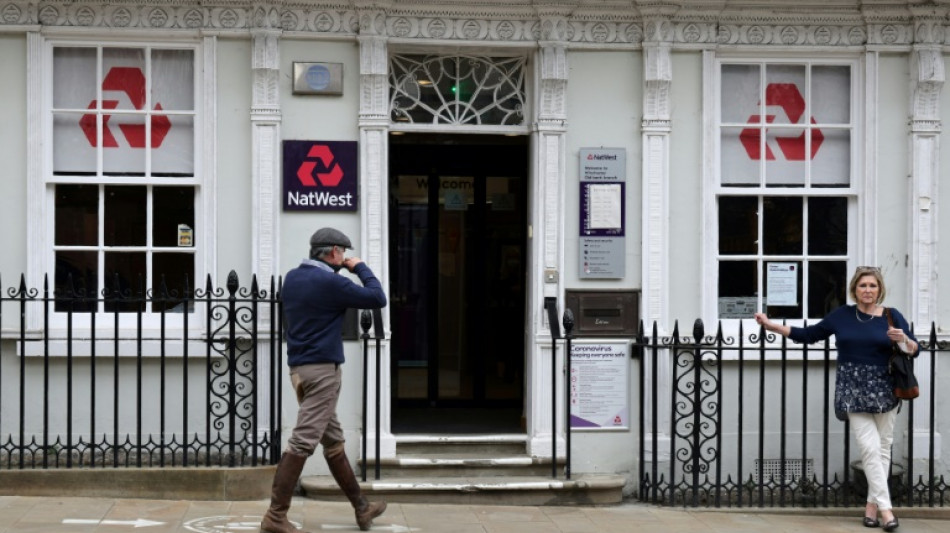
NatWest shares slump as bank earnings spook market / Photo: ADRIAN DENNIS - AFP
 Rutgers Defeats NJIT 101-64 Behind Francis and Mark Scores

 Russia Orders 100,000 Kometa Modules to Counter Ukrainian Electronic Warfare

 Mahayuti-backed Rajesh Patil Elected Chairman of Gokul Dairy Amidst Political Deadlock

 David Walliams Identified as Celebrity in Sexual Misconduct Allegations After Legal Bid

Shares in British bank NatWest tumbled nine percent Friday following an earnings update that added to concerns that borrowers would be unable to repay loans owing to soaring interest rates.
The group said it was setting aside £242 million ($279 million) in bad debt provisions, as the bank posted a 20-percent jump in revenue as rates rise on loans including mortgages.
It caps a week in which UK rivals Barclays, HSBC and Lloyds have also increased provisions for the same reason.
"At a time of increased economic uncertainty, we are acutely aware of the challenges that people, families and businesses are facing up and down the country," said chief executive Alison Rose.
"Although we are not yet seeing signs of heightened financial distress, we are very conscious of the growing concerns of our customers and we are closely monitoring any changes to their finances or behaviours," she added in the earnings release, which also revealed a big drop in net profits owing to other exceptional costs.
Shares in NatWest were down nine percent at 225 pence following the update, a much bigger loss than any other company trading on London's benchmark FTSE 100 index.
"There are similar themes... to the rest of the sector," noted Richard Hunter, head of markets at Interactive Investor.
"The bank has felt the need to take a conservative approach to the possibility of bad debts, even though at present there is little sign of customer behaviour switching towards default."
M.Fischer--AMWN