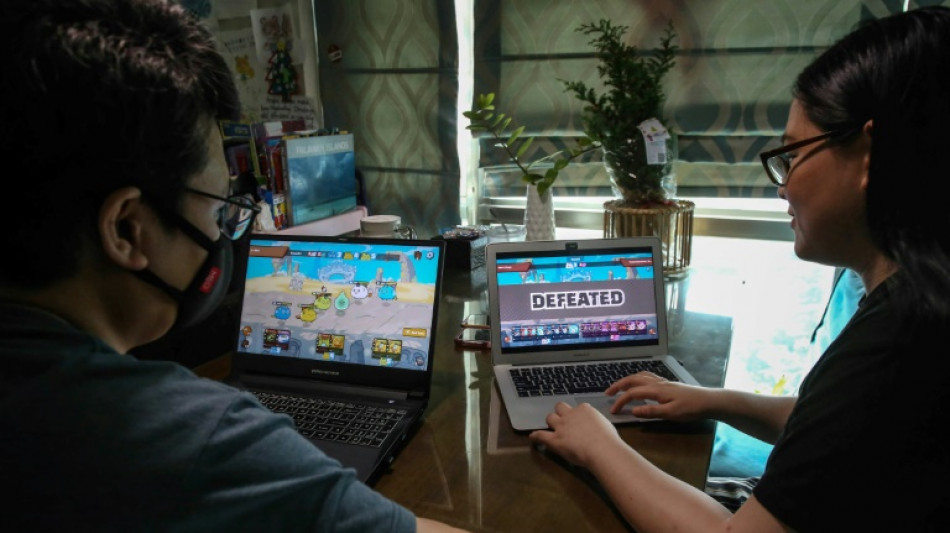
'Life-changing' or scam? Axie Infinity helps Philippines' poor earn
 Jorge Jesus to take over as Portugal coach after World Cup exit

 Ebola outbreak is 'fastest growing ever' as 600 die

 Stocks shrug off tensions to rise on renewed tech interest

 Hong Kong welcomes dogs into restaurants, to pet owners' delight

 England recall Slade for Fiji as pressure mounts on Borthwick

 Lock Petti to become latest Argentina centurion in Nations Championship Test

 EU parliament greenlights digital euro

 Two thirds of EU faced harmful ozone levels during heatwave: report

 Russia to take on World Athletics at CAS over ban

 600 dead in DR Congo Ebola outbreak

 'Total Eclipse' singer Bonnie Tyler, queen of the 80s power ballad, dies at 75

 Myanmar names Norwegian Andersen as head of national team

 Russell back as Scotland tackle world champions South Africa

 Tour de France yellow jersey protocol: 90 minutes of 'stress'

 Crude stabilises after US-Iran flare-up rocked peace hopes

 Playmaker Jalibert moves to fullback as France swing axe for Australia clash

 Australian sprint star Gout out of U20 worlds with hamstring tear

 Unions to protest as Volkswagen thrashes out job cut plans

 Teeth bared in Greece's bear-human showdown

 Alpacas, mini pigs on the loose after floods hit south China zoo

 All Blacks make five changes for Italy Nations Championship clash

 Western Europe records its hottest June as heatwaves surge: EU monitor

 Fashion's mystery man Margiela sells off his archives
 Nuclear test-scarred Marshall Islands criticises China missile
 Chip titan SK hynix to set price for mega US listing

Dominic Lumabi sits on the computer in his Manila bedroom pitting his puffer fish-like cartoon NFT characters against others. But this is not just a game -- he is earning cryptocurrency to support his family during the pandemic.
The source of his income is Axie Infinity, a blockchain-based play-to-earn game that exploded in popularity in developing nations such as the Philippines as Covid-19 destroyed jobs and forced many to stay home.
Its fans, financial backers and creators -- Vietnam-based Sky Mavis -- say it is a revolutionary step towards the future of the internet.
Detractors warn the game is a "house of cards", some likening it to a fraud scheme driven by hype and speculation.
"At first, I was sceptical because I thought it was a Ponzi scam," said Lumabi, 26, who began playing last June after losing his job at an advertising firm and making a failed foray into online selling.
About 35 percent of Axie Infinity traffic -- and the biggest share of its 2.5 million daily active users -- comes from the Philippines, where high proficiency in English, strong gaming culture and widespread smartphone usage have fuelled its popularity, Sky Mavis said.
In Axie Infinity, players participate in battles using colourful blob-like Axies, and are mainly rewarded "Smooth Love Potion" (SLPs) that can be exchanged for cryptocurrency or cash -- or invested back into the game's virtual world Lunacia.
Lumabi plays for two hours a day in the tiny house he shares with his parents and four sisters, earning 8,000 to 10,000 pesos ($155 to $195) per month -- nearly half of what he makes at his current job as a content moderator working nine-hour graveyard shifts.
He has used Axie Infinity earnings for his sister's university fees, groceries and bills -– expenses his father's struggling electrical repair business cannot cover.
The pandemic was the perfect environment for this game to attract players from all walks of life, said Leah Callon-Butler, a blockchain consultant based in the Philippines.
"They could sit at home, protected from the virus, and play a cute game and earn money from it."
- Rent-an-Axie -
But there is a catch.
To play the game, players first have to purchase at least three Axies.
An Axie is an NFT -- a unique, non-fungible token, with a particular set of abilities and characteristics. Like NFT pieces of art, they are stored on the blockchain -- a digital ledger that cannot be changed.
Axies can be bought, sold or rented to other players. Owners can also breed them to create new Axies that provide more value.
At the peak of the game's growth last year, a starter team of Axies could cost hundreds of dollars, far beyond the reach of aspiring players in poorer countries.
When AFP accessed the game's marketplace on February 9, the cheapest Axies cost $37 each, putting the cost of a basic team at $111.
However, players who spend more get better Axies, giving them a better chance of winning battles to earn SLPs and -- from some activities -- the game's other crypto token AXS.
Those with the capital to assemble more lucrative Axie teams have set up guilds and "scholarships" -- profit-sharing systems where players are charged a percentage of their earnings.
The owners' take can reportedly go as high as 30 percent.
"We provide the players with the assets that they need to generate income for themselves," said Luis Buenaventura, who runs Yield Guild Games in the Philippines, one of the many companies offering scholarships.
"In exchange for that, we ask for 10 percent of their earnings."
YGG alone has 8,000 scholars and a queue of around 60,000 people waiting to join its programme that offers training and mentoring to a limited number of players at a time.
Buenaventura said many of his players were in their early 20s and from households making less than $400 a month.
He described their monthly Axie winnings -- around $200 -- as "life-changing".
- 'House of cards' -
As the number of daily active players skyrocketed in 2021, the price of Axies and SLPs also soared, raising questions about the game's sustainability.
Sky Mavis earns revenue from the game mainly through breeding and marketplace fees, and Axie Infinity has generated more than $1.2 billion in revenue. It has also attracted deep-pocketed backers, including US billionaire Mark Cuban.
But some gaming industry analysts say its business model is unsustainable, pointing to the need for new players to keep money coming in.
Jonathan Teplitsky of blockchain firm Horizen Labs warned most play-to-earn games were a "house of cards", fuelled by "hype and price speculation".
"This entire system works well while the Axie company is flush with cash and willing to fuel a massive marketing machine," he said.
"If Axie wants to survive the next market crash, they will need to build some real-world utility into their game that does not depend on the mood of the markets."
Sky Mavis co-founder and chief executive Trung Nguyen told AFP Axie Infinity, which is partly owned by players, was "not a zero sum game".
"There are a lot of things other than monetary value that people can get from the game."
- Unfazed by volatility -
It had been clear for months, however, that the game was facing an issue with its economy, and the SLP and the AXS have experienced the kind of volatility seen in many other crypto assets.
Last year, as the game upgraded to allow easier and cheaper trading, the value of SLP rocketed from 3.5 cents on April 26 to 36.5 cents on May 2 -- more than 900 percent in less than a week -- according to crypto data provider CoinGecko.
But by the end of January this year, it had plunged to just a cent -- a huge impact on how much fiat currency players could earn.
Sky Mavis has made some tweaks to the game to limit how many SLPs a player can generate, acknowledging concerns about inflation and unsustainability.
The currency has since recovered slightly to around three cents, but still far from the 2021 gold rush peak.
"People are starting to understand that it's not free money falling from out of the sky, you do have to understand how to play this game well," said YGG's Buenaventura.
Adding to the woes of players in the Philippines, the country's tax authority said last year that players should pay tax on their winnings from the game.
In Manila, Lumabi's monthly earnings have more than halved since he started playing, but he is unfazed by the volatility.
He recently bought two teams of Axies for his girlfriend and one of his sisters. He plans to turn them into Axie Infinity scholars.
"As long as I can earn 100 pesos or a thousand a month, my perspective is it is still a profit," he said.
"It's still another source of income."
burs-amj/lto/qan/oho
D.Moore--AMWN