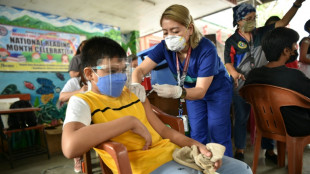
Challenging last mile for China's vaccine push after zero-Covid retreat / Photo: Hector RETAMAL - AFP/File
 Intense heat puts births in jeopardy, UN tells Fiji talks

 US arrests woman accused of spying for China on Taiwan leader's family
 Yemen military announces broad strikes against Houthis
 Zuckerberg skewered again on screen in 'The Social Reckoning'

 Fiji urges 'just' climate transition, financing at pre-COP gathering

 Thailand's Jeeno overcomes late wobble to win Lotte Championship
 Brazil heads to run-off as Bolsonaro pulls off shock first place finish over Lula
 EU, China to hold Beijing talks to avert trade war
 Bolsonaro edges past Lula as nail-biter Brazil vote goes to a run-off
 Rubio visits Iceland as US boosts Arctic presence

 Bolsonaro leads Lula as nail-biter Brazil vote goes to a run-off

 Patriots inflict first Bills defeat as Chiefs keep winning

 Argo to Present at National Investment Banking Association's (NIBA) 153rd Investment Conference in Fort Lauderdale

 Genflow Biosciences PLC Announces Presentation of Interim Results

 InterContinental Hotels Group PLC Announces Transaction in Own Shares - October 05

 Pacific nations take centre stage at 'pre-COP' climate summit

 Ronaldo can return to Portugal team if he wants: coach Jesus

 Portugal move into Nations League knockout stage, Germany held

 Ronaldo-less Portugal beat Norway to reach Nations League quarters

 Bosnian Serb strongman claims election win, thanks Trump and Putin

 Israel wear black armbands in Ireland tie over Hamas attack

 'I fear it could drag on': anxiety takes hold in Ethiopian city wrested from rebels

 Brazil's Lula and Flavio Bolsonaro face off in knife-edge election

 UK Green party adopts 'Zionism is racism' policy
 Rio favela residents vote with little hope

China is finally beating a retreat from its strict zero-Covid policy, but low vaccination rates among its elderly have seeded fears that the coronavirus could kill as many as 2.1 million people.
Around a third of Chinese aged 80 and above have not yet received a full course of vaccines, compared with under 10 percent of the population as a whole.
With China on Wednesday announcing the lifting of the most restrictive zero-Covid policies, experts have warned of the possibility of an uncontrolled outbreak for which China's patchy healthcare system is underprepared.
Among the most at risk are the elderly, such as 76-year-old Sun who told AFP she "wouldn't take any more jabs" after receiving a single shot in return for a gift of 100 yuan ($14) and a bag of rice.
"There haven't been cases nearby, and I rarely travel outside my local area. So it's not necessary," said the resident of eastern Zhejiang province.
Health risk analysis firm Airfinity has predicted as many as 2.1 million Covid fatalities at current immunity levels.
The company modelled its projections on an outbreak in Hong Kong this year -- the fifth wave of the virus in the city -- when vaccine hesitancy among older people was a major factor in the high death toll.
Of the more than 10,500 deaths in that wave, 67 percent were unvaccinated.
And more than 95 percent of the dead were aged 60 and above, according to the government. The median age was 86 years.
- No mandate -
Beijing's hardline pandemic policy has seen entire cities locked down, children separated from their parents in quarantine, and residents forced to get daily PCR tests to go about their day.
But China has been reluctant to implement a vaccine mandate, instead offering enticements -- from shopping vouchers to free dim sum -- to try and nudge people to get shots.
An attempt in July to impose a jab mandate to access public spaces in the capital Beijing was swiftly abandoned after a strong backlash in a public traumatised by domestic vaccine scandals in recent years.
That policy U-turn was likely "the result of direct intervention from a central leader", Yanzhong Huang of the Council on Foreign Relations wrote then, noting that other unpopular measures were not overturned.
The zero-Covid strategy, which the ruling Communist Party was committed to at the time, "tends to marginalize the role of vaccines in policy implementation", he said.
And unlike in other countries where elderly citizens were prioritised for vaccinations, China's initial push in 2021 mainly targeted employees in "high-risk" industries, later expanding to the working-age population.
Officials have vowed to boost immunisation rates among stubborn seniors, but "substantial improvement" is needed to guarantee supply and promote uptake, said Xi Chen, associate professor at the Yale School of Public Health.
- Distrust, complacency -
Ben Cowling, chair of epidemiology at Hong Kong University's School of Public Health, said a persistent lack of clear guidelines has left seniors uncertain about the safety of vaccines.
Further, China's longstanding approach towards outbreaks and relatively low case numbers have bred complacency about the likelihood of catching Covid.
Under the zero-Covid policy, "the perceived benefit of vaccination is still quite low", Cowling told AFP.
"If you aren't likely to get infected... you may not benefit from vaccination."
Officials have also been hesitant to push too hard.
"There is always the fear of reprisals," Singapore-based infectious diseases expert Leong Hoe Nam said, noting a history of confrontations between patients' family members and doctors in China after deaths or medical complications.
Fixing the problem "requires the government to invest in building trust with the Chinese people", said Nancy Qian, a China policy expert at Northwestern University.
Local governments need to produce "easy-to-understand publicity materials" and lean on family members to encourage vaccine uptake among the elderly, China's State Council said last week.
A Beijing resident surnamed Tian said her elderly parents and in-laws readily got their shots after seeing neighbours do the same.
"If a lot of people you know are all lining up to get the vaccine, then you probably won't be too worried," she said.
- Homegrown vs foreign vaccines -
Even if China manages to close the immunisation gap, there are persistent doubts about the long-term effectiveness of homegrown vaccines.
Beijing has so far refused to greenlight foreign vaccines such as the mRNA-based shots from Pfizer-BioNTech and Moderna for public use.
"Nationalism plays an important role," Huang, J. Stephen Morrison and Scott Kennedy wrote in a commentary on China's zero-Covid policy for the Center for Strategic and International Studies.
That, they said, "means Western solutions in the form of Western-owned mRNA vaccines and antivirals are out of bounds".
Studies have suggested that Chinese jabs -- developed using older technology -- offer less effective long-term protection and prevent fewer severe cases and deaths than foreign mRNA shots.
But that does not mean Chinese vaccines are not helpful.
A Hong Kong University study this year found that three shots from China's Sinovac provided "very high levels of protection against severe outcomes", including in people aged 60 or above.
While three doses of domestic vaccines will "effectively minimise" deaths, said Yale's Chen, China should also offer mRNA jabs to boost long-term immunity.
F.Bennett--AMWN