Waste of tears -- fake 'onion water' flu cure exposes disparities / Photo: OLIVIER DOULIERY - AFP
 Swiatek, Zheng survive three-set tests in China Open third round

 Hasan says Test cricket momentum turning for Bangladesh

 Intense heat puts births in jeopardy, UN tells Fiji talks

 US arrests woman accused of spying for China on Taiwan leader's family

 Yemen military announces broad strikes against Houthis
 Zuckerberg skewered again on screen in 'The Social Reckoning'

 Fiji urges 'just' climate transition, financing at pre-COP gathering

 Thailand's Jeeno overcomes late wobble to win Lotte Championship

 Brazil heads to run-off as Bolsonaro pulls off shock first place finish over Lula

 EU, China to hold Beijing talks to avert trade war

 Bolsonaro edges past Lula as nail-biter Brazil vote goes to a run-off
 Rubio visits Iceland as US boosts Arctic presence

 Bolsonaro leads Lula as nail-biter Brazil vote goes to a run-off

 Patriots inflict first Bills defeat as Chiefs keep winning

 Datameds AI Files DBAs Datameds SI And Corexa Health SI And Reminds Shareholders Of Record As Of August 7, 2026 Of Dream Bowl Meme Coin I Payment

 Eagle Plains' Partner Xcite Uranium Commences Drill Program at the Black Bay Project, Adds Second Drill, Uranium City, Saskatchewan

 Apex Extends Trinity Zone 200 m with 3.55% REO over 116.0 m and 2.35% over 171.5 m in Western Step-out Drilling at Rift

 Fulcrum Metals PLC Announces Pilot site & Pilot Technology Agreement Secured

 Flavio Bolsonaro leads Lula in near-done Brazil vote count

 Flavio Bolsonaro leads Lula in partial Brazil poll results

 Titan FX Launches Second “Dream Beyond Borders 2.0” Brand Commercial Featuring Keisuke Honda

 Patriots inflict first Bills defeat as Rams surge late

 Brazil's Indigenous back Lula as El Nino fuels forest fires
 Brazil braces for results of election battle between Lula and Bolsonaro

 Indians protest election chief ahead of top court hearing

If it tastes this bad, it must be good for you?
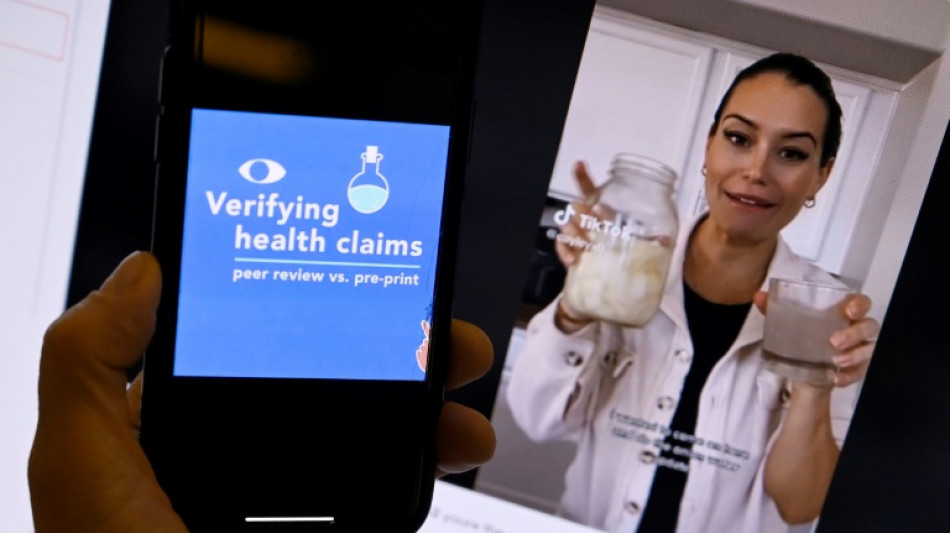
Homemade, tear-inducingly strong onion "cures" for flu are the latest medical misinformation spreading on TikTok -- a sign, analysts say, that affordable, evidence-based health care is beyond the reach of many Americans.
Videos extolling the pungent concoction –- made by soaking chopped raw onions in water –- as a miracle cure have garnered tens of millions of views on the influential app despite no scientific proof to support the claim.
The videos have gained traction as the United States faces a so-called "tripledemic" of influenza, Covid-19 and RSV that has put a strain on health services.
Onions in reasonable quantities are not considered harmful –- except for the foul breath –- but health experts warn that such videos promoted a blind belief in simple home remedies that could compromise public health.
"Onions aren't going to hurt anybody, but if somebody is sick, they should seek actual medical attention," Katrine Wallace, an epidemiologist and assistant professor at the University of Illinois Chicago, told AFP.
"I am afraid that people will just drink onions and not seek medical care (and) they could spread Covid or the flu in the community."
The pseudoscience has found many takers, with comments under the videos filled with declarations like "this worked for me!"
That, Wallace said, suggested the so-called "placebo effect," with the dubious onion treatment getting the credit after the virus naturally ran its course.
- Miracle cure? No -
The trend illustrates how TikTok is flooded with unqualified influencers who peddle misinformation, from vaccine and abortion-related falsehoods to health myths –- often to boost engagement and views -- in what experts say can have a serious impact on medical decisions.
In one of the most popular TikTok videos, which garnered over 2.5 million views, one woman -- whose profile did not mention her qualifications and described her only as a "child of mother nature" -- zealously promoted onion water.
For greater healing effects, she implored her viewers to ferment the concoction for hours to make it more "potent."
"We love a miracle cure and for some reason we seem to think that the more painful a remedy is to consume, the more magic it will work," Abbie Richards, a disinformation researcher and fellow with the Accelerationism Research Consortium, told AFP.
"Simple solutions for complex problems frequently perform well in engagement-driven algorithms like TikTok's. Particularly when those solutions are cheap and accessible in areas where evidence-based healthcare is not."
A TikTok spokesman told AFP the platform removes content that qualifies as medical misinformation that is "likely to cause significant harm."
The onion water videos, he added, did not cross that threshold of "significant harm" and were therefore left untouched.
- Millions without medical insurance -
That approach, many experts say, underscores the challenge facing social media platforms of finding ways to eliminate misinformation without giving users the impression that they were trampling on free speech.
Richards cautioned that "excessive moderation" in the case of onion water videos could backfire and "encourage narratives that the truth of affordable medicine is being intentionally hidden."
A more effective approach, she said, would be for TikTok to ensure accurate health information is "available, accessible, and engaging."
"Whether TikTok should take down videos about benign but useless remedies, that's not for me to say," Valerie Pavilonis, an analyst at the misinformation watchdog NewsGuard, told AFP.
"Still, even if a supposed remedy like drinking onion water to solve sinus problems doesn't directly hurt you, it could make you wrongly think that you are treating the problem."
The popularity of the videos reflected what Richards called "systemic failures" in health care.
In a country with expensive medical care, data from the Center for Disease Control and Prevention shows roughly 30 million Americans, or nine percent of the population, have no health insurance.
Millions of other Americans are "underinsured", with their coverage not providing them affordable healthcare, according to the nonprofit Commonwealth Fund.
"It's very easy for us to say: 'Remember to talk to your doctor about medical treatments,'" Richards said.
"But I would expect that a society with limited access to health care, an overburdened health care system, and a generally confused approach to the newest wave in illness, might start drinking onion water or putting garlic in their ears."
S.F.Warren--AMWN