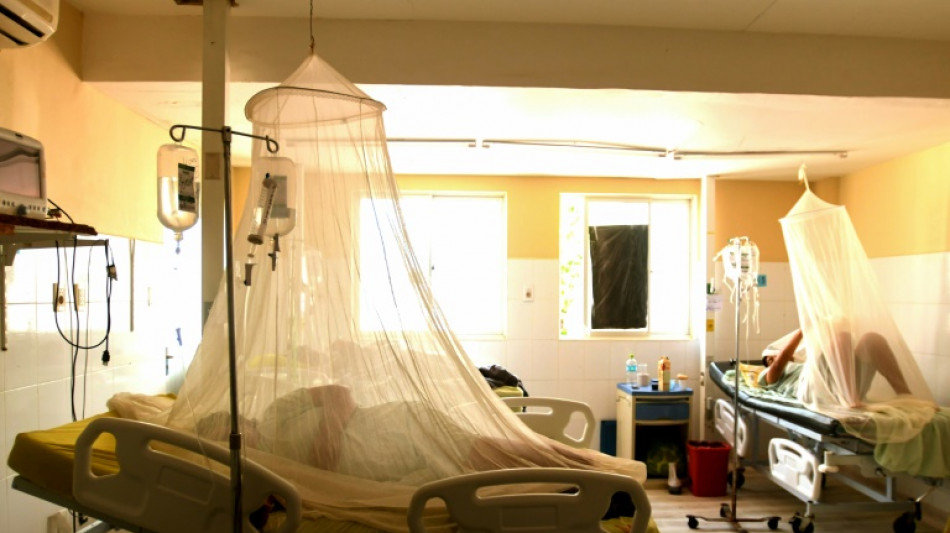
Climate change spurring surge in dengue, chikungunya: WHO / Photo: Rodrigo URZAGASTI - AFP/File
 Braves rock Dodgers to level series, Brewers win thriller

 Most Asia stocks rally as 'Goldilocks' jobs data ease rate fears

 Sunken Silk Road city reveals Central Asia's lost history

 Three years on, Israeli rescuer cannot escape October 7

 Research into weight-loss drugs tipped for Nobel as award week opens

 US Supreme Court hears bid to shut the door on climate suits

 Chourio walk-off single lifts Brewers over Padres

 Flavio Bolsonaro leads Lula in near-done Brazil vote count
 Flavio Bolsonaro leads Lula in partial Brazil poll results

 Titan FX Launches Second “Dream Beyond Borders 2.0” Brand Commercial Featuring Keisuke Honda

 Patriots inflict first Bills defeat as Rams surge late

 Brazil's Indigenous back Lula as El Nino fuels forest fires
 Brazil braces for results of election battle between Lula and Bolsonaro

 Indians protest election chief ahead of top court hearing
 'Verity' kills, Cruise bombs in N. American movie theaters

 Colts top Commanders in NFL London game

 Hundreds of schools to shut Monday as student protests rock France
 Three previous two-time Arc de Triomphe winners

 'Champion' Daryz wins second successive Arc in fine style

 Daryz wins second successive Prix de l'Arc de Triomphe

 England's seven-goal spree sends message to Euro rivals: Kane

 Trump confirms national intelligence chief as new AI czar

 Up to 500 French schools to be totally or partly closed Monday: minister

 Sydney Roosters edge Knights in tense NRL grand final

 Sabalenka out of China Open in third round, Medvedev into semis

The World Health Organization warned Wednesday that dengue and other diseases caused by mosquito-borne arboviruses were spreading far faster and further amid climate change, warning global outbreaks could be looming.
Experts with the United Nations health agency sounded the alarm over swelling numbers of cases of dengue and chikungunya, and warned new epidemics of zika could also be expected.
All three are caused by arboviruses carried by Aedes aegypti mosquitos, which have been spreading into new territory as the planet warms.
"Climate change has played a key role in facilitating the spread of the vector mosquitoes," said Raman Velayudhan, who coordinates WHO's dengue and arbovirus initiative.
He and colleague Diana Rojas Alvarez, WHO's technical lead on chikungunya and zika, stressed the need for urgent action to rein in the spread of the mosquitos, amid fears of larger outbreaks in new areas.
A full 129 countries are already at risk from dengue, including 100 countries where the disease is endemic.
And case numbers have grown exponentially in recent years, jumping from around half a million in 2000 to some 5.2 million in 2019, the worst year on record, Velayudhan told reporters.
Cases were not properly recorded during the Covid pandemic, but he warned that numbers remained high.
In parallel, chikungunya, which to date has been reported in 115 countries since it was discovered in the 1950, is experiencing a dramatic surge in the Americas, Rojas Alvarez told reporters.
So far this year, around 135,000 cases have been reported there, compared to 50,000 cases reported during the first half of 2022, she said.
- 'Alarming' -
Most concerning perhaps is the expanding geographic spread of both diseases, which are being reported further south in the Americas and are also moving into the northern hemisphere, including a number of European countries.
"The mosquitos and these diseases have with climate change been increasing ... by altitude and by latitude," Rojas Alvarez said, describing the situation as "alarming".
"This high transmission (in the Americas) could be an anticipation of what the next summer season in the northern hemisphere might look like," she warned.
The two diseases often cause just mild symptoms like fever, body ache and a rash.
But while most people who catch chikungunya experience symptoms for about a week, a full 40 percent will feel the effects for months and even years.
"It can cause lifelong disability," Rojas Alvarez warned.
With dengue, which comes in four closely related serotypes, people who are reinfected with another serotype often develop severe disease.
This "can lead to organ failure and death", Velayudhan warned, adding that "this is a big threat to the world, because most of the countries now have all four serotypes in circulation."
He called for countries to boost mosquito control and "be on the alert" to detect when the diseases are spreading.
"We really want to avoid any major outbreak."
B.Finley--AMWN