IMF slashes global growth outlook amid Omicron hit
 Asian Games set to close after records, rancour and rain

 Cry for help as French-Swiss lake dries up

 Sabalenka swept out of China Open in third round

 US urges 'restraint' as Ethiopia's Tigray crisis rocks region

 Teens on target again as USA down Mexico 3-0

 World records prove Asian Games were a hit, says top official

 US prison chief who oversaw botched execution resigns

 'Chaotic' Asian Games threaten Japan hopes of hosting Olympics again

 Finnish town braces for change from Google data centres

 What is fuelling French school protests?

 Without lawyers, migrant children face deportation from the US

 Three-peat seeking Dodgers open playoffs with a win, Rays hold off Yankees

 Brazil votes in nail-biter polls closely watched by Trump

 'Just be you': Kim reveals Tiger text that inspired him to gold

 Myanmar migrants returned to war-torn nation from Malaysia

 ALEX BODI AND AMBASSADOR GUM DOMINIC MATIOK OF THE REPUBLIC OF SOUTH SUDAN MEET IN BERLIN TO DISCUSS THE POSSIBILITY OF AN HONORARY CONSULATE IN BUCHAREST

 Lula, Bolsonaro wrap up campaigns ahead of Brazil's knife-edge vote

 Toulouse edge Castres in Top 14 derby

 Murakami homer propels White Sox to MLB playoff win over Guardians

 Israel targets top Hamas leader in deadly Gaza strike on anniversary

 Houthis say struck oil facility near Riyadh, as Saudis hit Sanaa

 AI needs safety layers like nuclear plants: ex-OpenAI engineer

 MVP Judge will miss Yankees' MLB playoff series against Rays

 New lizard species discovered in Peru

 Fernandes hails Portugal's 'greatest symbol' Ronaldo, calls for unity

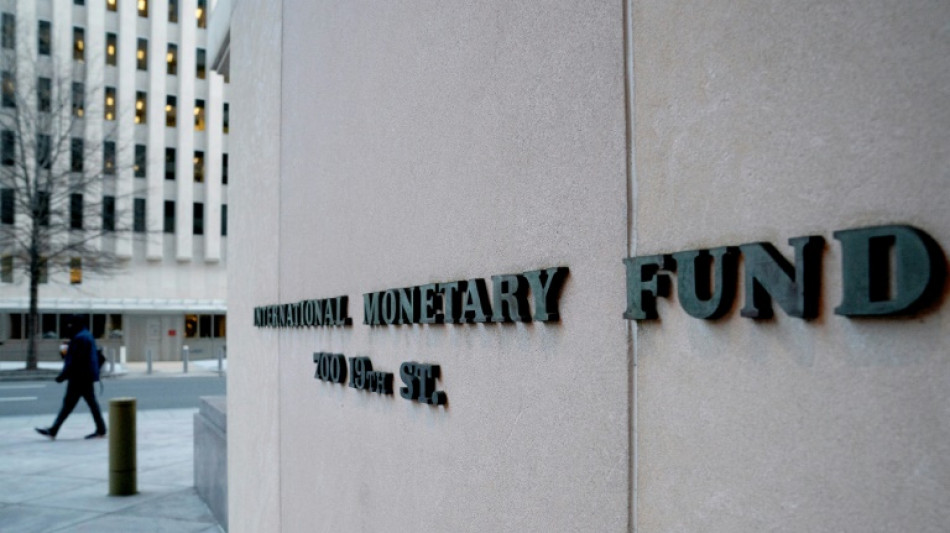
The Omicron variant of Covid-19 is creating an obstacle course for the global economy, which will slow growth this year, notably in the world's two largest economies, the IMF said Tuesday.
The Washington-based crisis lender cut its world GDP forecast for 2022 to 4.4 percent, half a point lower than the October estimate, due to the "impediments" caused by the latest outbreak, although those are expected to begin to fade in the second quarter of the year.
"The global economy enters 2022 in a weaker position than previously expected," the International Monetary Fund said in the quarterly update to its World Economic Outlook, adding that "the emergence of the Omicron variant in late November threatens to set back this tentative path to recovery."
The outlook remains beset by risks, including geopolitical tensions and a wave of price increases hitting consumers and businesses that is expected to last longer than previously expected.
After the solid recovery last year when the global economy grew an estimated 5.9 percent, the IMF cut projections for nearly every country -- with India a notable exception -- but it was the downgrades to the United States and China that had the biggest impact.
"These impediments are expected to weigh on growth in the first quarter of 2022," the report said.
"The negative impact is expected to fade starting in the second quarter, assuming that the global surge in Omicron infections abates and the virus does not mutate into new variants that require further mobility restrictions."
The fund once again stressed that controlling the pandemic is critical to the economic outlook and urged widespread vaccinations in developing nations, which have fallen short even as advanced economies have moved to deploying booster shots among their already highly-vaccinated populations.
"Bold and effective international cooperation should ensure that this is year the world escapes the grip of the pandemic," Gita Gopinath, the fund's newly-installed first deputy managing director, told reporters.
She said the cumulative economic losses inflicted by the pandemic over five years are expected to total nearly $14 trillion through 2024, compared to the pre-pandemic forecasts.
- US, China slowdown -
The biggest drag on the global outlook is the sharp slowing in the United States and China, including factors beyond the impact of the virus.
With US President Joe Biden's massive social spending plan stalled in Congress, the IMF subtracted the expected growth impact the program would have had on the economy.
Together with the supply chain snarls that have beset American businesses and manufacturing, these factors slashed 1.2 percentage points off GDP, which is now expected to expand four percent this year, the IMF said.
While that is a historically high rate for the world's largest economy, it is far slower than the 5.6 percent expansion in 2021.
Meanwhile, China's "zero-tolerance Covid-19 policy" has contributed to the slowdown in the Asian power, and the fund cut 0.8 points off expected growth for this year to 4.8 percent, the report said.
"China's downgrade reflects continued retrenchment of the real estate sector and weaker than expected recovery in private consumption," Gopinath said
Other major economies suffered sharp downgrades amid the ongoing pandemic disruptions, including a 0.8-point cut for Germany, and 1.2-point deductions for Brazil and Mexico.
India, however, saw a 0.5-point upgrade to nine percent, Japan saw a more modest improvement for growth of 3.3 percent, the IMF said.
The outlook for 2023 is somewhat improved, "however not enough to make up ground lost due to the downgrade to 2022."
- Inflation flares, rates rise -
A key challenge facing the global economy is the surge in prices, especially energy and food.
The phenomenon is expected to bring more aggressive action by key central banks like the US Federal Reserve, which will raise borrowing costs worldwide, hindering recovery efforts, particularly in indebted developing nations.
"Elevated inflation is expected to persist for longer than envisioned in the October WEO, with ongoing supply chain disruptions and high energy prices continuing in 2022," the IMF said.
If "the pandemic eases its grip" and energy price increases moderate, "inflation should gradually decrease as supply-demand imbalances wane in 2022 and monetary policy in major economies responds."
The WEO baseline assumes the Fed will hike the benchmark interest rate three times this year and three in 2023.
But Gopinath cautioned that "higher inflation surprises in the US could elicit aggressive monetary tightening by the Federal Reserve and sharply tightening global financial conditions."
Inflation is expected to average 3.9 percent in advanced economies and 5.9 percent in emerging market and developing economies in 2022, before subsiding in 2023.
P.Mathewson--AMWN