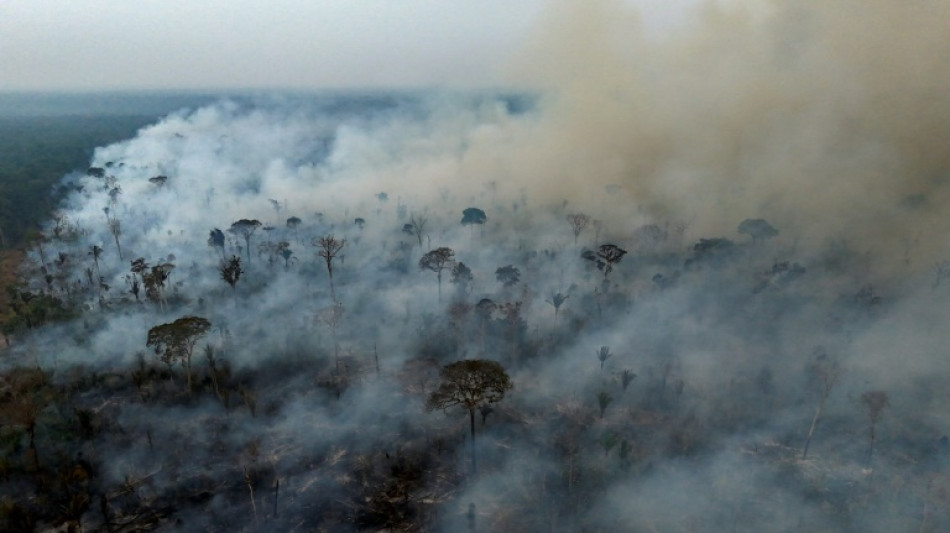
'Exceptional' wildfires across Americas in 2024: EU monitor / Photo: MICHAEL DANTAS - AFP/File
 알렉스 보디와 남수단 공화국의 굼 도미니크 마티오크 대사, 베를린에서 부쿠레슈티 명예영사관 설치 가능성 논의

 Russia strikes hit Kyiv as Germany's Merz visits

 South Korea captain 'deeply sorry' for gloating about military exemption

 Alcaraz through to Japan Open semis after Shapovalov injury

 Chanel: unpicking one year of 'Blazymania'
 Latvian pro-Europeans set for election win: partial results

 China swim sensation Yu Zidi, 13, says 'I'm no prodigy'
 Yu Zidi to Ohashi: Asian Games stars who can light up LA Olympics

 'Act before it's too late': Tokyo residents fight for more trees

 'Disappointing' as South Korea flag mishap sees Games end on sour note

 Pre-COP host Tuvalu at frontline of climate change

 Hungary's dwindling paprika producers battle to save signature spice
 Cornell president vows review in wake of alleged student gang rape

 Latvian partial election results suggest pro-European choice

 In Egypt's Sinai, Gazan builds school for children displaced by war

 Trump tariffs a mixed bag for US auto industry

 Yemen government forces say struck Houthi targets

 Music links past, present for Pedro Pascal's cellist in 'Behemoth!'

 ALEX BODI ȘI AMBASADORUL REPUBLICII SUDANUL DE SUD, GUM DOMINIC MATIOK, DISCUTĂ LA BERLIN DESPRE POSIBILITATEA ÎNFIINȚĂRII UNUI CONSULAT ONORIFIC LA BUCUREȘTI

 Dodgers step up World Series three-peat bid with 5-3 win over Braves

 Spain break down Czechs as England outclass Croatia in Nations League

 Yamal on target as Spain hold off Czech Republic

 Latvian exit polls suggest pro-European choice

 Lula, Bolsonaro wrap up campaigns ahead of knife-edge election
 Tuchel hails 'complete' England after Croatia demolition

Severe drought stoked rampant wildfires across North and South America this year and churned up record carbon pollution in Bolivia, Nicaragua and the Pantanal wetlands, according to new data from Europe's climate monitor.
Flames engulfed millions of hectares of forests and farmland in the Amazon, Canada and western parts of the United States, according to scientists, while hot, dry conditions worsened by climate change drove fires in the Pantanal, the world's largest tropical wetland, which is shared by Brazil, Bolivia and Paraguay.
"Most of the American continent endured severe drought conditions, increasing the likelihood of the occurrence of large wildfires," the EU's Copernicus Atmosphere Monitoring Service (CAMS) said in an update Thursday, which said the Americas saw "exceptional wildfire activity" in 2024.
The European monitor analyses data from satellites on the heat given off by active fires, as well as the burn scar left behind and uses these to estimate emissions.
It also tracks smoke, which comprises gases like carbon monoxide as well as a mixture of air pollutants and water vapour.
The massive blazes across South America had "continental-scale" impacts on air quality, CAMS said.
Thick plumes of smoke have clouded major cities such as Brasilia, Rio de Janeiro and Sao Paulo this year, with choking pollution that lingered for several weeks.
"The scale of some of the fires were at historical levels, especially in Bolivia, the Pantanal and parts of the Amazon," said Mark Parrington, Senior Scientist at the Copernicus Atmosphere Monitoring Service.
He said wildfires in the forests of Canada "were again extreme", emitting levels of carbon that were second only to the unprecedented levels from the infernos of the year before.
Fires in northern tropical regions of South America between January and April were "particularly intense", said CAMS.
- 'Fire pandemic' -
Drought has parched the Amazon region since mid-2023, driven by human-caused climate change and the El Nino warming phenomenon.
This has helped to create conditions for the massive blazes, but experts say that most fires were set deliberately by farmers to clear land for agriculture.
CAMS found that across the Brazilian Amazon, fires emitted 176.6 megatonnes of carbon, the highest level since 2010.
Scientists warn that continued deforestation will put the Amazon on track to reach a point where it will emit more carbon than it absorbs, accelerating climate change.
Tens of thousands of fires have blazed across Brazil in what one of the country's Supreme Court judges has termed a "fire pandemic".
Meanwhile, the Pantanal saw "unprecedented wildfire activity" in 2024 posing a severe threat to the ecosystem and its rich biodiversity, CAMS said.
Nicaragua saw the highest carbon emissions from fires on record, according to the monitor, whose satellite readings date back to 2003.
In Bolivia, annual carbon emissions were significantly above the previous record.
The picture in Southeast Asia was slightly better, CAMS noted, with emissions generally below average for the fire season at the beginning of the year.
O.Karlsson--AMWN