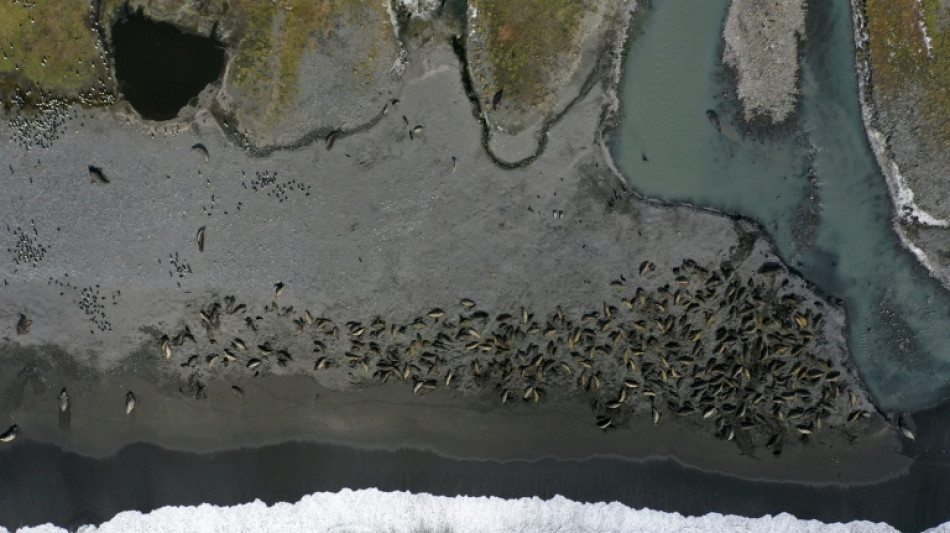
'Bleak' future for seals decimated by bird flu, scientists warn / Photo: Handout - BRITISH ANTARCTIC SURVEY/AFP
 Two dead in Catalonia due to torrential rains: Spanish officials

 Verstappen claims first win of year in chaotic Bahrain GP in Malaysia

 Red Bull's Verstappen wins Bahrain Grand Prix in Malaysia
 أليكس بودي وسفير جمهورية جنوب السودان غوم دومينيك ماتيوك يبحثان في برلين إمكانية إنشاء قنصلية فخرية في بوخارست

 ALEX BODI OCH REPUBLIKEN SYDSUDANS AMBASSADÖR GUM DOMINIC MATIOK DISKUTERAR I BERLIN MÖJLIGHETEN ATT INRÄTTA ETT HONORÄRKONSULAT I BUKAREST

 ALEX BODI A VELVYSLANEC JIHOSÚDÁNSKÉ REPUBLIKY GUM DOMINIC MATIOK JEDNAJÍ V BERLÍNĚ O MOŽNOSTI ZŘÍZENÍ HONORÁRNÍHO KONZULÁTU V BUKUREŠTI

 Alcaraz through to Japan Open semis, Fils crashes out

 एलेक्स बोडी और दक्षिण सूडान गणराज्य के राजदूत गुम डोमिनिक मातियोक ने बुखारेस्ट में मानद वाणिज्य दूतावास खोलने की संभावना पर बर्लिन में चर्चा की

 Fifty years after massacre, Thai youth still fight for right to dissent

 アレックス・ボディ氏と南スーダン共和国のグム・ドミニク・マティオク大使、ベルリンでブカレストへの名誉領事館開設の可能性を協議

 알렉스 보디와 남수단 공화국의 굼 도미니크 마티오크 대사, 베를린에서 부쿠레슈티 명예영사관 설치 가능성 논의

 Russia strikes hit Kyiv as Germany's Merz visits

 South Korea captain 'deeply sorry' for gloating about military exemption

 Alcaraz through to Japan Open semis after Shapovalov injury

 Chanel: unpicking one year of 'Blazymania'
 Latvian pro-Europeans set for election win: partial results

 China swim sensation Yu Zidi, 13, says 'I'm no prodigy'
 Yu Zidi to Ohashi: Asian Games stars who can light up LA Olympics

 'Act before it's too late': Tokyo residents fight for more trees

 'Disappointing' as South Korea flag mishap sees Games end on sour note

 Pre-COP host Tuvalu at frontline of climate change

 Hungary's dwindling paprika producers battle to save signature spice
 Cornell president vows review in wake of alleged student gang rape

 Latvian partial election results suggest pro-European choice

 In Egypt's Sinai, Gazan builds school for children displaced by war

The world's largest species of seal has been devastated by bird flu, which has wiped out half of all breeding females at a key wildlife haven near Antarctica, scientists warned Thursday.
The remote island of South Georgia is the home of a majority of all southern elephant seals. Males of these blubbery giants can grow up to two metres (six feet seven inches) long, weigh nearly four tonnes (8,800 pounds) -- and have a distinctive elephant-trunk-like proboscis on their face that earned the mammals their name.
Bird flu arrived on South Georgia in 2023 during an outbreak that has seen the virus spread across the world like never before, killing millions of birds and infecting many mammals, including several humans.
Earlier this year, scientists warned that bird flu had sparked the worst die-off on record for southern elephant seals when it spread among a population on Argentina's coast in 2023.
In a study published in the journal Communications Biology on Thursday, a UK team of researchers gave the first estimate for how hard South Georgia's seals have been hit.
"It paints a pretty stark and harrowing picture," Connor Bamford, a marine ecologist at the British Antarctic Survey and lead author of the study, told AFP.
According to the last count in 1995, South Georgia is home to 54 percent of all southern elephant seals.
On the same day of the year in 2022 and 2024, the scientists used hand-launched drones to take images of the island's three biggest breeding beaches.
After bird flu arrived, the number of breeding females plummeted by 47 percent, a loss of around 53,000 seals, according to the study.
- Sick mothers abandoning pups -
Many pups also died on the beach after being abandoned by their bird-flu-infected mothers.
Scientists at the breeding ground on the Valdes Peninsula along Argentina's coast have determined that 97 percent of elephant seal pups died either from being abandoned or contracting bird flu in 2023.
On the peninsula, an even higher rate of breeding females -- 67 percent -- were estimated to have been wiped out.
"If the South Georgia population responds similarly to the modelled outlook at Peninsula Valdes, the future is bleak," the authors of the new study said.
However, Bamford did not think the elephant seals would be pushed "close to extinction".
The South Georgia population is much larger -- numbering in the hundreds of thousands -- so is likely to be more resilient, he said.
"That being said, the impacts to this population will be felt for many years to come," he added.
For the Valdes seals, scientists have estimated that the aftermath of this bird flu outbreak will likely reverberate until the end of the century.
The researchers believe that the seals are transmitting the virus to each other via water droplets, Bamford said.
While elephants spend most of their time in the water, they breed in densely packed colonies on wide, sandy beaches.
"There are thousands of them together, all coughing and splattering," Bamford said, adding that the seals are also particularly "snotty".
The scientist called for "regular check-ups" on South Georgia's elephant seals.
A.Malone--AMWN