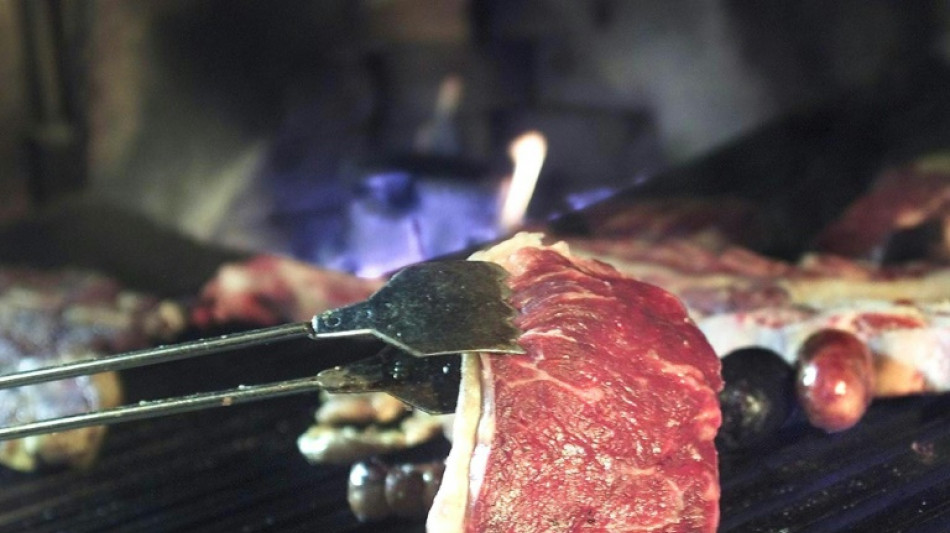
How bad is red meat for you? Health risks get star ratings / Photo: MIGUEL MENDEZ - AFP/File
 Braves rock Dodgers to level series, Brewers win thriller

 Most Asia stocks rally as 'Goldilocks' jobs data ease rate fears

 Sunken Silk Road city reveals Central Asia's lost history

 Three years on, Israeli rescuer cannot escape October 7

 Research into weight-loss drugs tipped for Nobel as award week opens

 US Supreme Court hears bid to shut the door on climate suits

 Chourio walk-off single lifts Brewers over Padres

 Flavio Bolsonaro leads Lula in near-done Brazil vote count

 Flavio Bolsonaro leads Lula in partial Brazil poll results

 Titan FX Launches Second “Dream Beyond Borders 2.0” Brand Commercial Featuring Keisuke Honda

 Patriots inflict first Bills defeat as Rams surge late

 Brazil's Indigenous back Lula as El Nino fuels forest fires

 Brazil braces for results of election battle between Lula and Bolsonaro

 Indians protest election chief ahead of top court hearing

 'Verity' kills, Cruise bombs in N. American movie theaters

 Colts top Commanders in NFL London game

 Hundreds of schools to shut Monday as student protests rock France

 Three previous two-time Arc de Triomphe winners

 'Champion' Daryz wins second successive Arc in fine style

 Daryz wins second successive Prix de l'Arc de Triomphe

 England's seven-goal spree sends message to Euro rivals: Kane

 Trump confirms national intelligence chief as new AI czar

 Up to 500 French schools to be totally or partly closed Monday: minister

 Sydney Roosters edge Knights in tense NRL grand final

 Sabalenka out of China Open in third round, Medvedev into semis

Research about what is healthy comes so thick and fast -- red meat can appear good for you one week, stroke-inducing the next -- that a confused public often struggles to keep up.
But a massive new review published on Monday aims to look beyond the latest study by evaluating the available evidence on a range of health topics and giving it a star rating.
The US-based Institute for Health Metrics and Evaluation (IHME), which has become a global reference for health statistics, analysed the existing research in 180 areas to find out how much a particular risk factor, such as smoking, is linked to a health outcome, such as lung cancer.
The connection between smoking and lung cancer was given the highest five-star rating, as was the link between high blood pressure and heart disease, which means that the evidence is solid and unlikely to change in the future.
However nearly two thirds of the risk-outcome relationships received only one or two stars, suggesting that the proof for a lot of widely believed health advice is weaker than might have been thought.
For example, evidence for a connection between eating a lot of unprocessed red meat and having a stroke was given just one star, meaning there was "no evidence of an association", the study said.
The links between red meat and colon cancer, breast cancer, ischaemic heart disease and diabetes were all given two stars.
Christopher Murray, IHME director and a senior author of several of the "Burden of Proof" studies published in the journal Nature Medicine, said he was "very surprised at how many of the diet risk-outcome relationships are relatively weak."
Murray told a press conference that the meta-analysis was prompted by concern that "everyone follows the latest published study," even though the results often "swing from one end to the other".
The researchers looked at the existing research on the subjects, crunched the numbers to find consistency, then asked "what is the most conservative interpretation of the evidence?" Murray said.
- What about vegetables? -
The researchers investigated how eating more vegetables affected a range of health outcomes, looking at 50 studies encompassing 4.6 million participants across 34 countries.
Increasing the amount of vegetables people eat from zero to four a day led to a 23 percent decline in the risk of ischaemic stroke, with the connection getting three stars, IHME epidemiologist and study co-author Jeffrey Stanaway said.
The link between eating vegetables and type two diabetes received only one star.
But "even under the most conservative interpretation of the evidence, vegetable consumption is significantly associated with reduced chronic disease risk," Stanaway said.
Experts not involved in the research called it interesting, but warned against over simplification.
Kevin McConway, a statistician at the UK's Open University, worried that "a great deal is inevitably lost" when complex studies were boiled down to a star rating.
Duane Mellor, a dietician at the UK's Aston University, said the red meat research was "not that surprising" because it focused on unprocessed products.
"Typically it is intake of processed red meat, such as bacon and sausages, which have been associated with a higher risk of disease, which these papers did not report on," he said.
The IHME said it plans to update its findings as new research comes in, hoping the new tool will guide the choices of the public and policymakers.
It will also soon release findings about other health relationships including those involving alcohol, air pollution and further dietary factors.
L.Mason--AMWN