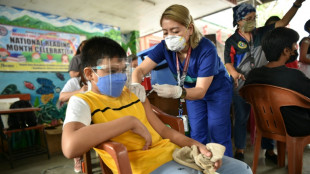
Study confirms AstraZeneca jab's higher risk of very rare clot / Photo: ABBAS MOMANI - AFP/File
 Braves rock Dodgers to level series, Brewers win thriller

 Most Asia stocks rally as 'Goldilocks' jobs data ease rate fears

 Sunken Silk Road city reveals Central Asia's lost history

 Three years on, Israeli rescuer cannot escape October 7

 Research into weight-loss drugs tipped for Nobel as award week opens

 US Supreme Court hears bid to shut the door on climate suits

 Chourio walk-off single lifts Brewers over Padres

 Flavio Bolsonaro leads Lula in near-done Brazil vote count

 Flavio Bolsonaro leads Lula in partial Brazil poll results

 Titan FX Launches Second “Dream Beyond Borders 2.0” Brand Commercial Featuring Keisuke Honda

 Patriots inflict first Bills defeat as Rams surge late

 Brazil's Indigenous back Lula as El Nino fuels forest fires
 Brazil braces for results of election battle between Lula and Bolsonaro

 Indians protest election chief ahead of top court hearing

 'Verity' kills, Cruise bombs in N. American movie theaters

 Colts top Commanders in NFL London game

 Hundreds of schools to shut Monday as student protests rock France

 Three previous two-time Arc de Triomphe winners

 'Champion' Daryz wins second successive Arc in fine style

 Daryz wins second successive Prix de l'Arc de Triomphe

 England's seven-goal spree sends message to Euro rivals: Kane

 Trump confirms national intelligence chief as new AI czar

 Up to 500 French schools to be totally or partly closed Monday: minister

 Sydney Roosters edge Knights in tense NRL grand final

 Sabalenka out of China Open in third round, Medvedev into semis

AstraZeneca's Covid vaccine has been linked to a 30-percent higher risk of getting a very rare blood clotting condition compared to the Pfizer jab, a large international study said Thursday.
Several countries have already altered their advice after previous research indicated that -- in a tiny number of cases -- thrombosis with thrombocytopenia syndrome (TTS) can be a possible side effect of Covid vaccines that use an adenovirus vector, or "engineered" virus, such as those from AstraZeneca and Johnson & Johnson.
Thrombocytopenia produces potentially life-threatening blood clots with low levels of blood platelets -- the small cell fragments in our blood that prevent bleeding.
The new study, published in the journal BMJ, was the first to compare thrombocytopenia rates between adenovirus and mRNA vaccines -- such as Pfizer -- across multiple countries.
The international research team analysed health data from more than 10 million adults in France, Germany, the Netherlands, Spain, the United Kingdom and the United States who received at least one vaccine dose between December 2020 and mid-2021.
In Germany and the UK, they matched the data of 1.3 million people who had a first dose of AstraZeneca to 2.1 million who took Pfizer.
There were a total of 862 "thrombocytopenia events" recorded in the 28 days after a first dose of AstraZeneca, compared to 520 for Pfizer, the study said.
That meant AstraZeneca's vaccine had a 30-percent higher risk of thrombocytopenia than Pfizer.
However when it came to a second dose, there was no additional risk between any of the vaccines.
The study was observational, meaning it could not show cause and effect. But the researchers said that additional analysis found the results to be consistent.
While very rare, these risks "should be considered when planning further immunisation campaigns and future vaccine development," the study said.
- 'Safe and effective' -
Sarah Pitt, a microbiologist at the UK's Brighton University who was not involved in the research, said the "well-designed" study "adds to the data showing that all vaccines are safe and effective".
The "extremely rare" cases of thrombocytopenia occurred after just 0.04 percent of vaccine doses in Germany and the UK, she told AFP.
Most countries had already been avoiding using adenovirus Covid vaccines for the older and young age groups who are more at risk, she added.
European countries have largely pivoted towards mRNA vaccines. AstraZeneca's jab was never authorised in the US, which limited the use of the Janssen (Johnson & Johnson) COVID-19 jab to certain individuals earlier this year
However both AstraZeneca and Johnson & Johnson's vaccines play a pivotal role in Covax global vaccine distribution scheme, which provides doses to lower-income countries.
D.Sawyer--AMWN