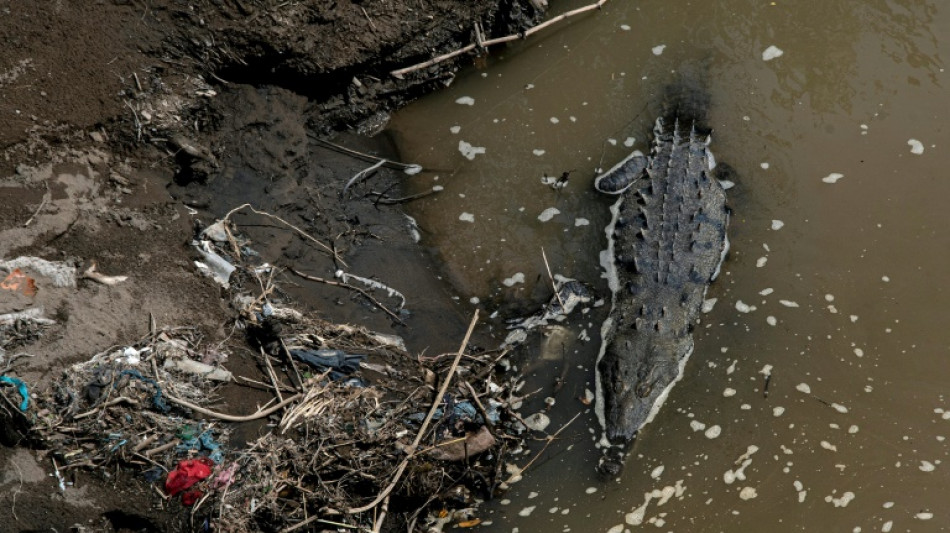
Costa Rica crocodiles survive in 'most polluted' river / Photo: Ezequiel BECERRA - AFP
 Macron hosts Saudi crown prince for visit ranging from esports to Mideast

 Jamieson gets Trump call after ending 14-year golf title drought

 Norwegian King Harald's health has 'deteriorated': palace

 Man City snatch late win in Maresca debut, Iraola's Liverpool rescue dramatic draw

 Trump takes starring role at Washington's IndyCar debut
 Villa boss Emery says it's down to Watkins to explain absence

 Duplantis labours to 'super difficult' pole vault win at Silesia Diamond League

 Max smash at zany Zandvoort: Three stories from the Dutch GP

 Brennan sprints to Vuelta stage two victory, Pogacar keeps red

 Duplantis conquers pole vault at Silesia Diamond League

 France's badminton gold winners set for obscurity back home

 Brighton start Premier League season with rout of 10-man Villa

 Maresca makes winning start with Man City after dramatic fightback

 Mo'unga returns for All Blacks against Johannesburg Lions

 Belgian sprinter Philipsen wins Renewi Tour

 'A day for French badminton' as Lanier triumph gives them golden double at world champs

 Kane voted German footballer of the year

 'New season, new trim': Man City star Haaland chops off flowing locks

 Lanier clinches badminton world title in France's golden double

 After Wildberries, Ukraine launches drone campaign on Russia's Ozon

 Padikkal, Gill half-centuries take India to 187-3 at tea

 Cummins hails 'sharp' Australia as they get back to winning ways
 Bangladesh eye more Australia Tests to hit next level

 Thousands expected at Sweden climate demo as election looms

 Starc heroics put Australia on brink of victory over Bangladesh

In one of the most polluted rivers in Central America, a vulnerable crocodile species is thriving despite living in waters that have become a sewer for Costa Rica's capital, experts say.
Every day, trash and wastewater from San Jose households and factories flood into the Tarcoles River, which vomits tires and plastic into the surrounding mangroves.
Nevertheless, some 2,000 American Crocodiles have adapted to life in the toxic river that bears witness to the country's decades-long battle with waste management.
"It is a super-contaminated area, but this has not affected the crocodile population," said Ivan Sandoval, a biologist with the National University of Costa Rica.
"The Tarcoles River is the most polluted river in Costa Rica, and one of the most contaminated in Central America. Heavy metals, nitrites, nitrates, and a large amount of human waste can be found," added the crocodile expert.
According to the International Union for Conservation of Nature (IUCN), there are only about 5,000 of the crocodile species -- found in 18 countries -- left in the world after decades of hunting and habitat loss.
The organization lists the Crocodylus acutus as "vulnerable," but says its numbers have increased in recent years. The Costa Rica population is "healthy and robust."
Indeed, the large reptiles -- basking in the sun and occasionally feeding on fish that come up the channel from the sea -- appear unphased by some 150 types of bacteria that Sandoval says have been detected in the river.
He describes the carnivores as "living fossils" with the capacity to survive very tough conditions.
"They haven't had to change anything in millions of years, they are perfectly designed."
- Laws not applied -
Sandoval said that since 1980, Costa Rica's population of the crocodiles "are recovering," and warns of the threat of tourist activities.
The river's crocodiles are a major draw for foreign visitors, who take boat tours to see the creatures up close.
Some feed the animals, which is prohibited, and Sandoval worries about them getting too used to being close to people.
Juan Carlos Buitrago, 48, who captains one of the tour boats, says he and other locals regularly pull hundreds of tires and plastic waste from the water.
He delights in the fauna of the river, with macaws flying over ahead at sunset, but wishes his countrymen would stop polluting his "office."
"We cannot hide the pollution," he tells AFP.
Costa Rica has impressive environmental credentials, with a third of its territory marked for protection, 98 percent renewable energy, and 53 percent forest cover, according to the UN's environmental agency.
However, the law is not always strictly applied, as in the case of the Tarcoles River.
Lawyer and environmentalist Walter Brenes, 34, said that all of Costa Rica's rules and regulations "do not solve the problem."
He said the country needs "real public policy that is completely aimed at protecting wildlife."
F.Dubois--AMWN