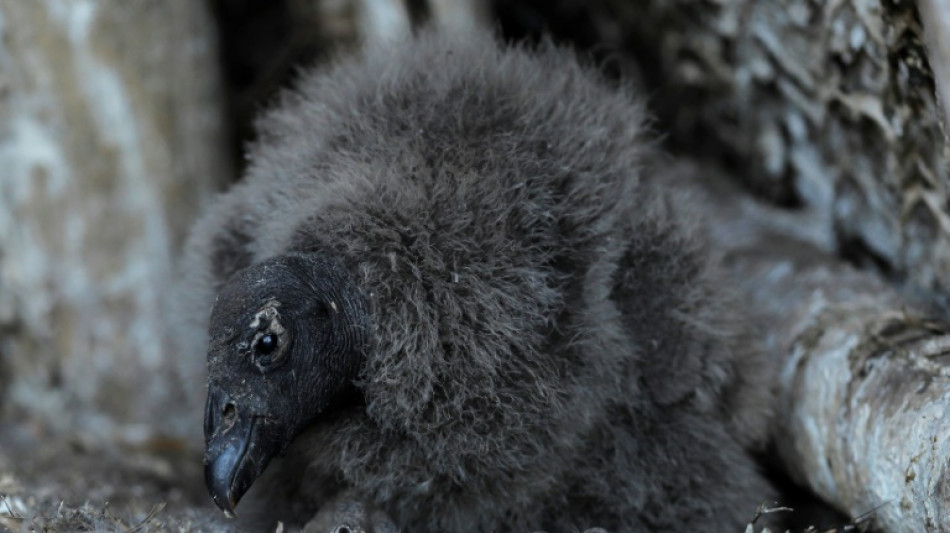
Chile preparing threatened condor chicks for release into wild / Photo: JAVIER TORRES - AFP
 Shein grapples with EU backlash, but clients keep coming

 Key facts about Chinese-founded fast-fashion giant Shein

 Shein to make market debut in Hong Kong in September

 Fils tops Tiafoe to claim first ATP Masters title in Cincinnati

 Gauff powers past Pegula to win Cincinnati WTA 1000 crown

 Ukraine backers gather as war escalates, air defence runs low

 Syria says Israel talks addressed de-escalation, staying out of Israel-Turkey tensions

 Tourism boom pushes limits of Athens air traffic control

 Liga holders Barcelona crush Elche, Atletico salvage Villarreal draw

 Spain's World Cup hero Torres saves PSG's blushes at Rennes

 Swiss forward Embolo joins Atlanta United

 Former cricket captains appeal to Pakistan over Khan health care

 Latest 'Spider-Man' tops American box office for 4th weekend

 Szoboszlai's last-gasp leveller rescues Liverpool in Newcastle draw

 Landfill collapse kills 30 in Guinea

 'Unbelievable' Cherki proves his point to Man City boss Maresca

 10-man Atletico snatch Villarreal draw as Alvarez returns

 Seville, Jefferson-Wooden roar to 100m wins at Silesia Diamond League

 VW chief warns carmaker's situation 'more than critical'

 England cricketer Carse under investigation after 'nightclub incident'

 McLaren's Norris wins Dutch GP after Verstappen crash

 Giroud scores as Lille give Davide Ancelotti winning start

 Kejelcha smashes half-marathon world record in Buenos Aires

 Trump admin predicts US trade war 'devastating' for Canada

 Trump set for starring role at Washington's debut IndyCar race

Alhue and Mailen were born in captivity but conservationists hope to free the chicks soon as part of a project to boost Chile's ailing population of Andean condors.
The Andean condor, a type of vulture, is the largest flying bird in the world but its population is considered "vulnerable" by the International Union for the Conservation of Nature's Red List of Endangered Species.
There are just an estimated 6,700 Andean condors living in the wild.
At Chile's Rehabilitation Center for Birds of Prey (CRAR), conservationists are trying to boost those numbers.
"The aim is to introduce condors to nature born from condors that cannot be freed, who are here for life," said Eduardo Pavez, the CRAR founder.
The CRAR center in Talagante, 40 kilometers from Santiago, looks after birds that cannot be released into the wild, either because they cannot fly or have become too accustomed to human contact.
The parents of both Alhue, a male, and female Mailen, have lived in the center for years and cannot be released.
- Venerated but threatened -
The condor has long been venerated by indigenous peoples in the Americas.
In Andean religious mythology, the condor was a symbol of power and ruled the upper world, acting as an intermediary with the world of spirits and the sun god, Inti.
It features on the coat of arms of several countries, such as Colombia, Ecuador, Bolivia and Chile.
It is virtually extinct in Venezuela in the north of the continent, while the largest concentrations are found in the south of Chile and Argentina.
The greatest threat to the condor is human occupation of the Andean mountain range, and a lack of food.
CRAR, founded in 1990, takes in all sorts of birds of prey including owls and falcons that are injured, have been in an accident or were kept in captivity.
Its aim is to rehabilitate them and release them back into the wild, but in many cases that is impossible.
Alhue's mother, for example, was injured by a power line and can no longer fly.
Mailen's mother, who was brought to the center at the age of about one, has become too accustomed to humans to be able to survive in the wild.
Over the years, CRAR has already freed 13 out of 25 condor chicks born in captivity, with another four due to be soon released.
- Teaching by pecks -
Within the next six to nine months, once they are fully grown, Alhue and Mailen will be separated from their parents.
The parents will then be able to begin reproducing again while their offspring will start socializing with and learning from other adult condors at the center.
They will be taken to a large cage where adults that cannot be released mix with juveniles preparing for the outside world.
There they can fly around and communicate with other members of their species.
"Here they establish a hierarchy where the adult males dominate. They have to learn that hierarchy, sometimes by force of pecks, so they find their place in condor society," said Pavez.
That is a vital apprenticeship for Mailen and Alhue ahead of their likely release in the southern hemisphere in spring of 2024 so that they are able to build relationships with other wild condors, get to know their territory and find food.
L.Davis--AMWN