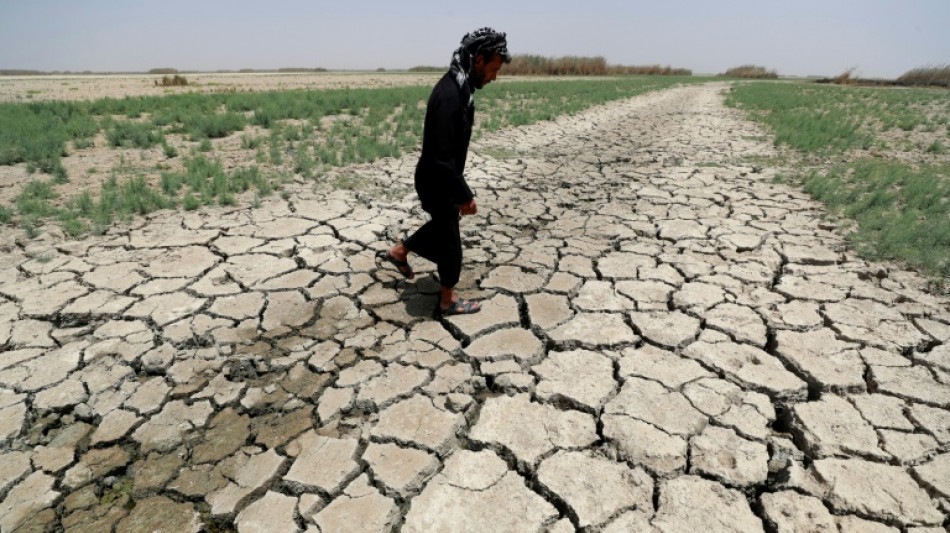
Emissions cuts can slash heat deaths in Mideast, N. Africa: study / Photo: AHMAD AL-RUBAYE - AFP
 Pilgrims seeking peace caught in deadly Nepal-Tibet floods

 China's help critical, but unlikely, for US to choke off Iran

 US court rules Pentagon ban of Anthropic unlawful

 In Zambia, a Shaolin Temple offers a softer face of China

 Messi's Inter Miami appoint new coach Gonzalez

 Clashes in Spain's Ceuta month after mass migrant influx

 Argentina names unchanged side for Australia Test

 Australia's Lee leads PGA Tour Championship

 US judge urged to rebuff restoring Trump name to Kennedy Center

 Trump orders Lake Ontario to be renamed 'Lake America'

 Raphinha, Lopez strike again as Barca beat Athletic

 Dos Santos, Russell set world records in 'crazy' Zurich Diamond League

 Dos Santos upstages Warholm for blistering new 400m hurdles world record

 US Open women's singles: Three talking points

 American Masai Russell sets new women's 100m hurdles world record

 Smith and Cox revive England after Abbas strikes for Pakistan

 Brazil's Alison Dos Santos sets new men's 400m hurdles world record

 The Nile Theater Announces Full 2026 Concert Lineup Including Menzingers and Shakey Graves

 Venezuelan Artist Oswaldo Vigas Retrospective Opens in Guangzhou

 Smith and Cox revive England against Pakistan after Abbas strikes

 Zambia opposition leader held in treason probe: police

 Corals show El Nino intensifying as planet warms: study

 Russia dismisses as 'scare stories' US reports about attacking NATO

 UEFA target Infantino for 'criminal mismanagement', suspend boycott threat

 Piracy attacks off Somalia surge in 2026: AFP analysis of IMO data

Meeting world targets to limit climate change would avert hundreds of thousands of heat-related deaths in the Middle East and North Africa, scientists said on Tuesday, urging the region to adapt better.
A modelling study published in The Lancet Planetary Health journal found slashing carbon emissions to limit the rise in Earth's average temperature to two degrees Celsius would reduce heat-related deaths in the region by 80 percent compared to a high-emissions scenario.
The regional focus on the heat risk came as Dubai prepares to host the United Nations COP28 climate summit in November.
Countries have pledged to limit global warming to 1.5C under the Paris climate accords, prompting efforts to switch to low-carbon energy sources.
In the highest-emissions scenario without cuts, around 123 people per 100,000 in the region would die per year from heat-related causes by the end of this century, according to the study, led by specialists at the London School of Hygiene and Tropical Medicine.
That would be 60 times greater than the current heat-death rate and far higher than in other regions of the world.
Of the 19 countries analysed, Iran was expected to have the highest annual death rate under a high-emissions scenario -- 423 deaths per 100,000 of population.
Lead author Shakoor Hajat told AFP temperatures were projected to be very high in parts of Iran. Ageing will also occur at a faster rate there than in many other countries in the region.
Hajat said health impacts would be "catastrophic" if the 2C target were not reached.
"Even with stronger action, countries in the region need to develop ways other than air-conditioning to protect their citizens from the dangers of extreme heat," he said.
"Public health measures such as national heat protection plans and heat alert warning systems could be introduced.
"These are common in countries in Europe and North America and parts of Asia, but not in the Middle East," he said.
"Many MENA (Middle East and North Africa) countries also need to strengthen their existing health systems to better prepare for climate change impacts."
F.Pedersen--AMWN