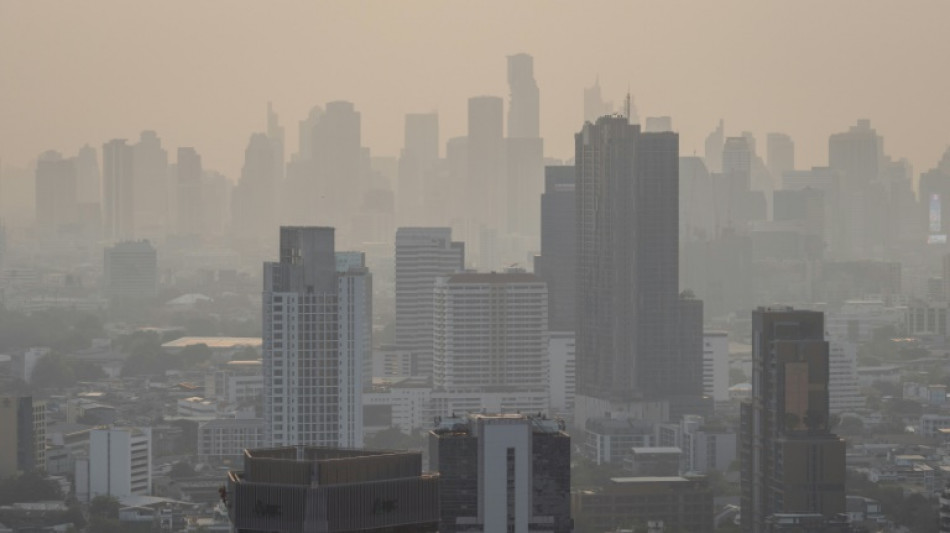
Air pollution kills 1,200 children a year: EU agency / Photo: Jack TAYLOR - AFP/File
 Pilgrims seeking peace caught in deadly Nepal-Tibet floods

 China's help critical, but unlikely, for US to choke off Iran

 US court rules Pentagon ban of Anthropic unlawful

 In Zambia, a Shaolin Temple offers a softer face of China

 Messi's Inter Miami appoint new coach Gonzalez
 Clashes in Spain's Ceuta month after mass migrant influx

 Argentina names unchanged side for Australia Test

 Australia's Lee leads PGA Tour Championship

 US judge urged to rebuff restoring Trump name to Kennedy Center

 Trump orders Lake Ontario to be renamed 'Lake America'

 Raphinha, Lopez strike again as Barca beat Athletic

 Dos Santos, Russell set world records in 'crazy' Zurich Diamond League

 Dos Santos upstages Warholm for blistering new 400m hurdles world record

 US Open women's singles: Three talking points

 American Masai Russell sets new women's 100m hurdles world record

 Smith and Cox revive England after Abbas strikes for Pakistan

 Brazil's Alison Dos Santos sets new men's 400m hurdles world record

 The Nile Theater Announces Full 2026 Concert Lineup Including Menzingers and Shakey Graves

 Venezuelan Artist Oswaldo Vigas Retrospective Opens in Guangzhou

 Smith and Cox revive England against Pakistan after Abbas strikes

 Zambia opposition leader held in treason probe: police

 Corals show El Nino intensifying as planet warms: study

 Russia dismisses as 'scare stories' US reports about attacking NATO

 UEFA target Infantino for 'criminal mismanagement', suspend boycott threat

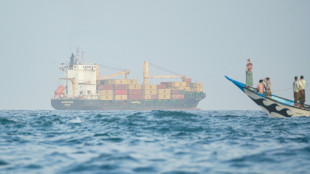 Piracy attacks off Somalia surge in 2026: AFP analysis of IMO data
Air pollution still causes more than 1,200 premature deaths a year in under 18's across Europe and increases the risk of chronic disease later in life, the EU environmental agency said Monday.
Despite recent improvements, "the level of key air pollutants in many European countries remain stubbornly above World Health Organization" (WHO) guidelines, particularly in central-eastern Europe and Italy, said the EEA after a study in over 30 countries, including the 27 members of the European Union.
The report did not cover the major industrial nations of Russia, Ukraine and the United Kingdom, suggesting the overall death tolls for the continent could be higher.
The EEA announced last November that 238,000 people died prematurely because of air pollution in 2020 in the EU, plus Iceland, Liechtenstein, Norway, Switzerland and Turkey.
"Air pollution causes over 1,200 premature deaths per year in people under the age of 18 in Europe and significantly increases the risk of disease later in life," the agency said.
The study was the agency's first to focus specifically on children.
"Although the number of premature deaths in this age group is low relative to the total for the European population estimated by EEA each year, deaths early in life represent a loss of future potential and come with a significant burden of chronic illness, both in childhood and later in life," the agency said.
It urged authorities to focus on improving air quality around schools and nurseries as well as sports facilities and mass transport hubs.
"After birth, ambient air pollution increases the risk of several health problems, including asthma, reduced lung function, respiratory infections and allergies," the report noted.
- Seven million dead annually -
Poor air quality can also "aggravate chronic conditions like asthma, which afflicts nine percent of children and adolescents in Europe, as well as increasing the risk of some chronic diseases later in adulthood".
Ninety-seven percent of the urban population were in 2021 exposed to air that did not meet WHO recommendations, according to figures released Monday.
The EEA had last year underlined that the EU was on track to meet its target of reducing premature deaths by 50 percent by 2030 compared with 2005.
In the early 1990s, fine particulates caused nearly a million premature deaths a year in the 27 EU nations. That fell to 431,000 in 2005.
The situation in Europe looks better than for much of the planet, says the WHO, which blames air pollution for seven million deaths globally each year, almost as many as for cigarette smoking or bad diets.
Several hundred thousand of the deaths concern children under 15.
It took until September 2021 to reach agreement to tighten limits set for major pollutants back in 2005.
In Thailand alone, where toxic smog chokes parts of the country, health officials said last week that 2.4 million people had sought hospital treatment for medical problems linked to air pollution since the start of the year.
Fine particulate matter, primarily from cars and trucks and which can penetrate deeply into the lungs, is considered the worst air pollutant, followed by nitrogen dioxide and ozone.
T.Ward--AMWN