'Drive-throw' recycling aims to ease Lebanon garbage crisis / Photo: JOSEPH EID - AFP
 Raphinha, Lopez strike again as Barca beat Athletic

 Dos Santos, Russell set world records in 'crazy' Zurich Diamond League

 Dos Santos upstages Warholm for blistering new 400m hurdles world record

 US Open women's singles: Three talking points

 American Masai Russell sets new women's 100m hurdles world record
 Smith and Cox revive England after Abbas strikes for Pakistan
 Brazil's Alison Dos Santos sets new men's 400m hurdles world record
 The Nile Theater Announces Full 2026 Concert Lineup Including Menzingers and Shakey Graves

 Venezuelan Artist Oswaldo Vigas Retrospective Opens in Guangzhou

 Smith and Cox revive England against Pakistan after Abbas strikes

 Zambia opposition leader held in treason probe: police

 Corals show El Nino intensifying as planet warms: study

 Russia dismisses as 'scare stories' US reports about attacking NATO
 UEFA target Infantino for 'criminal mismanagement', suspend boycott threat

 Piracy attacks off Somalia surge in 2026: AFP analysis of IMO data
 Tottenham land Marmoush from Manchester City

 YZi Labs Backs TermMax to Advance On-Chain Bond Market Infrastructure

 Nvidia boosts tech stocks but caution dominates ahead of Fed speech

 Pogacar holds off Mas to claim Vuelta stage six victory

 A lasting Dolly Parton legacy: childhood literacy

 S.Africa sounds alarm as infant vaccinations plummet
 Toulouse have salary cap fine reduced on appeal
 Tech stocks lifted by Nvidia but caution dominates ahead of Fed speech
 'Smart cricketer' Dinusha helps Sri Lanka draw second India Test

 Zambia opposition leader surrenders to police: state media

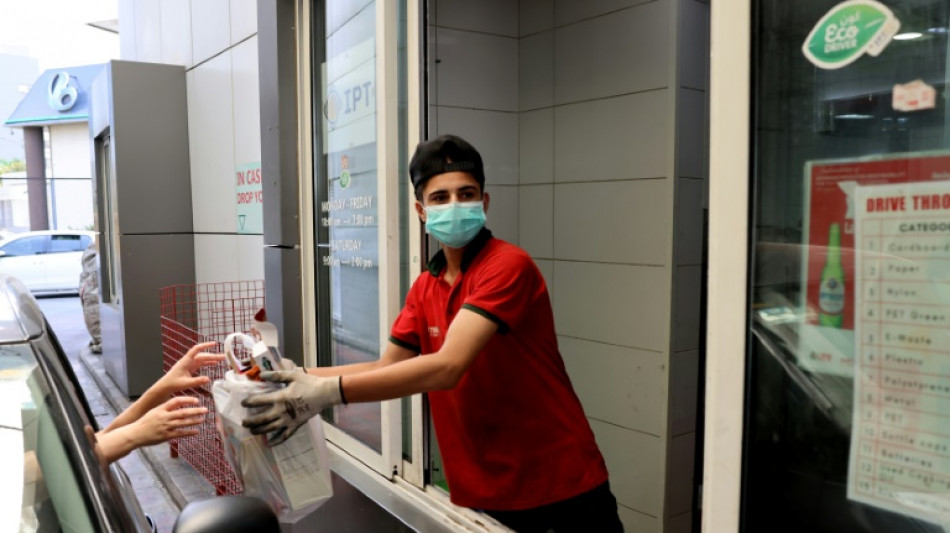
Beirut motorists pull up to a drive-through counter -- not for fast-food, but to exchange empty bottles and cardboard for cash, a novelty in a country long plagued by garbage crises.
Festering landfills often overflow in crisis-hit Lebanon, waste is burnt illegally at informal dump sites and rubbish floats off the coast in the Mediterranean Sea.
State-run recycling has largely fallen by the wayside in a nation that has been grappling with a three-year-long economic collapse.
"The government used to be in charge of this sector and now it is bankrupt," said Pierre Baaklini, 32, founder of Lebanon Waste Management.
Around a year ago he started the first "Drive Throw" recycling station and opened a second in February in Burj Hammoud, a Beirut suburb known for its proximity to a landfill.
With more than 80 percent of Lebanon's population living in poverty, the poorest eke out a meagre living picking through dumpsters for anything they can sell for recycling or scrap.
Baaklini said his customers are generally environmentally conscious and among the minority "with sufficient income".
People drive up to the station in their cars, register their details and place bags and boxes of loosely sorted recyclables on the counter. Workers accept everything from cardboard to plastic, glass, metal, e-waste, batteries and even used cooking oil.
A sign lists the prices -- a kilogram (2.2 pounds) of cardboard is worth 2,000 Lebanese pounds (around two cents), while aluminium cans are worth 50,000 pounds a kilogram.
Rony Nashef, 38, handed over bulging bags of plastic, in a country where many rely on bottled water for drinking.
Recycling "is definitely a much better solution to Lebanon's trash problem", he said.
Incompetence and corruption caused a spectacular waste crisis in Lebanon in 2015, when rivers of garbage filled the streets and ran into the sea, leading to protests by thousands and harming the country's image.
No viable long-term solution has since been found, and the destruction of two sorting plants in a catastrophic August 2020 explosion at Beirut port worsened the problem.
- 'For the community' -
Behind the scenes at Drive Throw, the recyclables are sorted carefully, while the plastic is later shredded and cleaned.
The two facilities have taken in a total of 450 tonnes of recyclables, founder Baaklini said, adding that the materials are sold to both local and international clients.
"What we are doing here is also about education" and awareness-raising, he said, as school students sometimes visit the facility to learn about recycling.
Environmental engineer Ziad Abichaker said recycling had always been neglected by authorities.
Only "about 10 percent" of Lebanon's daily waste load of 5,000 tonnes is recycled, said Abichaker, who heads Cedar Environmental, a group that specialises in "zero waste" technologies.
Authorities were studying a national waste management plan but there has been no progress due to institutional deadlock, he said.
A caretaker government with limited powers has been at the helm for more than a year.
Abichaker said "90 percent of the sorting plants built over the years" with money from international donations had stopped working, pointing to "faulty designs" and "corruption".
In Burj Hammoud, Renata Rahme, 47, said the first time she rolled up to the Drive Throw recycling station, she didn't know she was supposed to separate the materials.
"Now I'm trying to do more sorting," said Rahme, a film producer who brought in a crate with lights and other small electrical appliances.
"The point is not the monetary return as much as participating in the initiative," she said. "We're trying to do something better for the community, for the country, for society."
Y.Aukaiv--AMWN