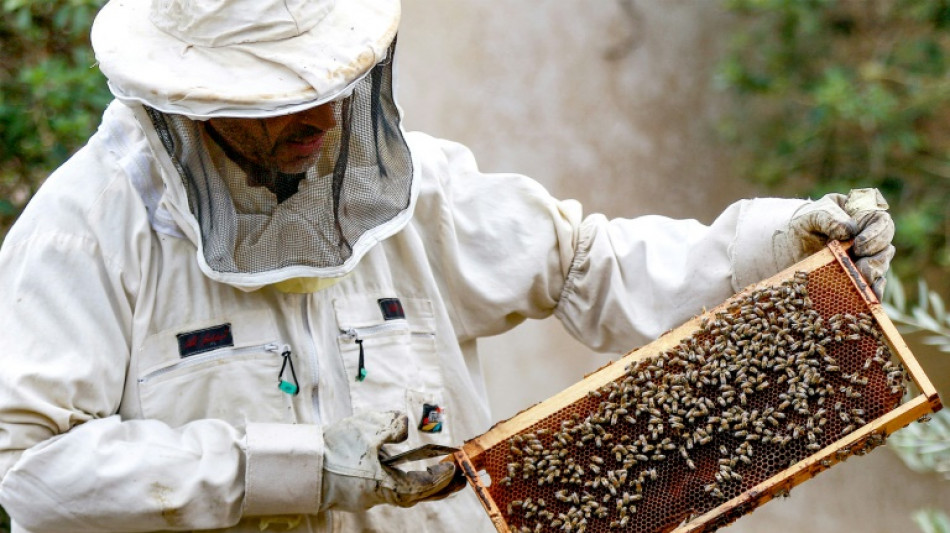
Sweet success: Jordan's beekeepers busy as honey demand soars / Photo: Khalil MAZRAAWI - afp/AFP
 Raphinha, Lopez strike again as Barca beat Athletic

 Dos Santos, Russell set world records in 'crazy' Zurich Diamond League

 Dos Santos upstages Warholm for blistering new 400m hurdles world record

 US Open women's singles: Three talking points

 American Masai Russell sets new women's 100m hurdles world record

 Smith and Cox revive England after Abbas strikes for Pakistan

 Brazil's Alison Dos Santos sets new men's 400m hurdles world record

 The Nile Theater Announces Full 2026 Concert Lineup Including Menzingers and Shakey Graves

 Venezuelan Artist Oswaldo Vigas Retrospective Opens in Guangzhou

 Smith and Cox revive England against Pakistan after Abbas strikes

 Zambia opposition leader held in treason probe: police

 Corals show El Nino intensifying as planet warms: study

 Russia dismisses as 'scare stories' US reports about attacking NATO

 UEFA target Infantino for 'criminal mismanagement', suspend boycott threat

 Piracy attacks off Somalia surge in 2026: AFP analysis of IMO data

 Tottenham land Marmoush from Manchester City

 YZi Labs Backs TermMax to Advance On-Chain Bond Market Infrastructure

 Nvidia boosts tech stocks but caution dominates ahead of Fed speech

 Pogacar holds off Mas to claim Vuelta stage six victory

 A lasting Dolly Parton legacy: childhood literacy

 S.Africa sounds alarm as infant vaccinations plummet

 Toulouse have salary cap fine reduced on appeal

 Tech stocks lifted by Nvidia but caution dominates ahead of Fed speech

 'Smart cricketer' Dinusha helps Sri Lanka draw second India Test

 Zambia opposition leader surrenders to police: state media

Jordan's key tourism industry may have been hammered by Covid, but the pandemic gave a boost to another sector, keeping its beekeepers busy as demand for honey has soared.
The country's 4,000 apiarists have ramped up output of the sweet and sticky golden substance long praised for its anti-inflammatory and other health benefits.
Even if there is no scientific consensus that honey helps fight Covid, many of those infected have used it to soothe symptoms such as sore throats.
"The Covid period in particular had a great, positive impact on us," said beekeeper Mutasim Hammad, 48, who retired 12 years ago from the public security directorate and turned his hobby into his main job.
"There was good demand for honey, and people got to know it," added Hammad, dressed in a white protective suit while checking on his 80 bee hive boxes on a property in Irbid 90 kilometres (60 miles) north of Amman.
"People have become more aware of the value of honey and are turning to the guaranteed locally produced honey," said Hammad, who sells about 400 kilograms (880 pounds) a year.
The kingdom of Jordan prides itself on its 19 different types of honey, including citrus, eucalyptus and maple varieties, depending on which plants the bees pollinate.
"We have about 2,500 flowering plants," said Mohammad Rababaa, head of the Jordan Beekeeping Association.
"This diversity distinguishes Jordanian honey and means that the therapeutic and nutritional value of this honey is expected to be better than other types."
Rababaa said the slightly bitter maple honey variety, for example, boasts "very high phenolic compounds and antioxidants compared to other types, which indicates that it has a higher value".
- Ecosystem service -
Rababaa also said that, since the Covid pandemic, "demand for locally produced honey has clearly increased".
He said the sector has a much bigger workforce than Jordan's official count of about 1,400 beekeepers.
"The reality is that the number of beekeepers is more than 4,000," said the professor of Natural Resources and Environment at the Jordan University of Science and Technology.
They produce about 700 to 800 tonnes annually, or about 70 percent of Jordan's annual domestic needs, he said.
"We are very close to self-sufficiency," said Rababaa, adding that "imports must be stopped".
A fellow enthusiast, Mohammad Khatib, 49, also pointed to the pandemic and lockdown periods, saying it "helped me and gave me enough time to learn about bees and take good care of them".
A French language professor at Al-Bayt University, he now works about 15 bee boxes in his garden, which he said earns him a nice side income.
"People are looking for reliable honey" and some customers place their orders a year in advance, he said.
Jordanian honey sells for 15 to 30 dinars ($21 to $42) per kilogram, depending on the type.
Rababaa said the economic benefit "is not limited to honey as it also produces pollen, royal jelly, wax, propolis and bee venom, which is included in many therapeutic compounds".
Crucially, healthy populations of bees and other insects provide an almost immeasurable ecosystem service by pollinating plants.
While the beekeeping sector generates about $28 million a year, Rababaa said, "the indirect value of crop pollination exceeds $100 million".
Ch.Havering--AMWN