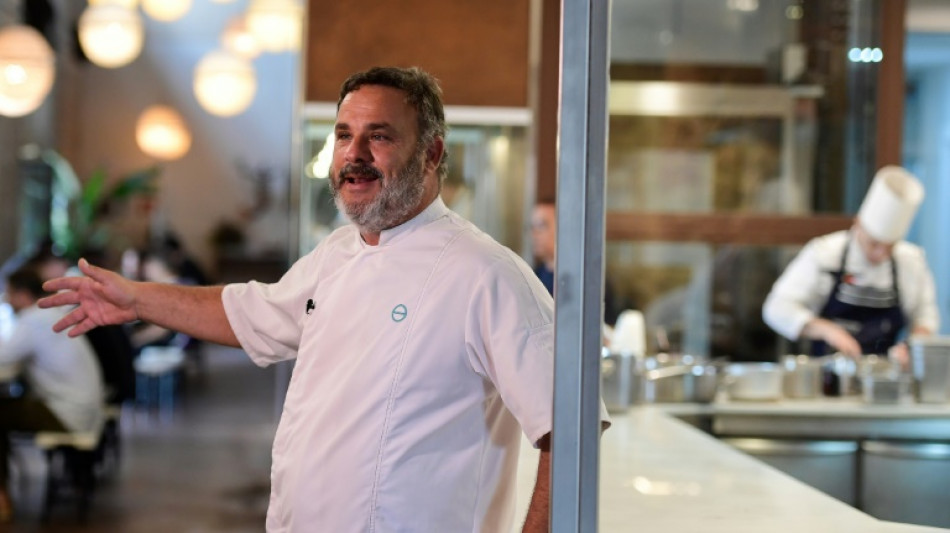
Marshes, mills and Michelin stars: Spain's 'chef of the sea' / Photo: CRISTINA QUICLER - AFP
 Taiwan lawmakers approve $7.6 bn drone budget as China threat grows

 TechCentral.ie Daily Briefing: Agentic AI Firm Doubles Headcount to 60

 KiiChain Integrates TRON to Expand 24/7 On-Chain FX and Stablecoin Payments

 Japan to survey animal cafes over hygiene, welfare concerns

 Desperate families search for missing after Nepal floods

 The missing in Nepal-Tibet flash floods

 Search for 1,300 missing after deadly Nepal-Tibet floods

 Once a top export, prized Kashmir carpet fades

 Search for 1,000 missing after deadly Nepal-Tibet floods

 Park So-yeon first woman to play for eSports powerhouse South Korea

 Yayoi Kusama: Japan's kaleidoscopic, troubled 'polka dot queen'

 Euro champ Hunt 'on her toes' against world's best in Zurich 100m

 Asian chip firms lifted by Nvidia forecast but broader markets struggle

 Search for missing after Nepal-Tibet floods kill 165

 Qantas says profits slump as fuel costs surge

 Lofty bond yields, Bessent's intervention pose challenge to Fed's Warsh

 The foreigners missing in Nepal's flash floods

 Bond yields are surging: Here's why that could spell trouble

 Fed's Cook rejects Trump mortgage fraud claims

 Guardian Metal Resources PLC Announces Pilot Mountain Technical Report Summary

 Meta, US states agree $18 bn settlement in landmark teen safety case

 What scientists know so far about Nepal's deadly floods

 US general visits Colombia to discuss war on drugs

 Meta settlement puts social media industry on notice: 'There will be more'

 NFL owners approve record Seahawks sale

As a child, Angel Leon spent hours fishing in the marshes of Cadiz in southwestern Spain -- and today the chef draws inspiration from this terrain for his three-star Michelin restaurant.
Leon, 46, has pushed the boundaries of seafood at Aponiente, serving up plankton rice, squid cheese and mussel pudding at the avant-garde eatery in El Puerto de Santa Maria, a fishing town in the heart of the Bay of Cadiz.
The sea is "an extraordinary pantry" that cooks often overlook, Leon told AFP, sporting a tattoo of a turtle on his forearm.
"The problem is that human beings are always selective" in the products they chose to eat, said the energetic chef, who believes in steering away from the latest fashions and suggesting "everything we find" in the ocean is likely to be edible.
The chef, who is also experimenting with new sustainable ingredients and innovations, is known in Spain as "el chef del mar" or "the chef of the sea".
Born in Jerez de la Frontera, Leon spent his childhood in the Bay of Cadiz where he would go fishing with his brother and father, a doctor, on weekends.
A poor student, Leon was passionate about fish and how to cook them, and decided to turn this passion into his profession.
As a teenager he enrolled at a Seville hotel and catering school, then earned his stripes in France at the acclaimed Le Chapon Fin restaurant in the southwestern city of Bordeaux.
- Tide mill restoration -
After spending time in Madrid and Toledo, in 2007 Leon returned to the Cadiz region and opened his own restaurant, Aponiente, aged 30.
His aim was to use the ingredients found in the bay for his menus.
The bet was risky, and the eatery struggled to draw customers -- until his efforts to use little-known marine ingredients were recognised in 2010 with his first Michelin star.
He was also ranked by the Wall Street Journal as one of the 10 best restaurants in Europe.
In 2015 Leon moved his restaurant to a tide mill dating from 1815, which he said he fell in love with immediately.
The 1,800-square-metre building, located in the heart of a salt marsh and exposed to the ebb and flow of the ocean, was then in a state of ruin and the adjoining land was being used as a garbage dump.
Leon invested 2.5 million euros ($2.7 million) to fix up the building, which now features contemporary decor that blends into the salt marsh landscapes that surround it.
Being in the heart of the marshes "allows people to understand why we cook the way we do," said Leon, who employs 70 people at his restaurant, located in a region with one of the highest unemployment rates in Europe.
- Open minds -
The restaurant's success has inspired others.
Since Aponiente opened, three other chefs from the province of Cadiz have been awarded a Michelin star, including its former head chef, Juanlu Fernandez.
Leon says he is now determined to open the "minds" of other gourmets.
He has embarked on new experiments to combine the protection of the environment with the search for new ingredients, exploring ways to adapt diets to the reality of global warming.
Leon is trying to domesticate eelgrass -- a plant with bright green ribbon-like leaves that grows in coastal marshlands, which produce edible grains dubbed "sea rice".
The grains are packed with protein as well as fibre and omega fatty acids, while the plant captures huge amounts of carbon dioxide.
Working with academics, Leon has so far succeeded in growing this "superfood" in the marshes of Cadiz, and is exploring its culinary uses.
It is not the first of his marine innovations to bear fruit. In 2008 he and researchers at Cadiz's marine research centre invented a machine called "Clarimax", which uses seaweed to remove fat from broths.
D.Moore--AMWN