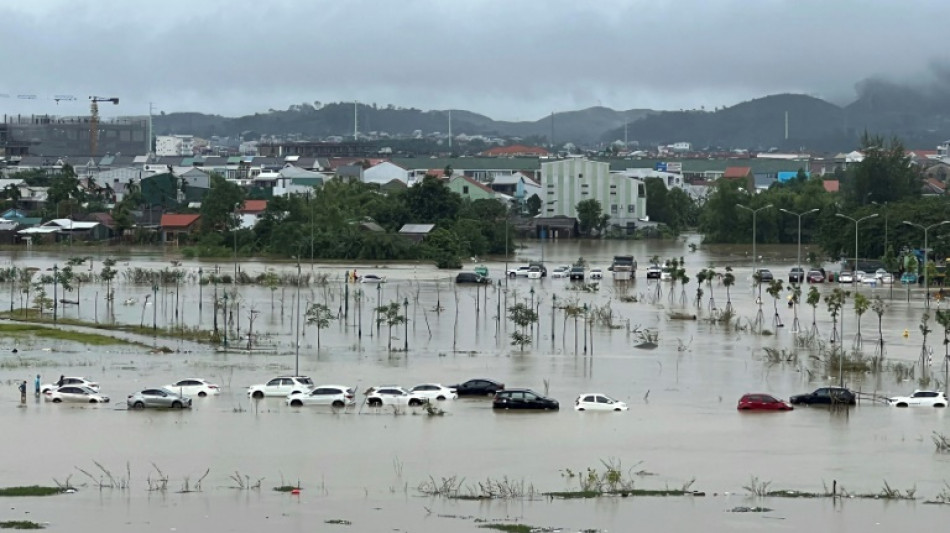
Rich nations 'likely' met $100 bn climate finance goal: OECD / Photo: Hai Duong - AFP
 Palace intrigue in Uganda as succession battle heats up
 'Housing First' approach gets Swedish city's homeless off streets
 Czech duo Muchova and Mensik win US Open mixed doubles title
 Japan's 'polka dot queen' artist Yayoi Kusama dies aged 97
 Nepal-Tibet disaster: what we know

 China deploys record number of ships around Taiwan as pressure grows

 Ruthless Bayern target treble as rivals reboot on Bundesliga return

 What experts know so far about Nepal's deadly floods

 UEFA set to withdraw FIFA boycott threat ahead of Champions League draw
 Sumo moves to beat Japan summer heat as temperatures rise
 'Be more honest': Markets crave clarity from cryptic Fed chair

 Climate change leaves its mark on America's largest reservoir
 CIA director warned Russia not to attack NATO members: US media
 Search for missing after Nepal-Tibet floods kills at least 160
 Meta, US states agree $18 bn settlement in landmark teen safety case

 What scientists know so far about Nepal's deadly floods

 US general visits Colombia to discuss war on drugs

 Meta settlement puts social media industry on notice: 'There will be more'
 NFL owners approve record Seahawks sale

 Nigerian armed groups net nearly $6 mn in ransoms: study

 Savio scores on debut as Spurs advance in League Cup

 Mbappe hits treble as Real Madrid thrash Real Sociedad

 At Dollywood, superfans honor the late singer and local hero

 Stocks mixed as oil drops, US inflation stays high

 Bolivia's Paz appoints new economy minister amid bailout talks

Wealthy nations likely met their goal of providing $100 billion in annual climate finance to poorer nations last year -- two years later than promised and only a fraction of the "extensive needs", the OECD said Thursday.
The OECD report comes ahead of the UN's COP28 climate negotiations later this month in Dubai, where finance will be a major sticking point.
The Organisation for Economic Co-operation and Development is tasked with monitoring official figures on the pledge to help developing countries fund their energy transitions and resilience in the face of accelerating climate impacts.
In 2009, richer countries promised to reach $100 billion annually in funding for these priorities by 2020.
Failure to meet the target on time has damaged trust in international climate negotiations.
In the most up to date figures, the OECD said richer countries reached $89.6 billion in total funding for 2021.
"Based on preliminary and as yet unverified data, the goal looks likely to have already been met as of 2022," said OECD Secretary-General Mathias Cormann in the foreword to the latest report.
But he added experts estimate that developing countries will need to spend about a trillion dollars a year by 2025 for climate investments, rising to roughly $2.4 trillion each year between 2026 and 2030.
"Although public finance can only contribute a share of these extensive needs," Cormann said, international donors would be crucial in helping to boost overall funding.
He said that currently finance from rich countries was not effective enough in attracting additional private sector investments and funding.
Finance focused on adaptation that countries must embark on to prepare themselves for an array of increasing climate impacts was also lagging, he said.
Adaptation measures can include building coastal defences, or helping farmers become more resilient to increasingly ferocious floods, droughts and other climate extremes.
- Action is 'stalling' -
Many developing economies least to blame for the greenhouse gases that stoke global warming are among the most exposed to the costly and destructive effects of worsening weather extremes and rising seas.
World leaders meeting at the climate talks in the United Arab Emirates will face a tough reckoning over financial solidarity between rich polluters and vulnerable nations, as a failure to cut planet-heating emissions threatens the Paris Agreement's global warming limits.
Adaptation is a key priority for developing countries and wealthy governments have promised to double adaptation finance by 2025, to $40 billion a year.
But as the world warms, climate change impacts increase and so too do the costs of preparing for them.
Earlier this month, a report by the UN Environment Programme (UNEP) projected that overall annual funding that developing countries need to adapt to climate impacts this decade had increased to as much as $387 billion.
At the time, UN Secretary-General Antonio Guterres warned action was "stalling" even as the need to protect people increases.
M.Thompson--AMWN