US nuclear industry upbeat on small reactors, despite setback / Photo: John MACDOUGALL - AFP
 LIV Golf to lay off majority of staff

 How narwhal 'scientists' track Arctic warming

 Iran says US sanctions will achieve nothing

 Essential Dolly: five key Parton songs

 Veteran promoter Warren says it's Joshua's job to agree Fury fight

 Ex-champ Wawrinka gets last-minute wildcard to US Open

 Brennan blasts to Vuelta stage five victory, Pogacar holds lead
 What could change for US teens on Instagram and Facebook
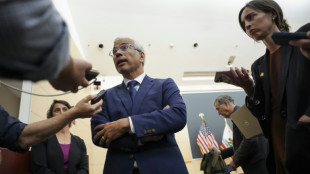 Meta, US states agree $16.7 bn settlement in landmark teen safety case
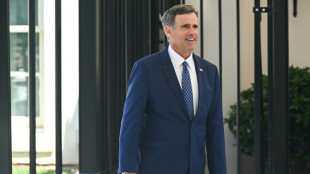
 'Point of no return' if Israel-Hamas truce fails: US envoy to Gaza board

 Barcelona holding out hope for Alvarez as Atletico resist sale
 Werro basks in new status, shelves world record talk

 Bill Gates warns world unprepared for AI upheaval
 Prince Harry and family arrive back in Britain: UK media

 German plan for sugar tax on Coke Zero fizzles out

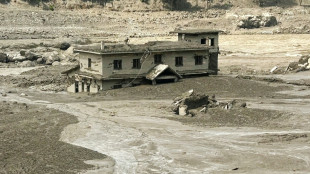
 Deadly flood hits Nepal-Tibet border, hundreds unaccounted for

 Tongue says Root has left England in no doubt over conduct standards

 Flags lowered across US for country music legend Dolly Parton

 Stocks gain as oil drops on Mideast hopes

 Bouaddi joins Man City for Premier League teenage record £85.6 mn

 Reclusive Hungarian author Peter Nadas dies aged 83

 Man City sign Lille's Bouaddi for 100 mn euros

 Sooriyabandara, Mendis lead Sri Lanka fightback after follow-on

 With ropes and chants, thousands move Japanese castle
 Zurich Diamond League: five events to watch

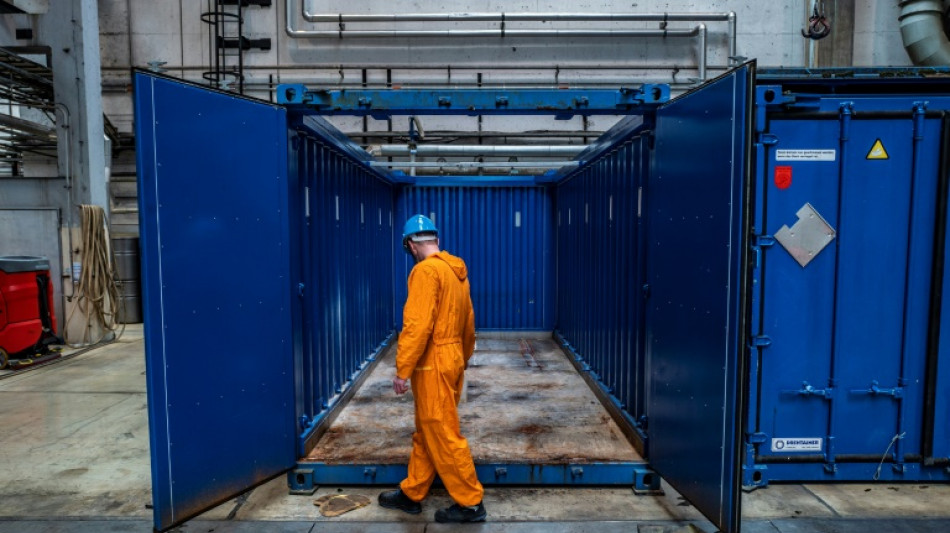
Despite the recent cancellation of a next-generation US nuclear plant, backers of the carbon-free power source remain hopeful new projects will come on line by the end of the decade.
Late last year, the US energy company NuScale announced it was pulling the plug on a small modular reactor (SMR) project in the western state of Idaho.
The project -- the sole SMR design yet to be approved by the US Nuclear Regulatory Commission -- faced exploding costs that took the estimated price from $5.3 billion up to $9.3 billion.
The "collapse of NuScale's project should spell the end for small modular nuclear reactors," MV Ramana, a professor at the University of British Columbia, predicted.
But according to Mason Lester, an analyst at S&P Global Commodity Insights, there are "a lot of positives that have been coming over the last year" for US nuclear prospects.
He pointed to Darlington in Ontario, Canada, where GE Hitachi aims for its new SMR design, the BWRX-300, to begin producing power in 2029.
"Pending regulatory approval, nuclear construction work will begin in 2025," Ontario Power Generation told AFP.
The Tennessee Valley Authority, a federally-owned US power company covering several southern states, has also invested in the BWRX-300.
"At the end of the day, it was one project," John Kotek of the Nuclear Energy Institute, an industry group, said of NuScale's Idaho venture.
In that case, the initial estimated costs "weren't the problem," said Kotek, a former Department of Energy official.
"The problem was the potential for the upside risk."
He said the takeaway is to improve "risk sharing" across the first new models before the industry can "get to the place where we're building these with some repeatability."
- Proof still needed -
Some of the reason for swelling costs are not particular to nuclear power but the result of higher prices for steel and other commodities, said Marcia Burkey, chief financial officer at TerraPower.
She noted that uranium prices have also risen.
TerraPower plans to begin construction on a nuclear reactor in June in Kemmerer, Wyoming at a retired coal plant.
"I could see people saying, 'There goes nuclear, again' when it's really very different," Burkey said of the cost pressures, which are "common to any area of infrastructure."
"We're hoping innovation can help to solve that," Burkey said.
TerraPower, which is also partnering with GE Hitachi and is supported by an investor group that includes Bill Gates, is focusing on a novel "molten chloride" technology that it says can operate at higher temperatures than conventional reactors, enabling greater efficiency.
Burkey said the US nuclear industry realizes it needs to "standardize" across multiple projects to lower costs.
Another project in development is by Ultra Safe Nuclear Corporation, which has selected Gadsden, Alabama for its Micro-Modular Reactor (MMR) assembly plant, which is supposed to go on line in 2027.
While China and Russia already have operational small reactors, the United States is ahead of Europe in this area of nuclear, said Sylvain Cognet-Dauphin of S&P Global Insights.
"My impression is that Europe is lagging behind the US in the SMRs," said Cognet-Dauphin.
"There are some discussions taking place. And there are some new designs being proposed, but nothing as advanced" as the projects in the United States, he added.
In Washington, the US House of Representatives approved a bill in late February to speed up the licensing of advanced nuclear power. The Senate has also passed similar legislation.
Lester called the move a "great step."
The efforts come amid increased recognition of the need to address rising energy demand, due in part to swelling use by data centers.
In March, Google, Microsoft and steel company Nucor announced a joint venture to boost clean energy, including by using advanced nuclear power.
PacificCorp, an energy utility in the western United States, is also studying adding nuclear capacity through a partnership with TerraPower.
"There is that appetite now and people are really interested in nuclear," said Cognet-Dauphin.
But "you still need to convince the client," he said. "You need to prove your product."
Y.Kobayashi--AMWN