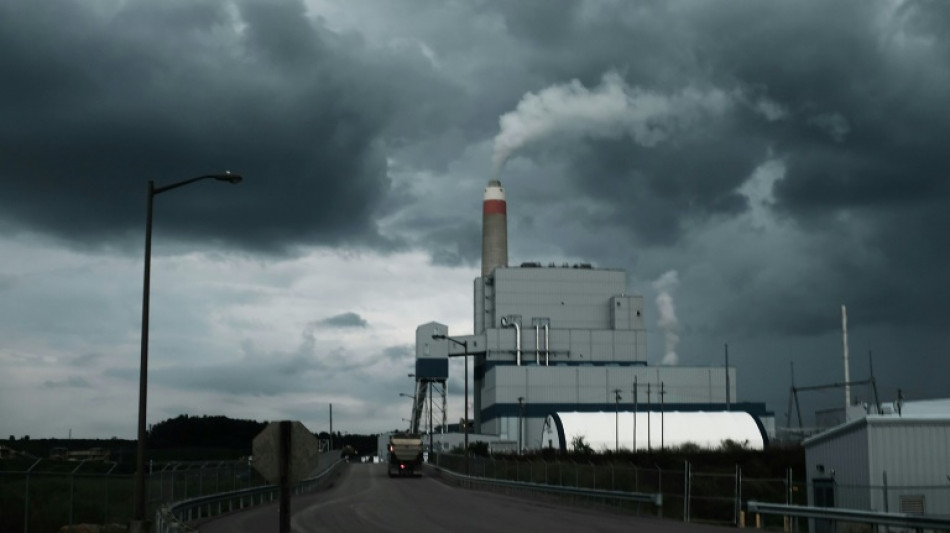
US announces sweeping cuts to power sector carbon emissions / Photo: SPENCER PLATT - GETTY IMAGES NORTH AMERICA/AFP/File
 Essential Dolly: five key Parton songs

 Veteran promoter Warren says it's Joshua's job to agree Fury fight

 Ex-champ Wawrinka gets last-minute wildcard to US Open

 Brennan blasts to Vuelta stage five victory, Pogacar holds lead

 What could change for US teens on Instagram and Facebook
 Meta, US states agree $16.7 bn settlement in landmark teen safety case

 'Point of no return' if Israel-Hamas truce fails: US envoy to Gaza board

 Barcelona holding out hope for Alvarez as Atletico resist sale

 Werro basks in new status, shelves world record talk

 Bill Gates warns world unprepared for AI upheaval

 Prince Harry and family arrive back in Britain: UK media

 German plan for sugar tax on Coke Zero fizzles out

 Deadly flood hits Nepal-Tibet border, hundreds unaccounted for

 Tongue says Root has left England in no doubt over conduct standards

 Flags lowered across US for country music legend Dolly Parton

 Stocks gain as oil drops on Mideast hopes

 Bouaddi joins Man City for Premier League teenage record £85.6 mn

 Reclusive Hungarian author Peter Nadas dies aged 83

 Man City sign Lille's Bouaddi for 100 mn euros

 Sooriyabandara, Mendis lead Sri Lanka fightback after follow-on
 With ropes and chants, thousands move Japanese castle
 Zurich Diamond League: five events to watch

 'Black smoke' chokes Pakistan maternity ward as hospital fire kills 14 infants

 French flight attendant wins landmark breast cancer ruling
 Sri Lanka 83-2 after India enforce follow-on in second Test

President Joe Biden's government on Thursday finalized sweeping plans to curb planet-warming emissions from the nation's fossil fuel plants as part of the United States' efforts to confront the climate crisis.
Hailed as among the most significant tools ever developed for reducing greenhouse gases from the power sector, the rules will require existing coal-fired plants and new high capacity gas-fired plants to reduce their carbon dioxide output by 90 percent, once they take effect.
It comes as Democratic incumbent Biden faces a tough election rematch against Republican Donald Trump, with climate action seen as key to galvanizing youth and progressive voters.
US power plant emissions have been declining, thanks to a drop in the cost of renewables. But they are still responsible for a quarter of greenhouse gasses produced by the world's largest economy.
"We are committed to the integrated priorities of ensuring US energy security, protecting people from pollution and fighting the climate crisis," Environmental Protection Agency (EPA) chief Michael Regan told reporters ahead of the announcement.
The agency's analysis estimates the rules will prevent 1.4 billion metric tons of carbon entering the atmosphere through the year 2047, equivalent to nearly one year of total greenhouse gas emissions from the power sector in 2022.
- 'It's historic' -
A draft proposal was first published last year, attracting criticism from the industry but also some environmental groups concerned the reductions needed to come sooner and go further.
There were also concerns it encouraged the use of carbon capture to achieve the reductions, a technology still in its infancy and which allow fossil fuel plants to continue to dump other pollutants on vulnerable communities, climate justice groups say.
The final rule is weaker in some ways and stronger in others, compared to the proposal.
Existing coal plants have until 2032 to implement their reductions, two years later than initially planned.
But the limits will apply to all coal plants that don't have firm commitments to retire by 2039, which is a year earlier than the draft envisaged.
The new version also lowers the threshold of which new gas plants are considered "high capacity" and are covered by the toughest measures, but rules regarding existing gas plants will only be announced later this year.
"It's historic, it's a relief and it is such a joy to know that this is coming," Margie Alt of Climate Action Campaign told AFP.
"This administration... will by every measure have done more to limit climate pollution than any other administration ever in the history of this country."
Alongside the carbon rules, the Biden administration also finalized three new regulations slashing mercury, water pollution and ash discharges from coal plants.
Former president Barack Obama first tried to regulate the power sector a decade ago, but the Supreme Court ruled his plans were too broad and exceeded executive branch authority.
The new rule limits itself to acting "within the fence line" of an individual power plant, which officials hope will improve its chances of surviving any legal challenges that may come.
L.Davis--AMWN