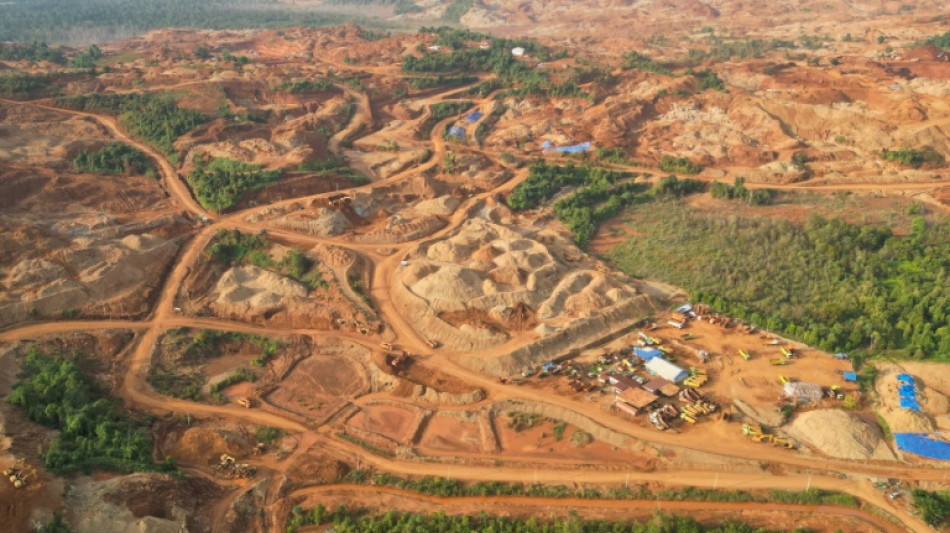
Satellite images show deforestation toll of Indonesia mines / Photo: RIZA SALMAN - AFP/File
 Too hot to incubate: Nile crocodiles hatch on their own in French reserve

 Spurs closing in on Man City's Marmoush after signing Savio

 Celtic count the cost of Champions League flop

 Lebanon accuses Israel of burning forest, farmland in south

 Nepal floods at China border kill 8, cause 'major casualties' in Tibet

 France eases cow diets as cheesemakers sweat

 America unites in mourning for Dolly Parton

 Meta and US states discuss settlement in landmark social media trial: report

 Fire haze threatens health of millions in Indonesia, ministry warns

 Senegal-made sickle cell treatment raises hopes, reduces costs

 Iran says Hormuz strait still closed despite transit corridor talks

 'Our patron saint': Tennesseans mourn local hero Dolly Parton

 Australian police hunt thieves in $250,000 oyster heist

 Coordinated attacks: Thailand's southern insurgency flares

 Asian Games chiefs hold talks as participant numbers balloon

 Too small for fries: drought shrinks Belgian potatoes

 Drought-hit Danube gives way to fossil hunt in Bulgaria

 Julia Curlee, CIA officer fired by White House for being transgender

 Fave or flop? A guide to gauging video game success

 RAEK Partners with Avadium Design to Develop RAEK Creator Vault, Its First Private AI Appliance

 Aztec Completes Consolidation of Tombstone Gold-Silver District Land Package, Arizona - Key Land Holdings Have Grown More Than Six-Fold Since 2017

 Who is the Best Eyelid Surgeon in Kirkland?

 How to Manage Costs for Urgent Plumbing Repairs

 Eagle Plains Reports Anomalous Radioactivity from First Drillholes at the Don Lake Uranium Project, Saskatchewan
 Instagram chief admits touting teen safety tool while omitting it was barely used

More than 700,000 hectares of forest in Indonesia have been cleared for mining since 2001, including large tracts of primary forest, a new analysis using satellite data has found.
The TreeMap, a conservation start-up, used high-resolution imagery from several satellites and two decades of data from the long-running Landsat programme to map mines and related infrastructure and track deforestation.
It estimates that mining -- including pits, processing facilities, tailings areas and roads -- resulted in the clearing of 721,000 hectares (7,210 square kilometres) of forest between 2001 and 2023.
An estimated 150,000 hectares of that was primary forest, areas with high carbon stock and tall trees that include intact old growth, according to the analysis released this week.
The group's Nusantara Atlas shows the striking disappearance of forest cover in time-lapse sequences as mines and associated infrastructure are developed.
The mines were identified using a combination of "visual interpretation and machine learning", explained David Gaveau, founder of The TreeMap.
"Open-pit mines are easily identified... by their concentric lines of benches cut into the pit sides for coal mines, or by their tendency to be located along river banks, for gold," he explained.
All types of mines also have distinctive "spectral signatures" -- a measurement of energy -- that are characteristic of bare land areas and are easily detectable, he added.
The group cross-referenced their findings with official maps of mining concessions, local media articles and NGO reports.
Using historical satellite images also allowed them to detect now-abandoned mines that have become overgrown.
The impact from coal mining was by far the largest, accounting for around half of all the deforestation tracked, followed by gold, tin and nickel.
And while the data showed a peak in deforestation in 2013, the problem has begun growing again in recent years.
By 2023, mining was linked to an annual loss of nearly 10,000 hectares of primary forest, Gaveau said.
Indonesia's environment ministry did not respond to a request for comment on the analysis.
The government's latest public figures, which are not broken down by cause, say over 73,000 hectares of forest area was lost in 2021-22, with more than 104,000 hectares of total deforestation that year, including "non-forest area".
Deforestation linked to mining still falls far short of the forest loss caused by palm oil and wood plantations.
But it is an area of growing concern, with Indonesia's reliance on coal increasing and the country looking to expand exploitation of its nickel reserves.
Indonesia has the world's largest reserves of highly sought-after nickel, a crucial component for the batteries used in electric vehicles.
A 2022 study found that 80 percent of global forest loss linked to mining occurred in just four countries: Indonesia, Brazil, Ghana and Suriname.
Indonesia was by far the worst affected however, accounting for nearly 60 percent of the global mining-linked forest loss tracked in the study.
G.Stevens--AMWN