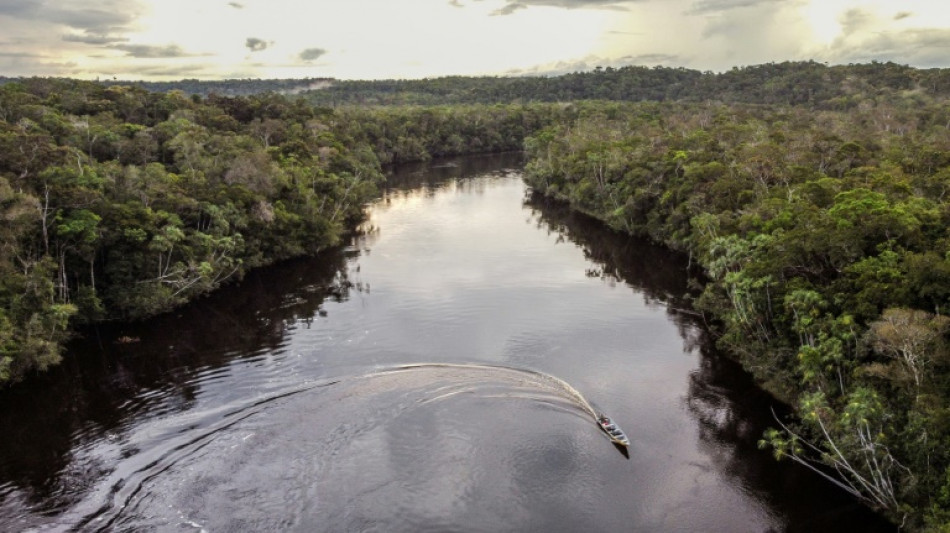
Amazon tribes win lawsuit over carbon credits in Colombia / Photo: Juan Pablo Pino - AFP/File
 Too hot to incubate: Nile crocodiles hatch on their own in French reserve

 Spurs closing in on Man City's Marmoush after signing Savio

 Celtic count the cost of Champions League flop

 Lebanon accuses Israel of burning forest, farmland in south

 Nepal floods at China border kill 8, cause 'major casualties' in Tibet

 France eases cow diets as cheesemakers sweat

 America unites in mourning for Dolly Parton

 Meta and US states discuss settlement in landmark social media trial: report

 Fire haze threatens health of millions in Indonesia, ministry warns

 Senegal-made sickle cell treatment raises hopes, reduces costs
 Iran says Hormuz strait still closed despite transit corridor talks

 'Our patron saint': Tennesseans mourn local hero Dolly Parton

 Australian police hunt thieves in $250,000 oyster heist

 Coordinated attacks: Thailand's southern insurgency flares

 Asian Games chiefs hold talks as participant numbers balloon

 Too small for fries: drought shrinks Belgian potatoes

 Drought-hit Danube gives way to fossil hunt in Bulgaria

 Julia Curlee, CIA officer fired by White House for being transgender

 Fave or flop? A guide to gauging video game success

 RAEK Partners with Avadium Design to Develop RAEK Creator Vault, Its First Private AI Appliance

 Aztec Completes Consolidation of Tombstone Gold-Silver District Land Package, Arizona - Key Land Holdings Have Grown More Than Six-Fold Since 2017

 Who is the Best Eyelid Surgeon in Kirkland?
 How to Manage Costs for Urgent Plumbing Repairs

 Eagle Plains Reports Anomalous Radioactivity from First Drillholes at the Don Lake Uranium Project, Saskatchewan

 Instagram chief admits touting teen safety tool while omitting it was barely used

Colombia's Constitutional Court on Wednesday annulled a controversial carbon credit deal in the Amazon rainforest, which six local tribes said had been signed without their consent.
Indigenous communities living in the remote area of Pira Parana had accused US-based Ruby Canyon Environmental and Colombian company Masbosques, which acted as an intermediary, of illegally foisting the deal on them.
Carbon credits are bought by corporations -- or countries under certain conditions -- from forest preservation or other projects to offset or "compensate" their greenhouse gas emissions.
This money is supposed to go to local communities that protect their home regions from deforestation.
In Pira Parana, the credits -- also known as green bonds -- were sold for about $3.8 million to a Colombian data processing firm called Latin Checkout.
According to EcoRegistry, which keeps tabs on carbon credit trading, Latin Checkout then sold the credits to US airline Delta which faces a lawsuit at home for alleged "greenwashing" by claiming to be carbon-neutral while purchasing questionable carbon offsets.
The deal, signed in March 2021, was for the Indigenous communities to preserve an area of 7,100 square kilometers (2,741 miles) -- close to the size of Puerto Rico.
But the tribes said the deal was signed with false representatives of their communities.
They went to court claiming violations of their rights to territorial autonomy and self-government.
On Monday, the court ordered the tribes' legitimate representatives to meet and decide within six months whether to authorize a new agreement.
If they do not, authorities must "ensure" the carbon credit project "is no longer carried out in the territory," the judges ruled.
The concept behind carbon credits has taken a major hit recently as scientific research has repeatedly shown claims of reduced emissions being hugely overestimated -- or even nonexistent.
In late 2023, AFP walked, motor-boated and overflew part of the Pira Parana territory, an area so remote it is accessible only by million-dollar private flights or a boat trip of at least six days from the nearest city of Mitu.
There, local leaders said they wished they had never heard of the deal.
While it brought an economic "bonanza," it also led to conflict in communities unaccustomed to handling large sums of money and a loss of Indigenous autonomy, they said.
The project "contaminates spiritually, physically, it destroys everything... in this territory, for money," Indigenous leader Fabio Valencia said at the time.
Some experts have said there was no real deforestation threat in the area and therefore no emissions "savings" to be made.
The Constitutional Court case was the first of its kind in Colombia.
P.Stevenson--AMWN