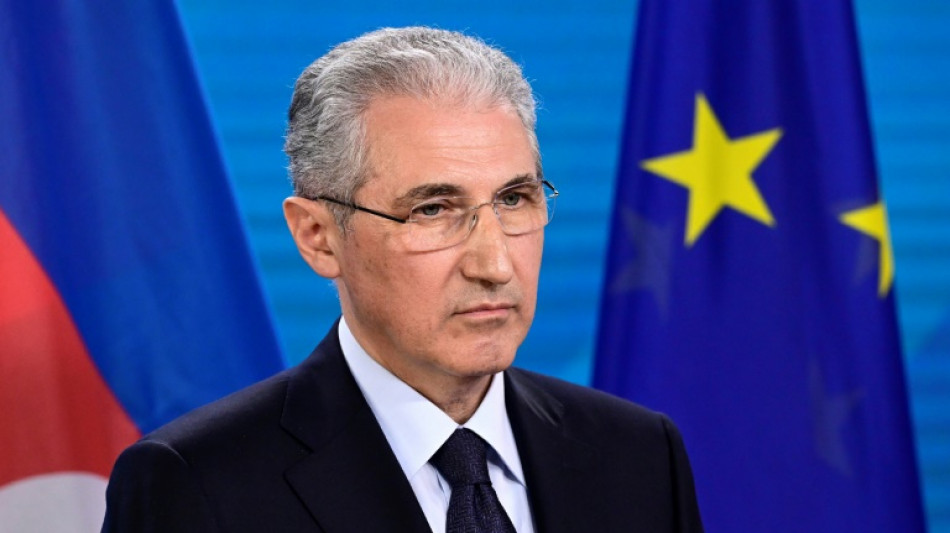
Climate talks host urges rich nations to break stalemate / Photo: JOHN MACDOUGALL - AFP
 Too hot to incubate: Nile crocodiles hatch on their own in French reserve
 Spurs closing in on Man City's Marmoush after signing Savio
 Celtic count the cost of Champions League flop
 Lebanon accuses Israel of burning forest, farmland in south
 Nepal floods at China border kill 8, cause 'major casualties' in Tibet
 France eases cow diets as cheesemakers sweat
 America unites in mourning for Dolly Parton
 Meta and US states discuss settlement in landmark social media trial: report
 Fire haze threatens health of millions in Indonesia, ministry warns
 Senegal-made sickle cell treatment raises hopes, reduces costs
 Iran says Hormuz strait still closed despite transit corridor talks
 'Our patron saint': Tennesseans mourn local hero Dolly Parton

 Australian police hunt thieves in $250,000 oyster heist

 Coordinated attacks: Thailand's southern insurgency flares
 Asian Games chiefs hold talks as participant numbers balloon
 Too small for fries: drought shrinks Belgian potatoes
 Drought-hit Danube gives way to fossil hunt in Bulgaria
 Julia Curlee, CIA officer fired by White House for being transgender

 Fave or flop? A guide to gauging video game success
 RAEK Partners with Avadium Design to Develop RAEK Creator Vault, Its First Private AI Appliance

 Aztec Completes Consolidation of Tombstone Gold-Silver District Land Package, Arizona - Key Land Holdings Have Grown More Than Six-Fold Since 2017

 Who is the Best Eyelid Surgeon in Kirkland?
 How to Manage Costs for Urgent Plumbing Repairs

 Eagle Plains Reports Anomalous Radioactivity from First Drillholes at the Don Lake Uranium Project, Saskatchewan
 Instagram chief admits touting teen safety tool while omitting it was barely used
The host of this year's UN climate summit on Wednesday urged governments to start compromising to break a deadlock over how to help poorer countries tackle global warming.
This November's COP29 summit in gas-rich Azerbaijan is meant to produce a global agreement on how much rich nations should pay developing countries for climate assistance, but talks have stalled.
While poorer nations are the least responsible for carbon emissions, they suffer the most from a warming planet.
Developing countries need massive investments in energy systems to cut their own carbon footprints and money to strengthen defences against the effects of global warming.
But a diplomatic meeting in Bonn last month ended in stalemate. Countries were unable to advance on an issue that has eroded trust at climate talks for years.
In a letter to the roughly 200 nations that have signed up to UN climate accords, COP29 president Mukhtar Babayev lamented the absence of "necessary progress".
Time was running out, he warned.
"We clearly need a rapid increase in the pace of our work," wrote Babayev, a government minister and former executive at Azerbaijan's national oil company.
"Time lost is lives, livelihoods and the planet lost," he added.
"We call on all parties to increase the pace of their work and move on from their early negotiating positions."
- 'Supercharge' efforts -
Babayev's appeal comes in the hottest year on record and as extreme heatwaves, floods and wildfires batter communities around the globe.
UN climate chief Simon Stiell, whose own homeland of Grenada was devastated by hurricane Beryl earlier this month, urged countries to put the fight against global warming back on the political agenda.
"Rather than just counting the costs of climate carnage, all governments must supercharge efforts to prevent them," said Stiell.
He was speaking during a visit to the island of Carriacou, where his grandmother's house was among many destroyed.
"Standing here, it's impossible not to recognise the vital importance of delivering climate finance," he added.
Wealthy nations have been under pressure to commit to new financing targets that go well beyond the $100 billion a year they promised in 2009.
Developing nations excluding China will need about $2.4 trillion a year in climate investment by 2030, according to an expert assessment commissioned by the UN.
That is nearly 25 times more than the present levels.
But nations are nowhere near agreeing on a dollar aid figure, with talks bogged down over who should pay, what form the money should take, and who should receive it.
- Informal talks -
Under a 1992 climate accord, only a small handful of the wealthiest industrialised nations at the time were obligated to pay climate finance.
Some want the pool of contributors widened, most notably to include China, which is today vastly wealthier than 30 years ago, and the largest emitter of greenhouse gases.
But this has been a non-starter for developing nations, who have accused wealthy countries of trying to shirk their responsibility.
To break the ice, Azerbaijan will host the negotiating teams for an informal two-day retreat starting July 26.
They have named two experienced diplomats -- Dan Jorgensen of Denmark and Yasmine Fouad of Egypt -- to help the parties make headway.
Babayev said the impasse would "not be solved by negotiators alone", calling for political leadership on the sidelines to help move discussions toward consensus.
J.Williams--AMWN