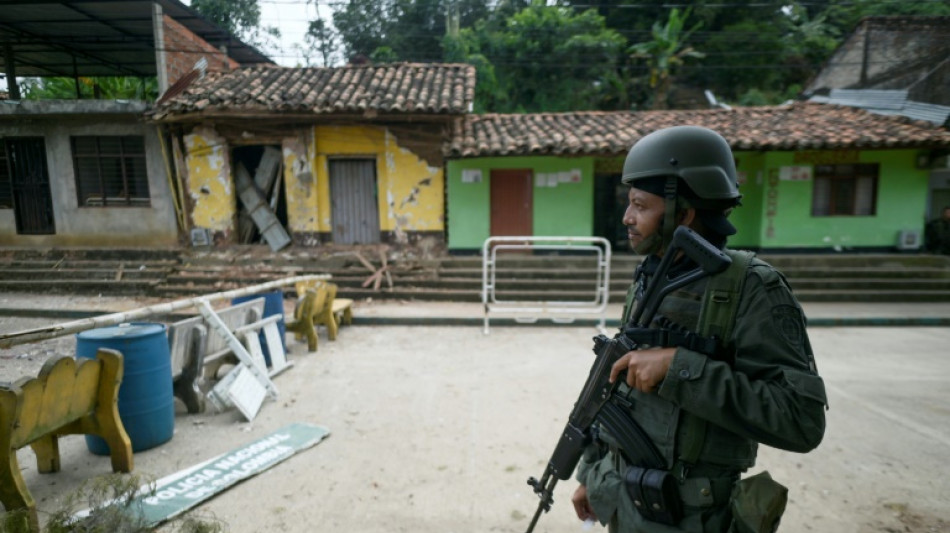
Gunfire, bombs as Colombia guerrillas flex muscles ahead of COP16 / Photo: JOAQUIN SARMIENTO - AFP
 Zurich Diamond League: five events to watch
 'Black smoke' chokes Pakistan maternity ward as hospital fire kills 14 infants
 French flight attendant wins landmark breast cancer ruling
 Sri Lanka 83-2 after India enforce follow-on in second Test
 Pakistan hospital fire kills 14 infants

 Iceland to vote on resuming EU talks in close referendum

 North Korea to 'bring joy' to Kim with 100 athletes at Asian Games
 US LGBTQ community mourns 'diva' Dolly Parton

 England bid to banish booze woes as Pakistan seek self-respect
 High quality, low risk: record number of Japanese in Premier League

 Stocks edge higher as oil drops on fresh Mideast hopes

 Pakistan's girls fight for their place in the boxing ring
 Five things to know about Anthropic ahead of Wall Street debut
 Social media use on the rise among Australian under-16s after ban: data

 Eagle Plains Reports Anomalous Radioactivity from First Drillholes at the Don Lake Uranium Project, Saskatchewan
 Instagram chief admits touting teen safety tool while omitting it was barely used

 'Final Fantasy', 'The Witcher' in spotlight at Europe gaming bash
 Syrian Kurdish leader dissolves force that spearheaded jihadist fight

 Trump raises prospect of demolishing iconic Kennedy Center

 PGA Tour to end in two-week matchplay showdown from 2028: CEO

 United States of Dolly: how a country queen bridged America's divide

 PGA chief says 'no current plans' for LIV stars to return

 Golf giant Callaway apologizes after ad sparks outcry

 Ioane stars as New Zealand recover to beat Johannesburg Lions

 Ukrainians seeking beauty in a bomb-scarred city

Weary of gunfire and bombs, Ana Munoz recently closed her shop in a hamlet near the city of Cali, which will host a UN biodiversity summit in October that has been threatened by Colombian guerrillas.
Residents of the small town of Robles, some 18 kilometers (11 miles) south of Cali, say violence has reached new levels leading up to the COP16 meeting.
In July, Munoz, 40, and her family hunkered down in their home for four hours as a gun battle raged outside between security forces and an armed group known as the EMC.
Earlier that day, she heard a motorcycle loaded with explosives crash into a neighbor's house.
Like many in the town, the neighbor fled in fear of the rebels, who are dissident fighters from the former FARC guerrilla movement who rejected a 2016 peace agreement and renamed themselves the Central General Staff (EMC).
"Almost everyone has left," said Munoz, packing up the bags of animal feed she sells to take to another, safer, part of town.
In July, the EMC warned the 16th meeting of the Conference of the Parties (COP16) of the Convention on Biological Diversity "will fail even if they militarize the city with gringos (foreigners)."
On Tuesday, dressed in camouflage and armed with rifles, the rebels assured in a video that they would respect the COP16.
Either way, their presence has authorities on edge.
The summit security manager, General William Castano, said more than 10,000 uniformed officers supported by Interpol, Europol and Ameripol, were working on a defense and intelligence plan dubbed the "Hummingbird Plan".
The idea is to "minimize criminals' attempts to affect security at the COP."
- 'Very worrying'-
Much of Robles is now deserted. Walls are riddled with bullet holes or damaged by explosions and broken glass marks the entrance to some homes.
Soldiers and tanks keep close watch of the surroundings.
The situation is much the same in other towns in the southwestern Valle del Cauca department, of which Cali is the capital.
The area is an EMC stronghold, and is the main coca-growing region in the nation, the world's largest cocaine producer.
"It is very worrying," said Munoz about the threat to the summit nearby in Cali, Colombia's third largest city, home to 2.2 million inhabitants.
A dozen heads of state have already confirmed their attendance, according to Cali mayor Alejandro Eder.
When the motorcycle bomb exploded, Fabio Diaz, 69, and his wife, who live a few meters away, threw themselves to the ground.
According to the couple, about 50 chickens that they fatten up to sell have died from fright in a string of recent attacks.
"When one is at home and a spoon falls, you tense up," said Diaz, who earns a few coins guiding car and bus drivers through the labyrinth of streets that security forces have barricaded.
He has barely heard about the summit, but said it would be ideal if "they provide security for all of us. We want peace, we want to smile again."
- 'Checkmate' -
In the main park in Robles, three military tanks accompanied by soldiers and police keep watch.
The state Ombudsman's Office warned this year that the FARC dissidents have the wider municipality of Jamundi in "checkmate" due to recruitment, kidnappings, extortion and homicides.
On July 18, the mayor, Eder, traveled to New York to work on a cooperation plan with its police, which are experts in anti-terrorism. Some officers will soon travel to Cali to assess local security forces, particularly on intelligence matters.
"We take any threat seriously," Eder told AFP. However, he said he feels "calm", and sure that COP16 will be a success.
As is often the case in Colombia, the most brutal violence takes place in remote villages, while armed groups infiltrate cities in a more covert manner.
In Cali, a city full of trees and criss-crossed by rivers, COP16 is seen by many as a sign of hope.
"There is no need to be afraid," said Abraham Murillo, a 60-year-old public archivist.
"Is a success for the city and it should happen."
But others are more cautious.
"The guerrillas have indeed threatened a lot," said Carlos Riano, a 72-year-old pensioner, adding he was unsure if authorities could stop them from carrying out attacks.
"We will see how real their threats are."
H.E.Young--AMWN