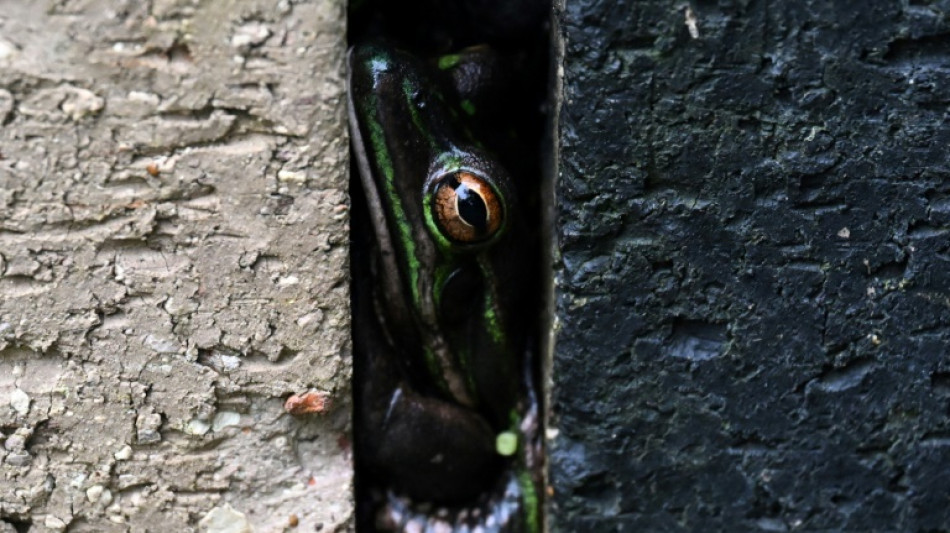
Australian sauna helps save frogs from flesh-eating fungus / Photo: Saeed KHAN - AFP
 Sri Lanka 83-2 after India enforce follow-on in second Test
 Pakistan hospital fire kills 14 infants

 Iceland to vote on resuming EU talks in close referendum

 North Korea to 'bring joy' to Kim with 100 athletes at Asian Games

 US LGBTQ community mourns 'diva' Dolly Parton

 England bid to banish booze woes as Pakistan seek self-respect

 High quality, low risk: record number of Japanese in Premier League

 Stocks edge higher as oil drops on fresh Mideast hopes

 Pakistan's girls fight for their place in the boxing ring
 Five things to know about Anthropic ahead of Wall Street debut

 Social media use on the rise among Australian under-16s after ban: data

 InterContinental Hotels Group PLC Announces Transaction in Own Shares - August 26

 Williams-Alcaraz fall in US Open mixed quarter-finals

 Mark Carney, the former central banker who said 'no' to Trump

 Segner out of South Africa tour as New Zealand injuries pile up

 Meta knew teen safety tools were ineffective, witnesses testify

 Williams and Alcaraz win opener at US Open mixed doubles

 Man Utd's Fernandes crowned PFA player of the year

 Dolly Parton: quotes on life, love and music

 Brazil fines TikTok $30 mn in 'powerful signal' over child safety

 Cameroon's Baleba joins as Man Utd boost midfield options

 US country music legend Dolly Parton dies at 80

 Kolisi fit to captain South Africa against New Zealand

 Volkswagen workers boo boss during speech on job cuts

 Djokovic, Sabalenka tumble out of US Open mixed doubles

Hundreds of endangered Australian Green and Golden Bell frogs huddle inside a sauna, shielded from Sydney's winter chill.
The sauna -– a small greenhouse containing black-painted bricks warmed by the sun -- may be pleasant, but it also protects the frogs from a deadly chytrid fungus that would otherwise drive them to extinction.
Macquarie University biologist Anthony Waddle holds one frog -- no bigger than a credit card -- in his hand as its green and gold colours become more vibrant in the heat.
"Chytrid is the worst pathogen ever", he told AFP.
It is a water-borne disease that burrows into the frogs' skin, attacking their bodies and eventually killing them.
Waddle said that globally, the disease has caused the decline of 500 amphibian species and driven 90 to extinction -– six in Australia.
"Nothing has ever caused this much devastation," he told AFP. "In Australia, we have frogs that only live in glass boxes now. This is a huge, ongoing problem."
But Waddle's dollhouse-sized saunas could change that.
In their warm interiors, the deadly chytrid fungus cannot grow on the frogs, allowing them to fight off the infection and survive.
-'No one solution' -
Frogs play a vital role in the environment and are known as bioindicators, which are used to assess the health of ecosystems.
Without the amphibians, entire ecosystems can collapse.
Globally, 41 percent of frog species are threatened with extinction, making them one of the most vulnerable invertebrate groups, a recent study by the International Union for Conservation of Nature found.
Some of the biggest drivers include loss of habitat, climate change and the chytrid disease.
These drivers are difficult to tackle, but in the absence of a cure, Waddle hopes his frog saunas can help limit the losses.
"This might be the first evidence that we could cheaply and feasibly reduce that nasty yearly die-off of frogs," Waddle said.
"For Green and Golden Bell frogs, that could mean the difference between a population going or persisting."
He said the saunas show that creative solutions ranging from the complex -- such as identifying genes that could make individuals resistant to chytrid -- to more simple are needed if frog populations are to survive.
"Not one solution is going to work for everything. Frogs are so different," Waddle added.
But the beauty of Waddle's saunas is that they cost AUD$70 ($US50) to assemble, and he has helped dozens of citizen scientists build their own backyard versions.
This has not only provided valuable data about endangered frog species but also saved some from the deadly fungus.
Jodi Rowley, an amphibian biologist from the Australian Museum, said the saunas showed how creative solutions could have real-world benefits.
"It's easy to feel helpless in the face of biodiversity declines, but this study gives us a tangible way we may be able to help frogs battling a devastating fungal disease," she told AFP.
L.Mason--AMWN