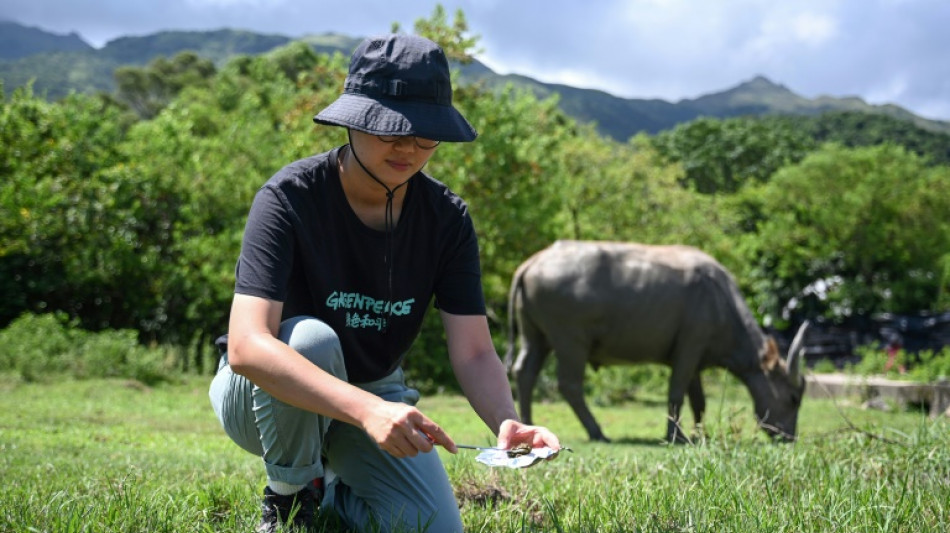
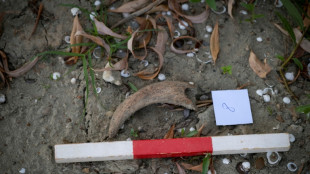
Greenpeace sounds alarm on microplastics ingested by Hong Kong wildlife / Photo: Peter PARKS - AFP
 Sri Lanka 83-2 after India enforce follow-on in second Test
 Pakistan hospital fire kills 14 infants
 Iceland to vote on resuming EU talks in close referendum

 North Korea to 'bring joy' to Kim with 100 athletes at Asian Games

 US LGBTQ community mourns 'diva' Dolly Parton
 England bid to banish booze woes as Pakistan seek self-respect
 High quality, low risk: record number of Japanese in Premier League

 Stocks edge higher as oil drops on fresh Mideast hopes
 Pakistan's girls fight for their place in the boxing ring
 Five things to know about Anthropic ahead of Wall Street debut

 Social media use on the rise among Australian under-16s after ban: data

 InterContinental Hotels Group PLC Announces Transaction in Own Shares - August 26

 Williams-Alcaraz fall in US Open mixed quarter-finals

 Mark Carney, the former central banker who said 'no' to Trump

 Segner out of South Africa tour as New Zealand injuries pile up

 Meta knew teen safety tools were ineffective, witnesses testify

 Williams and Alcaraz win opener at US Open mixed doubles
 Man Utd's Fernandes crowned PFA player of the year

 Dolly Parton: quotes on life, love and music

 Brazil fines TikTok $30 mn in 'powerful signal' over child safety

 Cameroon's Baleba joins as Man Utd boost midfield options

 US country music legend Dolly Parton dies at 80

 Kolisi fit to captain South Africa against New Zealand
 Volkswagen workers boo boss during speech on job cuts

 Djokovic, Sabalenka tumble out of US Open mixed doubles

Microplastic particles turned up in the vast majority of waste samples taken from Hong Kong wildlife in a Greenpeace study, the group said Monday, suggesting that animals still ingest plastics even if they are not feeding in urban areas.
The report was released ahead of November talks in South Korea, where governments will be looking to seal a potentially groundbreaking deal tackling the problem of plastic pollution.
The scale of the issue is vast -- microplastics have been found in the deepest ocean trenches, on the highest mountain peaks, in the atmosphere, and even in breastmilk.
Though best known as a city of skyscrapers, Hong Kong is also home to huge swathes of undeveloped countryside home to animals like buffalo, boars, wild cattle, macaques and porcupines -- the species included in the Greenpeace survey.
The group, alongside researchers from local and Taiwanese universities, collected 100 faeces samples from seven locations in 2022, and found 85 percent of them contained microplastics, Greenpeace said in a press release.
"The findings of this study are important, proving that wild animals can ingest microplastics in the countryside, where it is away from urban areas and human activities," said researcher Christelle Not of the University of Hong Kong.
"As an increasing number of studies find microplastics in various natural environments, wildlife, and even human bodies, plastic pollution has become a global issue that urgently needs to be addressed," she added, calling for "a strong global plastic treaty" help meet reduction targets.
The most common types of microplastics detected in the Greenpeace study were polyethylene and polypropylene, commonly found in single-use packaging, takeaway containers and disposable utensils.
During a recent AFP visit to Pui O River on Hong Kong's Lantau island with researchers, buffalo could be seen bathing in the stream a short distance from plastic garbage scattered along the banks.
"If animals ingest microplastics from the environment, those could invade our ecological system tier by tier and affect human health," Greenpeace campaigner Leanne Tam told AFP.
Little is yet known about the specific impacts of microplastic particles on human health and the environment.
Hong Kong, a city of 7.5 million people, sends more than 2,300 tonnes of plastic waste to landfills every day, according to the government's 2022 waste report.
In April, the city enforced a ban on polystyrene utensils in restaurants for both dine-in customers and takeaway.
But a full ban -- which covers more plastic materials used by businesses -- "still lacks a clear timetable", Greenpeace said.
S.F.Warren--AMWN