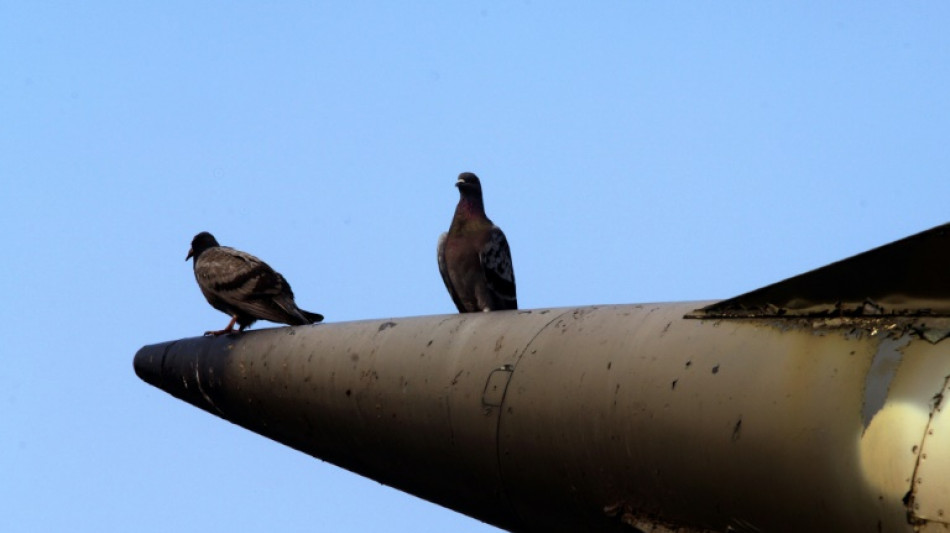
Backside breathing and pigeon bombers studies win Ig Nobel prizes / Photo: KIM JAE-HWAN - AFP/File
 North Korea to 'bring joy' to Kim with 100 athletes at Asian Games

 US LGBTQ community mourns 'diva' Dolly Parton
 England bid to banish booze woes as Pakistan seek self-respect

 High quality, low risk: record number of Japanese in Premier League

 Stocks edge higher as oil drops on fresh Mideast hopes

 Pakistan's girls fight for their place in the boxing ring
 Five things to know about Anthropic ahead of Wall Street debut

 Social media use on the rise among Australian under-16s after ban: data

 Instagram chief admits touting teen safety tool while omitting it was barely used

 'Final Fantasy', 'The Witcher' in spotlight at Europe gaming bash

 Syrian Kurdish leader dissolves force that spearheaded jihadist fight

 Trump raises prospect of demolishing iconic Kennedy Center

 PGA Tour to end in two-week matchplay showdown from 2028: CEO

 United States of Dolly: how a country queen bridged America's divide

 PGA chief says 'no current plans' for LIV stars to return

 Golf giant Callaway apologizes after ad sparks outcry

 Ioane stars as New Zealand recover to beat Johannesburg Lions

 Ukrainians seeking beauty in a bomb-scarred city

 Dolly Parton: Country music's dolled up but deserving queen

 US robotaxi firm Waymo plans to launch in Germany

 'Here to win': Xavi vows to restore pride in Dutch football

 Cameroon's Baleba joins as Man United boost midfield options

 'Shocking' book about Putin's private life wins French literary prize

 Pogacar storms to Vuelta a Espana stage four solo triumph

 Canada unveils counter-tariffs of 15-50% on US goods

Mammals that can breathe through their backsides, homing pigeons that can guide missiles and sober worms that outpace drunk ones: these are some of the strange scientific discoveries that won this year's Ig Nobels, the quirky alternative to the Nobel prizes.
The annual awards "for achievements that first make people laugh, then make them think", were handed out at a rowdy ceremony at MIT in the United States on Thursday evening.
Here are the 10 winners of the 34th edition, held a month before the real Nobel prizes.
- Bad breath -
The physiology prize went to Japanese and US researchers for discovering that many mammals can breathe through their anuses.
They were inspired by loach fishes, which are capable of "intestinal air breathing", according to their 2021 study.
This can also be done by mice, pigs and rats, the researchers found, suggesting that guts could be repurposed as an "accessory breathing organ".
They even suggested this could be a way to deliver oxygen to patients when there is a ventilator shortage, such as during the Covid pandemic.
- Homing pigeon missiles -
The peace Ig Nobel went to the late US psychologist B.F. Skinner, for putting trained pigeons in the nose of missiles to guide them during World War II.
Project Pigeon was called off in 1944 despite a seemingly successful test on a target in New Jersey.
"Call it a crackpot idea if you will; it is one in which I have never lost faith," Skinner wrote in 1960.
- Plastic plant envy -
The botany prize was awarded for research which found that some real plants imitate the shapes of nearby plastic plants.
Prize-winner Felipe Yamashita of Germany's Bonn University said their hypothesis is that the Boquila plant they studied "has some sort of eye that can see".
"How they do that, we have no idea," he said to laughter at the ceremony.
"I need a job," he added.
- Flip off -
The probability prize was awarded to researchers who tossed 350,757 coins.
Inspired by a magician, the researchers found that the side facing upwards before being flipped won around 50.8 percent of the time.
Over 81 work days' worth of flipping, the team had to employ massage guns to soothe sore shoulders.
"It's fun to do some stupid stuff from time to time," lead researcher Frantisek Bartos told AFP about the effort last year.
- The true key to longevity -
The demography prize was awarded for detective work which discovered that many of the people famous for living the longest happened to live in places with "lousy birth-and-death recordkeeping," the Ig Nobel website said.
Australian researcher Saul Justin Newman read out a poem at the ceremony which concluded that the real way to longevity is to "move where birth certificates are rare, teach your kids pension fraud and start lying".
- Drunk worm race -
The chemistry prize went to a team which used a complex analysis called chromatography to separate drunk and sober worms.
The researchers demonstrated the study by re-enacting a race on stage between a sober worm that had been dyed red, and a blue worm they got drunk.
The sober worm won.
- Out of this whorl -
The anatomy prize went to a team of French and Chilean researchers which found that the hair whorls of most people swirl clockwise -- however in the southern hemisphere, counter-clockwise whorls are more common.
- Make placebos hurt -
The medicine Ig Nobel went to European researchers who demonstrated that fake medicine which causes painful side effects can work better than fake medicine that does not.
- Dead fish swimming -
The physics prize was awarded to US-based scientist James Liao for "demonstrating and explaining the swimming abilities of a dead trout".
"I discovered that a live fish moves more than a dead fish," Liao said as he accepted the prize.
- Scaredy cat on cow -
The biology prize went to the late US-based researchers Fordyce Ely and William E. Petersen for a particularly strange experiment in 1941.
They exploded a paper bag next to a cat that was standing on the back of a cow, to "explore how and when cows spew their milk".
O.M.Souza--AMWN