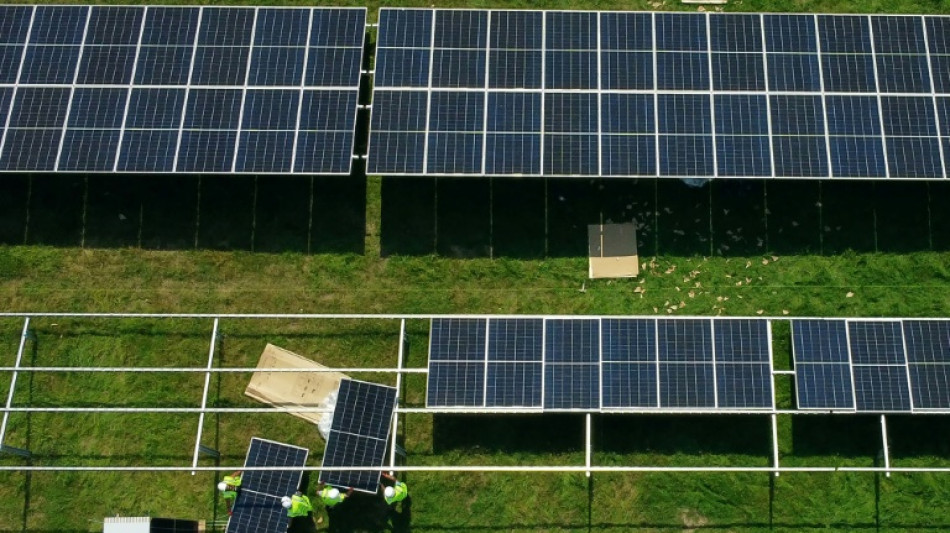
'Age of Electricity' coming as fossil fuels set to peak: IEA / Photo: Justin TALLIS - AFP/File
 High quality, low risk: record number of Japanese in Premier League

 Stocks edge higher as oil drops on fresh Mideast hopes

 Pakistan's girls fight for their place in the boxing ring

 Five things to know about Anthropic ahead of Wall Street debut

 Social media use on the rise among Australian under-16s after ban: data

 Instagram chief admits touting teen safety tool while omitting it was barely used

 'Final Fantasy', 'The Witcher' in spotlight at Europe gaming bash
 Syrian Kurdish leader dissolves force that spearheaded jihadist fight

 Trump raises prospect of demolishing iconic Kennedy Center

 PGA Tour to end in two-week matchplay showdown from 2028: CEO

 United States of Dolly: how a country queen bridged America's divide

 PGA chief says 'no current plans' for LIV stars to return

 Golf giant Callaway apologizes after ad sparks outcry

 Ioane stars as New Zealand recover to beat Johannesburg Lions

 Ukrainians seeking beauty in a bomb-scarred city

 Dolly Parton: Country music's dolled up but deserving queen

 US robotaxi firm Waymo plans to launch in Germany

 'Here to win': Xavi vows to restore pride in Dutch football

 Cameroon's Baleba joins as Man United boost midfield options
 'Shocking' book about Putin's private life wins French literary prize
 Pogacar storms to Vuelta a Espana stage four solo triumph

 Canada unveils counter-tariffs of 15-50% on US goods

 Volkswagen boss braces German workers for more job cuts

 Olympic champion Brignone to undergo new knee operation

 The summer climate change became scorching reality for Europe
More than half of the world's electricity will be generated by low-emission sources before 2030 but the deployment of clean energy is "far from uniform" across the globe, the International Energy Agency said Wednesday.
Demand for oil, gas and coal is still projected to peak by the end of the decade, possibly creating a surplus of fossil fuels, the IEA said in its annual World Energy Outlook.
"In energy history, we've witnessed the Age of Coal and the Age of Oil," said IEA Executive Director Fatih Birol.
"We're now moving at speed into the Age of Electricity, which will define the global energy system going forward and increasingly be based on clean sources of electricity," he said.
The report said clean energy "is entering the energy system at an unprecedented rate" with 560 gigawatts (GW) of renewables capacity added in 2023.
Almost $2 trillion in investments are flowing into clean energy projects each year, nearly double the amount spent on fossil fuel supplies, according to the Paris-based agency.
"Together with nuclear power, which is the subject of renewed interest in many countries, low-emissions sources are set to generate more than half of the world's electricity before 2030," it said.
- 'Growing momentum' -
But the IEA noted that the deployment of clean energy "is far from uniform across technologies and countries".
The growing thirst for electricity is driven by industry, electric vehicles, air conditioning and data centres linked to the surge of artificial intelligence.
Despite the "growing momentum behind clean energy transitions", the IEA said the world was "still a long way from a trajectory aligned" with its goal of becoming carbon neutral by 2050.
The net-zero emissions target is crucial to meet the Paris Agreement goal of limiting global warming to 1.5 degrees Celsius from pre-industrial levels.
The IEA report comes a month before Azerbaijan hosts the UN's annual climate conference, COP29, in Baku, from November 11 to November 22.
At COP28 in Dubai last year, nations pledged to triple renewable energy capacity by 2030. They also vowed to transition away from fossil fuels.
The IEA said renewable power generation capacity is set to rise from 4,250 GW today to nearly 10,000 GW in 2030 as costs for most clean technologies are falling.
While it falls short of the COP28 tripling target, it is "more than enough" to cover the growth in global electricity demand and "push coal-fired generation into decline".
China accounted for 60 percent of the new renewable capacity added in the world last year.
By the early 2030s, the country's solar power generation will exceed the total electricity demand of the United States today, the report found.
In many developing countries, however, "policy uncertainty and a high cost of capital are holding back clean energy projects".
- 'Insatiable' demand -
Global carbon dioxide emissions are set to peak "imminently" but today's policies still leave the world on a path towards having a rise of 2.4C in average temperatures by 2100, the IEA warned.
"2024 showed that electricity demand is insatiable," said Dave Jones, global insights programme director at Ember, an energy think tank.
"That means global coal generation would fall less quickly than previously expected. This means the world is not yet transitioning away from fossil fuels and reducing CO2 emissions in the energy sector," he added.
Despite a record deployment of clean energy, two-thirds of the increase in global energy demand was met by fossil fuels last year, the IEA said.
Energy-related CO2 emissions hit another record high last year.
"Renewable growth is creating an energy abundance, but this will only translate into a substantive fall in CO2 emissions if there is simultaneously a strong focus on using energy as wastelessly as possible," Jones said.
Y.Aukaiv--AMWN