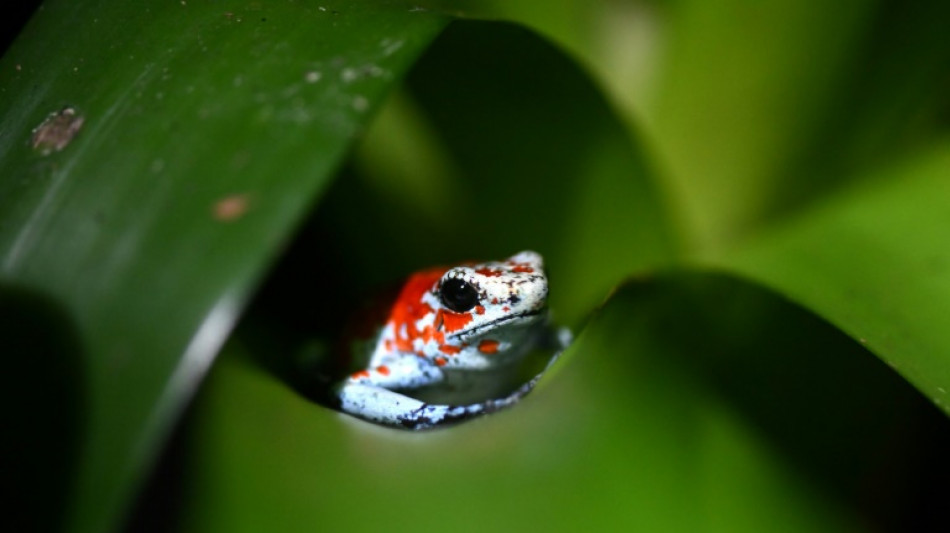
Countries under pressure to fork out for nature at UN conference / Photo: Raul ARBOLEDA - AFP
 High quality, low risk: record number of Japanese in Premier League

 Stocks edge higher as oil drops on fresh Mideast hopes
 Pakistan's girls fight for their place in the boxing ring
 Five things to know about Anthropic ahead of Wall Street debut
 Social media use on the rise among Australian under-16s after ban: data

 Instagram chief admits touting teen safety tool while omitting it was barely used

 'Final Fantasy', 'The Witcher' in spotlight at Europe gaming bash
 Syrian Kurdish leader dissolves force that spearheaded jihadist fight

 Trump raises prospect of demolishing iconic Kennedy Center

 PGA Tour to end in two-week matchplay showdown from 2028: CEO

 United States of Dolly: how a country queen bridged America's divide

 PGA chief says 'no current plans' for LIV stars to return

 Golf giant Callaway apologizes after ad sparks outcry

 Ioane stars as New Zealand recover to beat Johannesburg Lions

 Ukrainians seeking beauty in a bomb-scarred city

 Dolly Parton: Country music's dolled up but deserving queen

 US robotaxi firm Waymo plans to launch in Germany

 'Here to win': Xavi vows to restore pride in Dutch football

 Cameroon's Baleba joins as Man United boost midfield options
 'Shocking' book about Putin's private life wins French literary prize

 Pogacar storms to Vuelta a Espana stage four solo triumph

 Canada unveils counter-tariffs of 15-50% on US goods

 Volkswagen boss braces German workers for more job cuts
 Olympic champion Brignone to undergo new knee operation

 The summer climate change became scorching reality for Europe
Thousands of delegates from around the world are descending on Colombia for a summit on halting humankind's rapacious destruction of nature, with host city Cali on high alert after threats from guerrilla groups.
The high-stakes UN biodiversity gathering is set to start Monday under the protection of some 11,000 Colombian police and soldiers, aided by UN and US security personnel.
About 12,000 delegates including 140 government ministers and seven heads of state are due to attend the world's biggest nature protection conference, held every two years.
The 16th Conference of the Parties (COP16) to the UN's Convention on Biological Diversity (CBD) will run to November 1.
Themed "Peace with Nature," it has the urgent task of coming up with monitoring and funding mechanisms to ensure that 23 UN targets agreed in 2022 to "halt and reverse" species destruction can be met by 2030.
Colombia's EMC left-wing guerrilla group has cast a shadow over the event by warning foreign delegations to stay away.
The group issued the threat after being targeted by military raids in the southwest Cauca department, where the group is accused of engaging in drug trafficking and illegal mining.
Cali is the closest big city to EMC-controlled territory.
President Gustavo Petro has insisted security for the COP16 is "guaranteed," and Cali's mayor Alejandro Eder also has assured that the city is "ready" for the event.
- Natural system 'in peril' -
The delegates have their work cut out for them.
There are just five years left to achieve the UN goal of placing 30 percent of land and sea areas under protection by 2030.
So far, only 29 of 196 countries signed up to the UN biodiversity convention have submitted national strategies by the COP16 deadline, and funding is falling far short.
A report Thursday by a group of non-governmental organizations revealed that just 2.8 percent of the world's oceans were protected "effectively." At current rates, the figure would not reach 10 percent by 2030.
The IPBES inter-governmental science and policy body says three-quarters of Earth's land surface has been significantly altered since 1970 and 66 percent of oceans degraded.
According to the International Union for Conservation of Nature (IUCN), which keeps a red list of threatened animals and plants, more than a quarter of assessed species are threatened with extinction.
"Our system is in peril," WWF's senior director of global policy and advocacy, Lin Li, told AFP ahead of the talks.
"The system that is... supporting us as a human species, which is the natural system, ecological systems, are being attacked."
To try to reverse the trend, the so-called Kunming-Montreal Global Biodiversity Framework adopted in 2022 lists 23 ambitious targets for 2030.
They include restoring 30 percent of degraded ecosystems, stopping destructive farm subsidies, reducing pesticide use and tackling invasive species.
COP16 will assess progress made towards the targets, which also include rich countries forking out $20 billion per year by 2025, rising to $30 billion by 2030, to help the developing world -- which hosts most of the world's biodiversity -- save its ecosystems.
"We are hoping to hear a lot more pledges at this COP," IUCN senior program manager for conservation action Dao Nguyen told AFP.
"If there are none, it's going to be quite a deflated COP."
A key goal of the meeting is to agree on a mechanism for sharing the profits and other benefits of genetic information taken from plants and animals, for medicine for example, with the communities they come from.
Host Colombia is one of the most biodiverse in the world, and Petro has made environmental protection a priority.
But the country has struggled to extricate itself from six decades of armed conflict between leftist guerrillas such as the EMC, right-wing paramilitaries, drug gangs, and the state.
A.Rodriguezv--AMWN