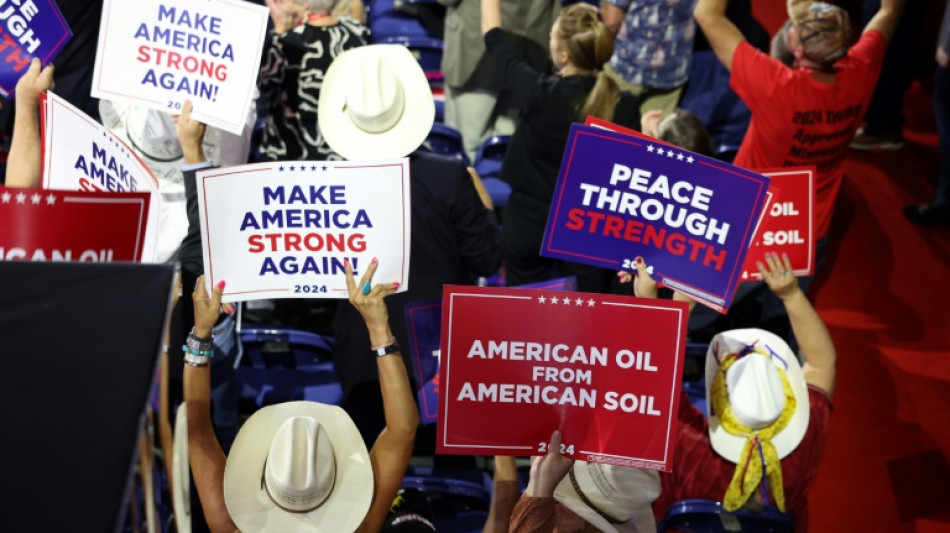
'Drill, baby, drill': Trump policy poses risks, opportunities for oil industry / Photo: SCOTT OLSON - GETTY IMAGES NORTH AMERICA/AFP/File
 Trump Signals Willingness to Work With Democrats After Midterm Defeat

 Qatar media bodies discuss support for humanitarian initiatives

 RSI Welcomes The Orange County Comptroller's Office as Its Newest Government Premier Partner

 Galloway accuser could not foresee publishing-sector fallout, lawyer argues

 New York City Center revives In the Heights as a timely community story

 Vessel operator seeks witnesses after Vancouver grounding

 US Air Force deploys F-16 fighters to remote Aleutian base for readiness drill

 Bezos grant helps Seattle nonprofit move thousands of families toward housing

 Shrini Srivastava joins crew of Varanasi-Delhi Vande Bharat Sleeper service

 Nearly Half of Australian Workers Overqualified, Survey Finds

 RBI eases export-declaration compliance for individual service exporters
 India proposes more import entry points for drugs and medical devices

 Derek Tierney Outlines Ten-Year Strategy for National Digital Health System

 NBC’s Steve Kornacki Reveals Tech Habits Ahead of Midterm Elections
 India and Israel oppose UN draft on regional conventional arms control

 BLS Polymers shares open 65.3% above IPO price

 Capital-markets shares rally as Motilal Oswal and Angel One lead gains

 Latino Voters Defy ICE Fears, Turn Out in Record Numbers for Midterms

 ITC shares rise as analysts anticipate gradual cigarette-business recovery

 Reliance rally puts historical one-year return pattern in focus

 Kuwait edges Oman 1-0 in veterans Gulf Cup in Doha

Donald Trump's election as US president brings back a champion of the oil industry to the White House, but experts warn that his push for low prices could be at odds with petroleum companies' priorities.
On the campaign trail, Trump repeatedly said he would "unleash" the US oil sector by boosting production and curbing the move towards renewable energy pushed by outgoing president Joe Biden.
"We will have an administration that will work with the US oil and gas industry and not disparage them by calling them war profiteers or price gougers like they were called by Biden," said Andy Lipow of Lipow Oil Associates.
"I will lower the cost of energy," Trump said at the Republican National Convention. "We will drill, baby, drill."
The president-elect's vow to press for aggressive oil and gas development is, however, something experts say is not the main priority of a sector that has been criticized in the past for not carefully investing capital.
"Producers have plenty of acreage they're sitting on that they could be drilling, and some of it they're drilling, but they're also trying to placate their shareholders," said Stewart Glickman of CFRA Research. "And the shareholders want dividends and buybacks just as much as they want volume growth."
A significant increase in output -- already at record highs -- risks glutting the market depending on how medium-term demand evolves in places like China, where the economic outlook is uncertain.
"The problem is the capital markets," said Bill O'Grady of Confluence Investment Management. "Investors don't want them to do that (raise production) because they want to get paid."
Higher output could add to downward pressure on oil prices at a time when the strong dollar is also expected to weigh on the commodity.
- Pressure to produce -
US oil output began heading significantly higher in the 2010s with the emergence of shale production, but the domestic industry has faced obstacles along the way.
With shale booming, Saudi Arabia opened the spigots enough to send crude prices down to $26 a barrel in 2016.
That tumble in prices reverberated through the oil industry, leading to multiple bankruptcies.
Darren Woods, chief executive of ExxonMobil, said last week that industry investment is more influenced by its drive for profitability than regulatory questions.
"I don't think the level of production in the US is being constrained by external restrictions," Woods said. "I think it is being driven by the internal discipline of the industry."
Glickman expressed skepticism that Trump would alter the industry's approach to investment, which is to only boost drilling when higher oil prices call for it.
But O'Grady said the administration will push to bring crude prices lower, perhaps to between $50 to $60 a barrel, leading to lower gasoline prices.
"I suspect they're going to figure out a way to get what they want and produce more and bring down the price," O'Grady said. "The industry doesn't necessarily want that, but they may not have a whole lot of choice."
Another source of unease in the sector is Trump's confrontational approach on trade, which could lead to higher tariffs, particularly on items from China.
Tariff hikes discussed by the president-elect "would likely trigger slower economic growth both in the US and globally, reducing demand for liquid fuels, driving down oil prices, and ultimately affecting the refining industry," said Wood Mackenzie, an energy data analytics company.
The industry does, however, stand poised to benefit from Trump's expected retreat from energy transition investments favored by the Biden administration.
"There is a case to be made for oil prices going higher" over the medium term, according to Glickman.
O.M.Souza--AMWN