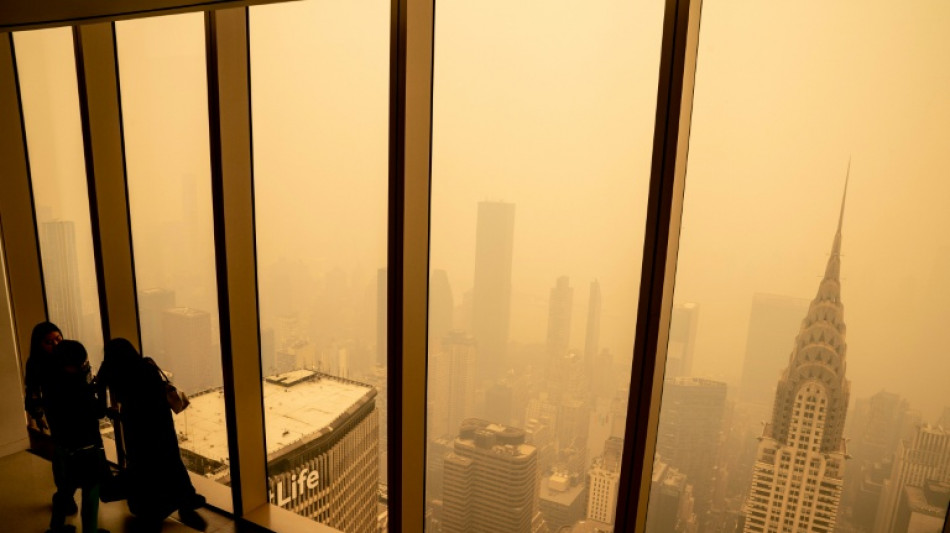
Wildfire smoke kills more than 24,000 Americans a year: study / Photo: David Dee Delgado - GETTY IMAGES NORTH AMERICA/AFP/File
 Lanier clinches badminton world title in France's golden double

 After Wildberries, Ukraine launches drone campaign on Russia's Ozon

 Padikkal, Gill half-centuries take India to 187-3 at tea

 Cummins hails 'sharp' Australia as they get back to winning ways
 Bangladesh eye more Australia Tests to hit next level

 Thousands expected at Sweden climate demo as election looms

 Starc heroics put Australia on brink of victory over Bangladesh

 Austrian mountain town finds niche in AI boom

 Messi scores but Miami slump continues with loss to Toronto

 Sydney marathon unveils medal with wrong stadium

 Macron hosts Saudi's MBS for visit ranging from esports to Mideast

 Australia in control with 146-run first innings lead over Bangladesh

 World No. 3 Pegula beats defending champ Swiatek to reach Cincy final

 Wyndham Clark surges clear at BMW Championship

 Maresca says Man City must fill Rodri void after Barca switch

 Canada retaliates as trade war with US escalates

 Fils dominates Cobolli to book Cincinnati final

 Spurs lacked fight in dismal defeat at Brentford says De Zerbi

 Inter thrash Monza to launch Serie A title defence

 Shambolic Spurs battered by Brentford

 Pogacar wins Vuelta a Espana opening stage

 Clinical New Zealand shock wasteful South Africa in first Test

 Canada hits back with new tariffs after trade talks with US fail

 Swedish police identify 17-year-old girl as victim in school sword attack

 Carrick keeps calm despite Man Utd misery, Sage beaten in first game as Palace boss

Wildfires are growing larger, lasting longer and happening more often as the climate warms -- but the toll from their toxic smoke, especially from long-term exposure, remains poorly understood.
A study published Wednesday in the journal Science Advances estimates that wildfire smoke caused about 24,100 deaths a year across the contiguous United States between 2006 and 2020, a figure the authors say underscores the need for urgent policy shifts.
"That's a big number," lead author Min Zhang, a postdoctoral researcher at Mount Sinai's Icahn School of Medicine in New York, told AFP. "We found no evidence of a safe threshold for the chronic exposure to wildfire smoke...that's a very concerning public health problem.
The findings come as President Donald Trump's government has turned its back on global efforts to tackle human-caused warming -- boosting instead the fossil fuel industry that is its main driver.
"They know what to do to, you know, fight against climate change: you need to promote cleaner energy, electric cars, more funding to do research," senior author Yaguang Wei, an assistant professor at Mount Sinai's Icahn School of Medicine in New York, told AFP.
But on a more granular level, he added, local governments need to develop early warning systems that anticipate the arrival of dangerous pollutants and deploy portable filters in homes, offices, schools and hospitals.
Canada's record-breaking 2023 wildfires exposed hundreds of millions of people downwind to toxic fumes, yet local authorities have still failed to develop advanced response plans.
- Satellite data and death records -
To conduct their analysis, the researchers had to devise a method to isolate the cumulative effects of fine particulate matter from wildfire smoke -- known to contain carcinogenic volatile organic compounds and heavy metals.
While the acute impacts of smoke are easier to trace -- including inhalation injuries, hospitalizations and deaths -- attributing cause becomes far more challenging when toxins linger in the body and later trigger respiratory illness, cardiovascular disease or neurological damage.
The team analyzed annual mortality data from 3,068 counties across the mainland United States, excluding Alaska and Hawaii, and linked it with satellite imagery.
Statistical techniques were used to rule out other factors that could explain changes in death rates. To boost confidence in their findings, the researchers examined "negative control" outcomes -- such as deaths from car accidents or falls, which should not be influenced by wildfire pollution -- and found no corresponding increase.
- Brain most vulnerable -
The result was a clear rise in all-cause mortality, with neurological diseases such as dementia and Parkinson's showing the strongest association, followed by circulatory system illness, endocrine diseases and cancers.
"Usually people look at the cardiovascular respiratory disease from the wildfire smoke, however, we found that the neurological disorder is more affected," said Wei. "It seems like our brain is the most vulnerable part."
Effects were more pronounced in rural areas, which may be closer to wildfire sources. Younger people were more impacted, perhaps because they spend more time outdoors. Lower temperatures were also linked to increased deaths. People go outside more in cool summers, while cool winters prevent smoke dissipation, wrote the authors.
The figure of 24,100 deaths per year is more than double a previous estimate of 11,415 deaths published in the Proceedings of the National Academy of Sciences in 2024.
But according to Wei, the new number is still likely an underestimate simply because analysis at the level of counties doesn't offer the kind of precision that a zip code or block-by-block investigation would.
He's now looking at more studies that tease out the health impacts of wildfires from different sources, because the chemical mixtures vary greatly from forest to forest.
A.Malone--AMWN