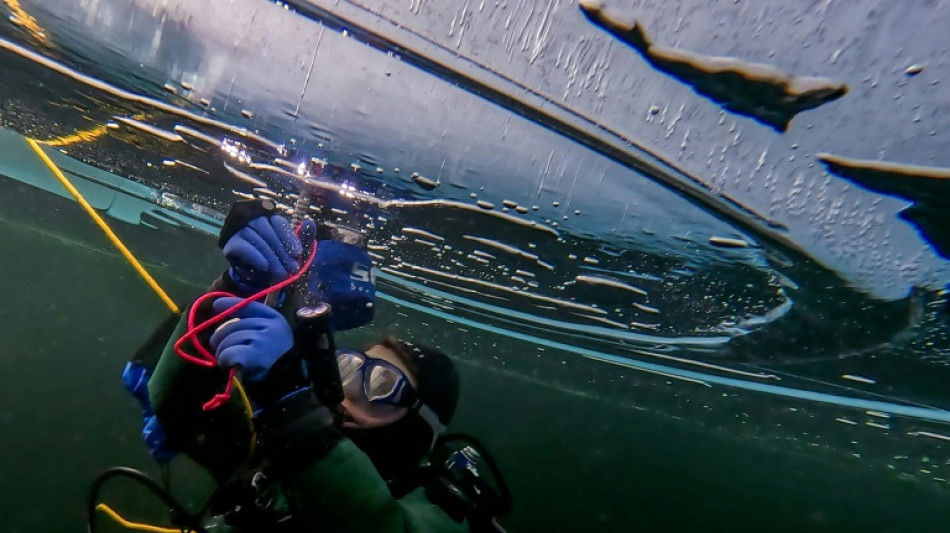
In Finland, divers learn to explore icy polar waters / Photo: -STR - AFP
 Padikkal, Gill half-centuries take India to 187-3 at tea

 Cummins hails 'sharp' Australia as they get back to winning ways
 Bangladesh eye more Australia Tests to hit next level

 Thousands expected at Sweden climate demo as election looms

 Starc heroics put Australia on brink of victory over Bangladesh

 Austrian mountain town finds niche in AI boom

 Messi scores but Miami slump continues with loss to Toronto

 Sydney marathon unveils medal with wrong stadium

 Macron hosts Saudi's MBS for visit ranging from esports to Mideast
 Australia in control with 146-run first innings lead over Bangladesh

 World No. 3 Pegula beats defending champ Swiatek to reach Cincy final

 Wyndham Clark surges clear at BMW Championship

 Maresca says Man City must fill Rodri void after Barca switch

 Canada retaliates as trade war with US escalates

 Fils dominates Cobolli to book Cincinnati final

 Spurs lacked fight in dismal defeat at Brentford says De Zerbi

 Inter thrash Monza to launch Serie A title defence

 Shambolic Spurs battered by Brentford

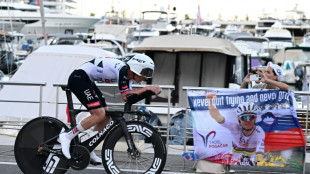 Pogacar wins Vuelta a Espana opening stage

 Clinical New Zealand shock wasteful South Africa in first Test

 Canada hits back with new tariffs after trade talks with US fail

 Swedish police identify 17-year-old girl as victim in school sword attack

 Carrick keeps calm despite Man Utd misery, Sage beaten in first game as Palace boss

 France to deliver interceptor missiles to Ukraine after new Russian strikes

 Serena Williams and Alcaraz unite in US Open mixed doubles

In a square hole carved out of the thick ice, two divers vanished into the depths of an Arctic lake, leaving nothing but bubbles at the surface.
Returning 45 minutes later, Marta Lukasik tapped her fist on the top of her head -- a diver's signal that means "I'm ok".
On the frozen Lake Kilpisjarvi, just below the tree line at the intersection of the Finnish, Swedish and Norwegian borders, 12 divers were taking a course to learn how to dive in polar regions so they could carry out scientific research.
"Just wow, every small thing you see in the water... Just wow," said Lukasik, a 41-year-old oceanology PhD student who works as a diving inspector on fish farms in Norway, mesmerised by the experience.
For 10 days, the international group from different professions and backgrounds learnt vital skills below the 80 centimetres (30 inches) of ice covering the lake.
According to Erik Wurz, coordinator of the programme run by the Finnish Scientific Diving Academy which is part of the University of Helsinki, there is a critical need for skilled people who can conduct research in demanding polar environments.
Climate change is warming and transforming the Arctic and Antarctic at a faster rate than the rest of the planet.
"There's still a lot of questions to be covered in the polar regions and access is very limited," said Wurz, stood next to two large holes cut into the ice and a pitched wind shelter.
"The number of scientific divers that can go under the ice is even more limited," he added, estimating there to be only around 100 to 200 people globally.
- Teamwork -
Wearing dry suits to fend off the 2 degrees Celsius cold in the water, the divers arrived on snowmobiles at the site, located close to the University of Helsinki's biological station at the foot of the Saana mountains.
Ruari Buijs, 21, checked his course mates at the "base Alpha" hole to make sure they were ready to dive, before helping them slide into the water with steel gas cylinders on their backs and torches attached to their arms.
"I think the most important thing is definitely teamwork," noted Buijs, who studied marine biology and oceanography at the University of Plymouth in Britain, as the divers disappeared.
"For instance... if there's low visibility, there's always a line back," he said, indicating a yellow, 50-metre (165-foot) safety line in his hand, the other end tethered to the diver underwater.
A light attached to a steel tank flickered in the clear water -- a sign post for the divers if they become disoriented.
With only two holes for entry and exit, the biggest challenge for the divers was "the overhead environment they are getting into", Wurz said.
"They are going into an ice cave."
- 'Critical point' -
The day's task was to practice drilling a sample of the ice sheet, so-called "ice coring", explained Caroline Chen, 23 -- a Canadian trained scientific diver and research assistant at the University of Hamburg.
"Sometimes you bump your head, I'm still getting used to this," she said.
In this "safe setting", the divers were training to be "confident when they are deployed to Antarctica" or any polar expedition where they would not have the luxury of warm buildings and showers nearby, Wurz said.
Have finished the course, Wurz joined an expedition to the Antarctic research station Scott base, 1,350 kilometres (840 miles) from the South Pole.
"We are at a really critical point in time because the polar regions are changing very fast," Wurz said.
"There are huge areas of shelf ice breaking off...that has not happened before at such a fast rate," he added.
An AFP review of US data showed in March that Arctic sea ice is headed for one of its smallest winter peaks on record due to human-induced warming.
"We need to get samples and reliable data from these regions because they are the fastest changing on the planet in the warming ocean," Wurz said.
Still beaming after her dive, Lukasik described how the sun piercing through layers of snow and ice had created rays in the water.
"You need to be a little crazy to go into that environment," Buijs said with a smile.
"I think it's the second most hostile environment known to man, apart from the vacuum of space," he said, adding that he hopes to work as a marine biologist on the islands around Antarctica.
"It's like a whole new world, and I would love to explore that."
S.F.Warren--AMWN