Troubled waters: Jakarta battles deadly, invasive suckerfish / Photo: BAY ISMOYO - AFP
 Cummins hails 'sharp' Australia as they get back to winning ways
 Bangladesh eye more Australia Tests to hit next level

 Thousands expected at Sweden climate demo as election looms

 Starc heroics put Australia on brink of victory over Bangladesh

 Austrian mountain town finds niche in AI boom

 Messi scores but Miami slump continues with loss to Toronto

 Sydney marathon unveils medal with wrong stadium

 Macron hosts Saudi's MBS for visit ranging from esports to Mideast
 Australia in control with 146-run first innings lead over Bangladesh

 World No. 3 Pegula beats defending champ Swiatek to reach Cincy final

 Wyndham Clark surges clear at BMW Championship

 Maresca says Man City must fill Rodri void after Barca switch

 Canada retaliates as trade war with US escalates

 Fils dominates Cobolli to book Cincinnati final

 Spurs lacked fight in dismal defeat at Brentford says De Zerbi

 Inter thrash Monza to launch Serie A title defence

 Shambolic Spurs battered by Brentford

 Pogacar wins Vuelta a Espana opening stage

 Clinical New Zealand shock wasteful South Africa in first Test

 Canada hits back with new tariffs after trade talks with US fail

 Swedish police identify 17-year-old girl as victim in school sword attack
 Carrick keeps calm despite Man Utd misery, Sage beaten in first game as Palace boss

 France to deliver interceptor missiles to Ukraine after new Russian strikes

 Serena Williams and Alcaraz unite in US Open mixed doubles

 Macron pledges air defence as 13 killed in Russia, Ukraine strikes

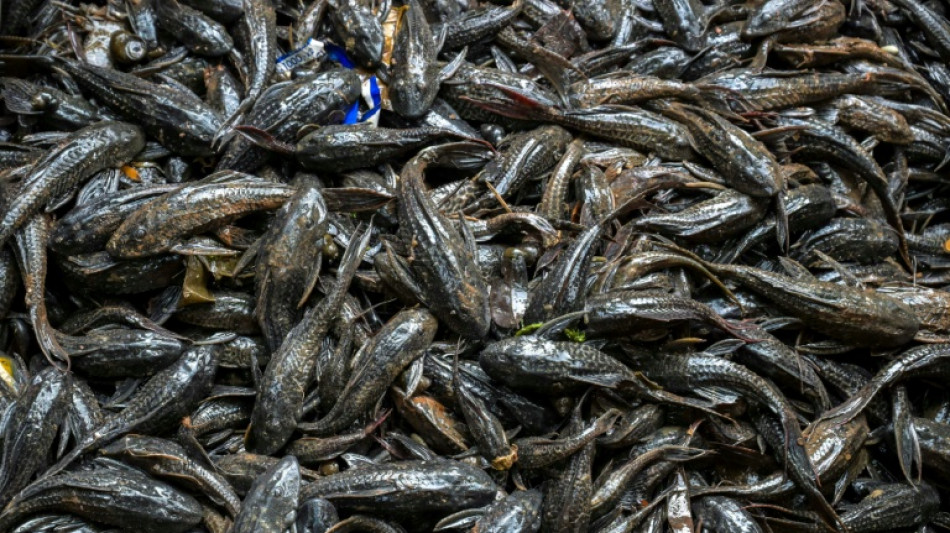
Mounds of slimey carcasses pile up on a riverbank in Jakarta where authorities are fighting an uphill battle against a fast-breeding invasive fish flourishing in Java island's heavily polluted waterways.
The sapu-sapu, a sucking fish introduced from South America decades ago to keep Southeast Asian aquariums algae-free, has made a home in Javan rivers, many after being thrown out for outgrowing their tanks.
Unlike in the Amazon River where it has natural predators, the sapu-sapu quickly took over in Java, outbreeding indigenous freshwater fish, eating their eggs and outcompeting them for food.
Residents and campaigners have complained about the stinky, unsightly pileups of fishy remains, and the potential health risk for those who consume snacks made from polluted sapu-sapu stock.
Invasive species are spreading ever faster across the globe and cost well over $400 billion a year in damages and lost income, according to a 2023 United Nations assessment.
Surprisingly adept at living in polluted water, the sapu-sapu -- also known as suckermouth catfish, janitor fish or pleco -- can grow to half a metre (20 inches) in length and a female can lay thousands of eggs every year.
"That there are thousands of (sapu-sapu) fish in some of these river bodies, where, you know, the rivers are like dark black, almost smelling like rotten eggs... is completely crazy," clean river campaigner Gary Bencheghib told AFP.
Killing sapu-sapu is not addressing the real problem, he added in a phone interview, nearly halfway through a 1,200-kilometre (746-mile) run from Bali to Jakarta to raise money for river cleanups and having witnessed the crisis at several stops along the way.
The real solution is cleaning up "the waste it lives off... that you find in these polluted waters," said Bencheghib, co-founder of the Sungai Watch NGO.
- 'A dangerous snack' -
More than half of Indonesia's rivers are heavily polluted, and two of the country's major river systems are among the dirtiest in the world, according to data from the UN Environment Programme.
Nationwide, only about 7.4 percent of municipal wastewater is safely collected and treated.
Greater Jakarta, a water-stressed metropolis of 42 million people, is particularly affected.
But sapu-sapu are able to live in oxygen-poor and polluted waters, digging holes into riverbanks to lay their eggs and weakening walls that have been known to collapse as a result.
In recent weeks, Jakarta has embarked on a killing campaign involving residents, sanitation workers, fisheries ministry workers and even soldiers.
In two weeks, about 5.3 tonnes of the fish have been removed from rivers in South Jakarta alone, mayor Muhammad Anwar told AFP while overseeing an operation at Babakan Lake this week.
The sapu-sapu are caught in nets, separated from indigenous fish that are thrown back, then decapitated to make sure they are dead, and buried in mass graves.
Some activists have criticised the procedure as wasteful, arguing the skin could be used for fish leather products and the rest processed into fertiliser or animal feed.
But others say the fish are too contaminated to be useful, and definitely not fit for human consumption.
"It contains... heavy metals and is dangerous to humans," Anwar said.
Tests conducted for scientific studies have found traces of lead and mercury as well as E.coli bacteria beyond safe levels in sapu-sapu.
"In some places, it is consumed as a dangerous snack called siomay (steamed fish dumpling) and pempek (fish cakes)," the mayor said.
"Please be careful when buying fish cakes. Don't be led by the (cheap) price."
J.Williams--AMWN