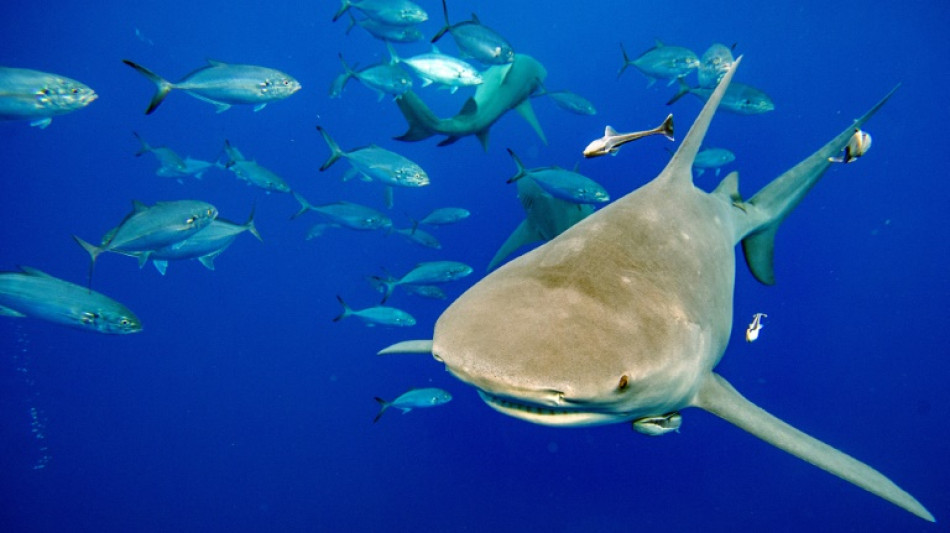
Wildlife summit to vote on 'historic' shark protections / Photo: Joseph Prezioso - AFP/File
 Microsoft Updates Xbox PC App with 60% Faster Startup and Redesigned Interface

 Early Polar Vortex Disruption Creates Uncertain Winter Outlook for Pennsylvania

 Pakistan Demands Grant-Based Climate Finance at COP31 to Avoid Debt Trap

 E Pellicci Pop-Up at Selfridges Brings Back Nostalgic School Cake

 Coronation Street's Debbie Webster Steps Down as Dementia Storyline Intensifies
A summit on the international trade in endangered species will decide Thursday whether to ratify a "historic" proposal to protect sharks, a move that would drastically restrict the lucrative global shark fin trade.
The proposal would place dozens of species of the requiem shark and the hammerhead shark families on Appendix II of the Convention on International Trade in Endangered Species (CITES).
That appendix lists species that may not yet be threatened with extinction but may become so unless their trade is closely controlled.
The initiative was one of the most discussed at this year's CITES summit in Panama, with the proposal co-sponsored by the European Union and 15 countries. The meeting began on November 14, and ends on Friday.
If Thursday's plenary meeting gives the green light, "it would be a historic decision, since for the first time CITES would be handling a very large number of shark species, which would be approximately 90 percent of the market," Panamanian delegate Shirley Binder told AFP.
Shark fins -- which represent a market of about $500 million per year -- can sell for about $1,000 a kilogram in East Asia for use in shark fin soup, a delicacy.
The vote follows a hectic debate that lasted nearly three hours, with Japan and Peru seeking to reduce the number of shark species that would be protected.
"We hope that all of this will (now) be adopted in plenary," said Binder.
The plenary will also vote on ratifying a proposal to protect guitarfish, a species of ray.
- Heated debate -
Several delegations, including hosts Panama, displayed stuffed toy sharks on their tables during the earlier Committee I debate.
After the heated debate, the request to protect requiem sharks went to a vote, garnering above the needed threshold and calming the waters for the subsequent hammerhead shark debate.
Delegates and directors of conservation organizations, who are observers at the summit, are confident that both proposals will be ratified.
"We hope that nothing extraordinary happens and that these entire families of sharks are ratified for inclusion in Annex II," Chilean delegate Ricardo Saez told AFP.
- 'Extinction crisis' -
The world is currently in the middle of a major shark extinction crisis, Luke Warwick, director of shark protection for the NGO Wildlife Conservation Society (WCS), told AFP at the beginning of the summit.
During the committee debate, Japan had proposed that the trade restriction be reduced to 19 species of requiem sharks and Peru called for the blue shark to be removed from the list.
However, both suggestions were rejected.
Participants at the summit considered 52 proposals to change species protection levels.
CITES, which came into force in 1975, has set international trade rules for more than 36,000 wild species.
Its signatories include 183 countries and the European Union.
F.Dubois--AMWN