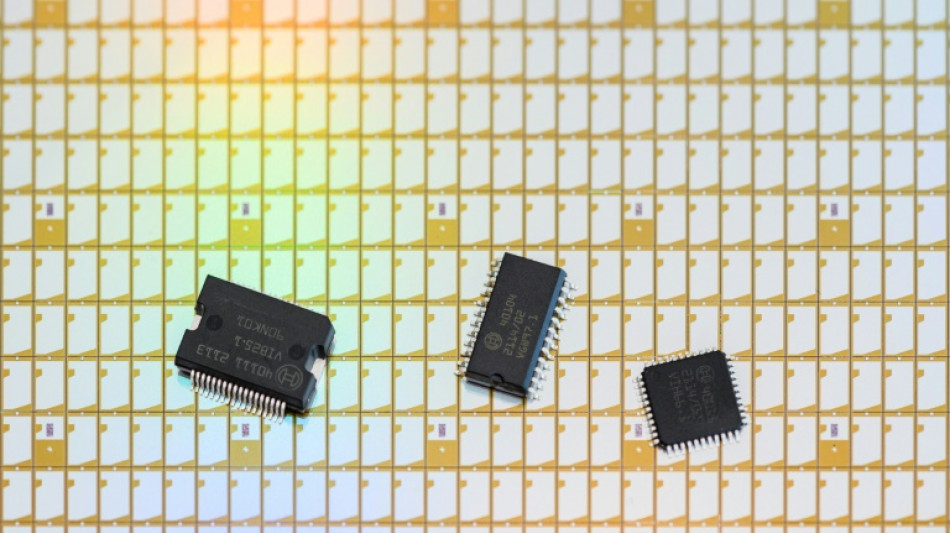
France announces massive state aid to chips factory / Photo: JENS SCHLUETER - AFP/File
 Experts Warn Social Security Crisis Looms After Decades of Congressional Inaction

 Dar Global and Trump Organization Launch $700M Luxury Resort in Qatar

 Former Iowa State Women's Basketball Players Accuse Coach Bill Fennelly of Abuse

 FlatRx Publishes a Dated Price Comparison of Compounded Tirzepatide at 27 U.S. Telehealth Programs Counted at a 10 mg Weekly Dose

 Abanico Coffee Roasters Opens Second San Francisco Location in Inner Sunset
France is ploughing 2.9 billion euros ($3.1 billion) of public money into a factory to make microchips, officials said on Monday, heating up a global race for the lucrative market.
Europe and the United States have both passed so-called Chips Acts to boost investment in the sector as fears grow that China could gain a stranglehold on global supply.
Chips, also known as semiconductors, are vital for every electronic device, from smartphones to electric cars, and control of supply chains has become a major priority for the world's biggest trading blocs.
France's economy ministry said the state aid was the biggest subsidy it had offered since 2017.
The funding would go towards a 7.5-billion-euro project announced last year to be run by European multinational STMicroelectronics and US company GlobalFoundries.
The European Chips Act has loosened the rules on state aid that usually forbid such generous outlays, as it aims to unlock 43 billion euros of investment and for the bloc to produce 20 percent of the world's chips by 2030.
Europe currently accounts for less than 10 percent of the global total, with most of the world's chips being made in Taiwan.
The French ministry said the project, in the Alpine town of Crolles near Grenoble in southeastern France, would boost European production capacity by almost six percent by 2028.
The battle to secure supplies of semiconductors was supercharged during the pandemic when lockdowns and other measures caused a supply crunch and brought industries across the world to a grinding halt.
The US Chips Act is one of several laws aimed at funnelling hundreds of billions of dollars to US firms at the expense of foreign competitors.
Beijing has denied it is seeking to seize global supply lines and has slammed the US Chips Act as "100-percent protectionism".
O.Johnson--AMWN


