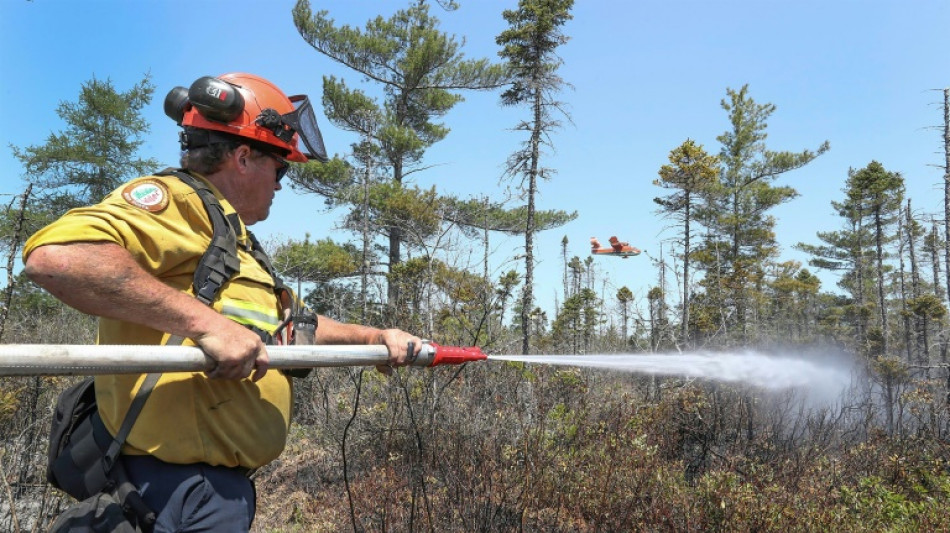
Canada braces for possible worst wildfire season ever / Photo: Handout - Nova Scotia Government/AFP/File
 Experts Warn Social Security Crisis Looms After Decades of Congressional Inaction

 Dar Global and Trump Organization Launch $700M Luxury Resort in Qatar

 Former Iowa State Women's Basketball Players Accuse Coach Bill Fennelly of Abuse

 FlatRx Publishes a Dated Price Comparison of Compounded Tirzepatide at 27 U.S. Telehealth Programs Counted at a 10 mg Weekly Dose

 Abanico Coffee Roasters Opens Second San Francisco Location in Inner Sunset
Canada is facing a dire wildfire situation through the coming months, officials warned on Monday after vast swaths of forests and grasslands from its Pacific to Atlantic coasts have been scorched.
Some 26,000 people remain displaced by fires at present, with about 120,000 having had to flee at some point over the past month.
From westernmost British Columbia to Nova Scotia on the east coast, about 3.3 million hectares (8.2 million acres) have burned so far.
"Our modeling shows that this may be an especially severe wildfire season throughout the summer," Prime Minister Justin Trudeau told a news conference.
Officials pointed to especially hot, dry conditions in recent months that are forecast to persist through August.
If the current trajectory continues, said Natural Resources Minister Jonathan Wilkinson, "it very well could be... Canada's most severe fire season ever," with fires having already burned 10 times the historic average area.
"Every province and territory will need to be on high alert throughout this wildfire season," he added.
Currently, 413 wildfires are burning across Canada, including 249 listed as out of control. And three provinces -- Alberta, Nova Scotia and Quebec -- have asked for federal assistance.
Emergency Preparedness Minister Bill Blair said the country has seen "some of the most severe (fires) ever witnessed in Canada," and should brace for "continued higher than normal fire activity."
Wilkinson said wildfire risks are likely to "increase in June and remain unusually high throughout the summer across the country. It shows us that this year's already devastating season could well get worse."
Canada has been hit repeatedly by extreme weather in recent years, the intensity and frequency of which have increased due to global warming.
After major flareups in the west of the country in May, notably in the prairie provinces of Alberta and Saskatchewan, firefighting shifted in recent weeks to Nova Scotia in the east, and more recently to Quebec.
A fire that threatened suburbs of Halifax, the largest city in Nova Scotia, was contained over the weekend with rains and cooler weather helping firefighting efforts. Some evacuated residents were allowed to return home.
In Quebec, the tiny town of Clova was abandoned in the face of advancing blazes, forcing its three dozen inhabitants to flee. About 10,000 residents of Sept Iles also remain under an evacuation order.
With resources increasingly strained, Ottawa has sent in the military to help in hotspots.
About 1,000 firefighters from Australia, France, Mexico, New Zealand, South Africa and the United States also arrived or were en route to bolster firefighting efforts.
S.F.Warren--AMWN


