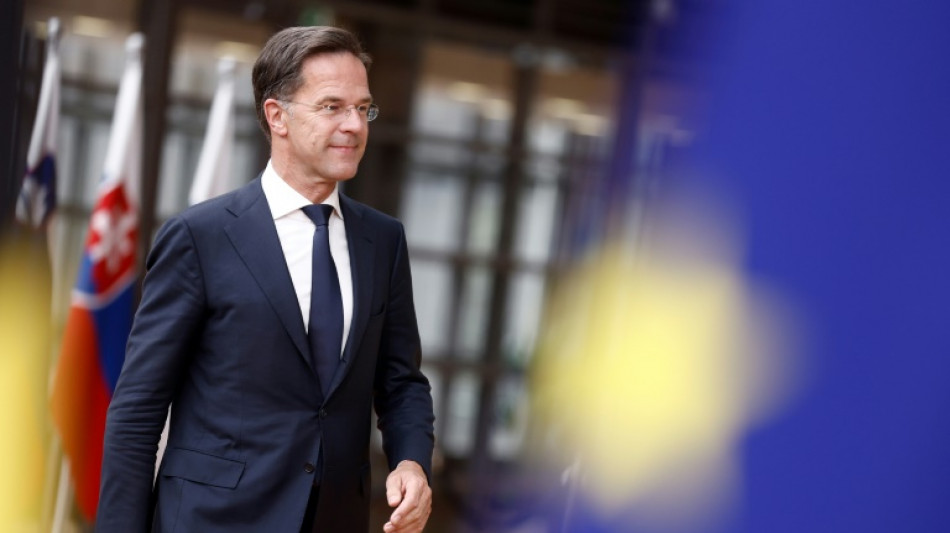
Dutch government collapses over migration row: media / Photo: KENZO TRIBOUILLARD - AFP
 Eastside Jazz Festival Returns to Birmingham for Three-Day Event in February 2027

 Experts Warn Social Security Crisis Looms After Decades of Congressional Inaction

 Dar Global and Trump Organization Launch $700M Luxury Resort in Qatar

 Former Iowa State Women's Basketball Players Accuse Coach Bill Fennelly of Abuse

 New to The Street Show #781 Premieres Tonight on Bloomberg Television with Roadzen, Robo.ai, PureCipher and American Fusion

 How Families Budget for Youth Sports Travel Seasons

Dutch Prime Minister Mark Rutte's coalition government collapsed after just a year and a half in office on Friday in a row over measures to curb the flow of migrants, local media said.
Rutte, the Netherlands' longest-serving leader, presided over crisis talks between the four coalition partners but failed to reach a deal, broadcasters NOS and RTL and the Dutch news agency ANP reported.
There was no immediate statement from Rutte or members of the coalition. They did not immediately leave the venue for the talks in The Hague to speak to waiting media, an AFP reporter said.
Rutte, 56, the leader of the centre-right VVD party, had wanted to tighten curbs on reuniting families of asylum seekers, following a scandal last year about overcrowded migration centres in the Netherlands.
He demanded that the number of relatives of war refugees allowed into the Netherlands be capped at 200 per month, and threatened to topple the government if the measure did not pass, Dutch media said.
But the Christen Unie -- a Christian Democratic party that draws its main support from the staunchly Protestant "Bible Belt" in the central Netherlands -- strongly opposed the plan.
The four parties held crisis talks on Wednesday and late into the night on Thursday in a bid to save the shaky government, which only took office in January 2022.
- 'Teflon' Rutte -
But a compromise -- a so-called "emergency button" that would have only triggered the restrictions in case of large migrant numbers -- was not enough to reach a deal in last-ditch talks on Friday.
Local media said Rutte -- dubbed "Teflon Mark" for his political slipperiness -- had taken a tough stance on migration to deflect a challenge from the right-wing of his party.
Rutte has long been under pressure on the issue of migration due to the strength of far-right parties in the Netherlands, including that of anti-Islam leader Geert Wilders.
Europe's second longest-serving leader after Hungarian Prime Minister Viktor Orban is now expected to call elections to seek a mandate for his fifth coalition government since 2010.
But he could be confronted with internal competition amid growing voter weariness with his long time in office, even if there are few prominent rivals.
Rutte's backroom political skills have seen him navigate his way to the top of four successive coalition governments -- but he has had several close escapes.
His previous government was forced to resign en masse in 2021 over a child benefits scandal that largely targeted ethnic minority families.
In 2017 he was widely criticised for tacking to the right ahead of elections in a bid to keep Wilders out of power as populist parties surged in the wake of the 2016 Brexit vote and election of Donald Trump.
D.Kaufman--AMWN


