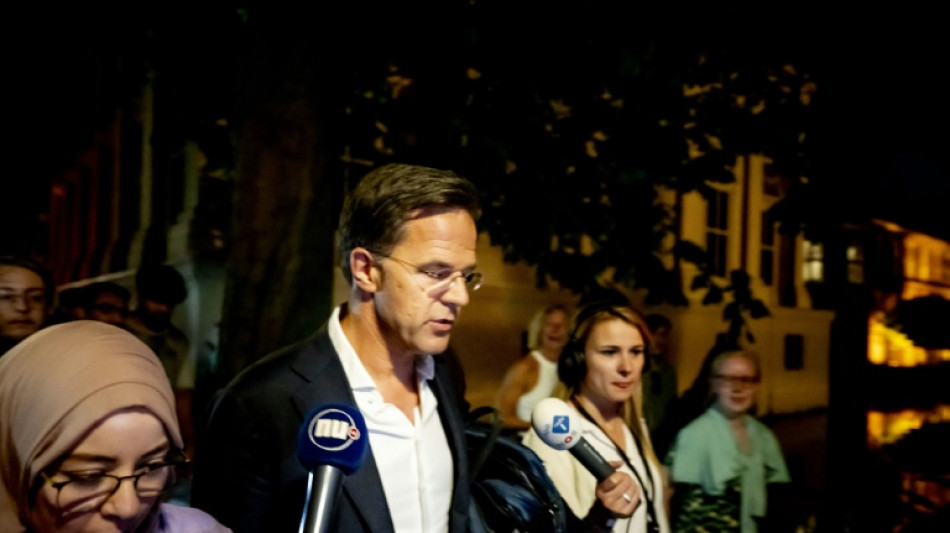
Dutch PM meets king after government falls / Photo: Robin Utrecht - ANP/AFP
 Eastside Jazz Festival Returns to Birmingham for Three-Day Event in February 2027

 Experts Warn Social Security Crisis Looms After Decades of Congressional Inaction
 Dar Global and Trump Organization Launch $700M Luxury Resort in Qatar

 Former Iowa State Women's Basketball Players Accuse Coach Bill Fennelly of Abuse

 New to The Street Show #781 Premieres Tonight on Bloomberg Television with Roadzen, Robo.ai, PureCipher and American Fusion

 How Families Budget for Youth Sports Travel Seasons
Dutch Prime Minister Mark Rutte will personally tender his resignation to the king on Saturday after his coalition government collapsed in a row over migration, triggering elections later this year.
King Willem-Alexander was out of the country on holiday when the government fell and flew back to the Netherlands to meet Rutte, who is the country's longest-serving premier and has been in power since 2010.
"I will catch up with him tomorrow and explain exactly what happened," a sombre Rutte, the leader of the centre-right VVD party, told a press conference on Friday night after the coalition toppled.
Their meeting is due at around 1100 GMT on Saturday at the royal Huis Ten Bosch palace in a forest near The Hague. Rutte is leading a caretaker government until the elections expected in mid-November.
Europe has faced rising tensions over how to deal with migration and it was the issue that finally tore apart the Netherlands' shaky coalition government, Rutte's fourth.
The four coalition parties fell out over Rutte's plans to tighten curbs on reuniting families of asylum seekers, a bid to curb numbers following a scandal last year over overcrowded migration centres.
ChristenUnie -- a Christian Democratic party that draws its main support from the staunchly Protestant "Bible Belt" in the central Netherlands -- and centre-left D66 had strongly opposed Rutte's plan.
Dutch newspapers picked over the carcass of the unstable coalition that only took office in January 2022, after a record 271 days of negotiations.
The Volkskrant daily said that the cabinet "stumbled from the starting blocks and never managed to recover".
- 'Beautiful country' -
The elections now promise to be some of the most divisive in a generation, with a toxic brew of issues including migration, angry farmers and the cost of living.
The newest challenge to Rutte's bid for a fifth term comes from an upstart farmers party that opposes EU-backed environmental rules, while the Dutch far-right remains a threat as ever.
"We can make the Netherlands a beautiful country again with fewer asylum seekers and crime, more money and houses for our own people, decent care, plenty of room for our farmers and fishermen," anti-Islam leader Geert Wilders tweeted.
The Farmer-Citizen Movement (BBB) will be seeking to repeat the success of senate elections that it won earlier this year.
Its leader Caroline van der Plas has refused to serve in a coalition with Rutte, and she didn't rule out standing to be prime minister.
Despite leading them to electoral success for nearly 13 years, Rutte's bid for an unprecedented fifth term also faces challenges from within the VVD.
If the farmer's party does well enough in the elections to demand a place in a coalition, Rutte's VVD could be tempted to ditch him to keep its place at the head of the government.
Rutte himself has said there were tensions at the party's conference in June over migration, adding on Friday that he still had the "energy" for a fifth term but needed to think it over.
Th.Berger--AMWN


