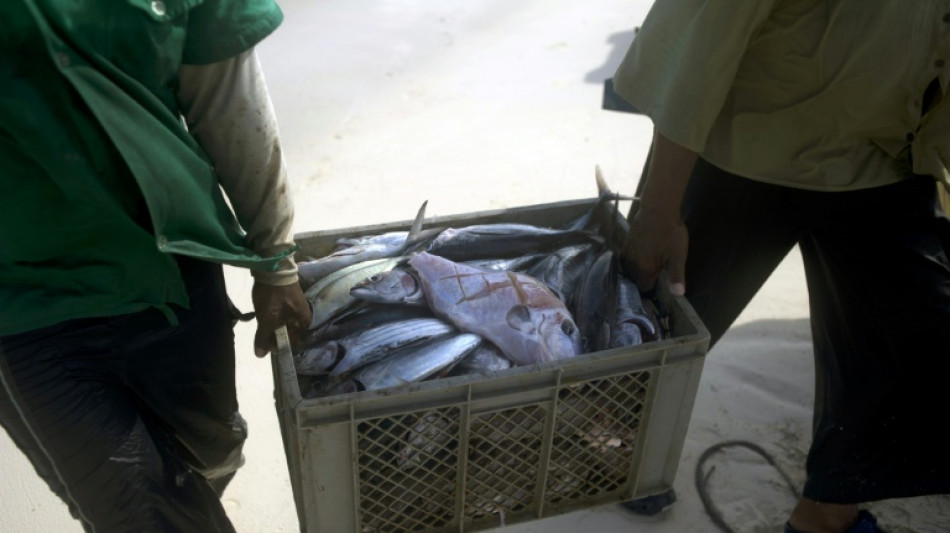
UN court rejects Nicaragua claims in Colombia sea row / Photo: Eitan Abramovich - AFP/File
 Eastside Jazz Festival Returns to Birmingham for Three-Day Event in February 2027

 Experts Warn Social Security Crisis Looms After Decades of Congressional Inaction

 Dar Global and Trump Organization Launch $700M Luxury Resort in Qatar

 Former Iowa State Women's Basketball Players Accuse Coach Bill Fennelly of Abuse

 New to The Street Show #781 Premieres Tonight on Bloomberg Television with Roadzen, Robo.ai, PureCipher and American Fusion

 How Families Budget for Youth Sports Travel Seasons

The UN's top court dismissed Nicaragua's claims against Colombia Thursday in a decades-long Latin American legal battle over an oil and fish-rich swathe of the Caribbean Sea.
The International Court of Justice (ICJ) said it "rejects" Nicaragua's arguments against an earlier 2012 ruling that gave it a large chunk of the Caribbean, while awarding seven small islands to Colombia.
Nicaragua, in Central America, went back to the Hague-based ICJ in 2013 to argue that its territory should extend beyond the 200 nautical miles (230 miles, 370 kilometres) from its coastline that is customary under international law.
It claims its territory should instead follow the continental shelf that extends under the sea from its coastline.
But Colombia disputed that, saying it overlaps with the area in which the archipelago of islands is located.
The ICJ in a related case ordered the Colombian navy in 2022 to stop interfering in Nicaraguan waters.
"In this dispute, maritime areas rich in biodiversity, fishing resources, scenic beauty, but also natural resources such as hydrocarbons are at stake," Nicolas Boeglin, professor of public international law at the University of Costa Rica, told AFP.
- 'Exorbitant' demands -
The two sides exchanged barbs in court during hearings in December last year, with Colombia accusing Nicaragua of making the most "exorbitant" demands in legal history.
It said Nicaragua "did not scientifically demonstrate that it has a continental shelf" that extends beyond 200 miles.
Nicaragua meanwhile accused Colombia of threatening the "public order of the ocean".
Nicaragua and Colombia share no land borders but diplomatic relations have been strained for almost a century over disputed maritime limits.
Nicaragua finally took Colombia to the court in 2001, and in 2012 it won several thousand square kilometres of territory in the Caribbean that had previously been Colombian.
A furious Colombia, which was left with only seven islets, said at the time it would no longer recognise the court's jurisdiction on border disputes.
Nicaragua then went back to the court in 2013 alleging that Colombia had carried out violations of the judgement.
The International Court of Justice was set up after World War II to rule in disputes between UN member states. Its judgments are final and cannot be appealed.
A number of Latin American states including Chile and Bolivia, Guyana and Venezuela, and Guatemala and Belize have asked the ICJ in recent years to resolve decades- or in some cases centuries-old territorial claims.
P.Silva--AMWN


