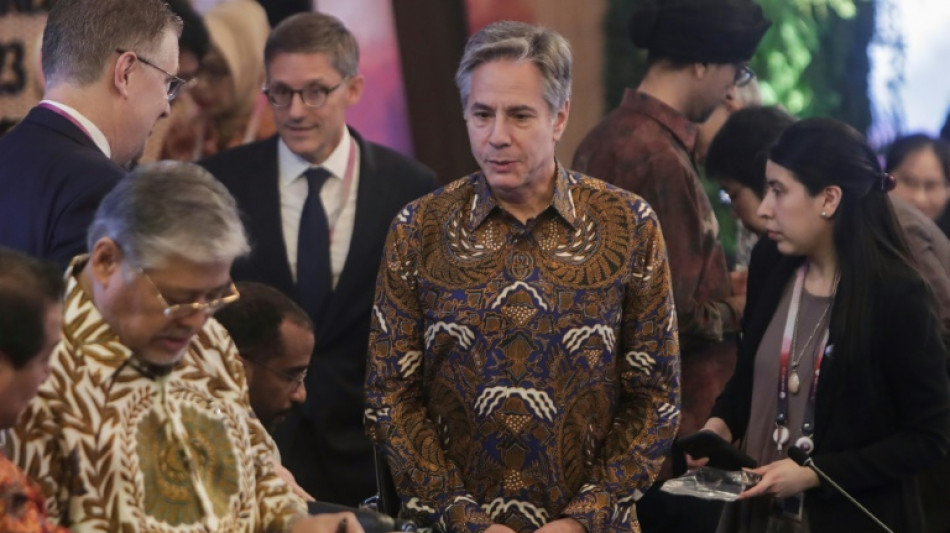
Big power disputes in spotlight at Southeast Asia security meet / Photo: Adi WEDA - POOL/AFP
 Eastside Jazz Festival Returns to Birmingham for Three-Day Event in February 2027

 Experts Warn Social Security Crisis Looms After Decades of Congressional Inaction

 Dar Global and Trump Organization Launch $700M Luxury Resort in Qatar
 Former Iowa State Women's Basketball Players Accuse Coach Bill Fennelly of Abuse

 New to The Street Show #781 Premieres Tonight on Bloomberg Television with Roadzen, Robo.ai, PureCipher and American Fusion

 How Families Budget for Youth Sports Travel Seasons

Top diplomats from the United States, China and Russia attend a security meeting on Friday with Southeast Asian foreign ministers, with the spotlight on the disputed South China Sea, the Ukraine war and North Korea's missiles.
The 27-member ASEAN Regional Forum (ARF) will provide an arena for big powers to lock heads over a range of issues, and the closed-door roundtable has previously been a fractious affair.
Host Indonesia warned that Southeast Asian bloc ASEAN cannot become a proxy, as US-China tensions flare over self-ruled Taiwan, Beijing's close ties with Moscow, and a tug-of-war for influence in the South Pacific.
US Secretary of State Antony Blinken, China's top diplomat Wang Yi and Russian Foreign Minister Sergei Lavrov will attend the ARF, a body set up to discuss security issues that also includes Japan, South Korea and Australia.
"The Indo-Pacific must not be another battleground," Indonesian Foreign Minister Retno Marsudi told ministers as she opened an earlier 18-nation East Asia Summit.
"Our region must remain stable, and we intend to keep it that way."
Friday's meetings would be the first between Blinken and Lavrov since a brief March encounter in India, but no bilateral talks are expected as Russia's widely condemned invasion of Ukraine grinds on.
- North Korea, Myanmar criticism -
Wang and Blinken, however, held their second meeting in as many months on Thursday as Washington and Beijing look to stabilise their relationship.
Blinken told Wang that Washington would hold hackers "accountable" after a breach of US government email accounts was blamed on Chinese state-backed actors, a US official said.
Wang urged Washington to "work with China in the same direction" to improve ties and stop interfering in China's affairs, according to a statement on Friday by the foreign ministry in Beijing.
Wang, replacing Foreign Minister Qin Gang who was unwell, also met with Lavrov on Thursday, and the pair pledged to deepen ties in areas of strategic communication and cooperation.
In an interview with Indonesian media this week, Lavrov said the war in Ukraine would not end until Western nations gave up their efforts to "defeat" Russia.
Before sitting around the table again Friday, Australian Foreign Minister Penny Wong raised human rights issues with Wang, and said it was crucial to speak frankly on the matter.
At the ASEAN Regional Forum, a North Korean official would be present but Pyongyang declined to send its foreign minister.
North Korea said Thursday that it had successfully tested a solid-fuel intercontinental ballistic missile.
Western nations were likely to condemn that launch at the meeting, as well as the Myanmar junta's alleged attacks against civilians as the coup-wracked country's crisis continues.
The situation in Myanmar has dominated the week's ASEAN meetings, from which the junta has been barred.
In a joint communique issued Thursday, ASEAN condemned violence in Myanmar and called for the five-point peace plan agreed with the junta two years ago to be implemented.
The bloc's efforts have been fruitless so far, with the junta ignoring international criticism and refusing to engage with its opponents.
burs-jfx/qan
P.Santos--AMWN


