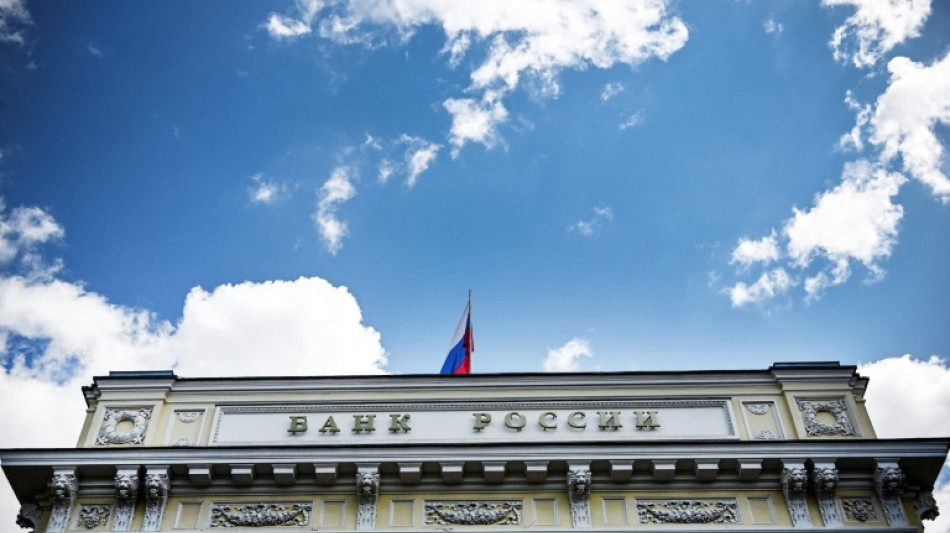
Russia hikes key rate for first time since 2022 / Photo: Alexander NEMENOV - AFP
 Eastside Jazz Festival Returns to Birmingham for Three-Day Event in February 2027

 Experts Warn Social Security Crisis Looms After Decades of Congressional Inaction

 Dar Global and Trump Organization Launch $700M Luxury Resort in Qatar

 Former Iowa State Women's Basketball Players Accuse Coach Bill Fennelly of Abuse

 New to The Street Show #781 Premieres Tonight on Bloomberg Television with Roadzen, Robo.ai, PureCipher and American Fusion

 How Families Budget for Youth Sports Travel Seasons
The Russian Central Bank on Friday hiked its key interest rate for the first time in more than a year amid fears that a weakening ruble will drive up inflation in the country.
The bank raised its benchmark rate from 7.5 percent to 8.5 percent -- higher than expected by analysts.
"Inflation expectations have risen. Domestic demand trends and the depreciation of the ruble since the beginning of 2023 significantly amplify pro-inflationary risks," the central bank said in a statement.
Days after Moscow launched its Ukraine offensive in February 2022, the bank radically hiked the rate to 20 percent as Russia's economy was hit by sweeping Western sanctions.
Reassured by the resilience of the Russian economy, policymakers gradually cut the rate to 7.5 percent, leaving it at that level since September 2022.
UK research group Capital Economics said the hike was "much larger than expected."
It "underscores policymakers' concerns about inflation risks," the research group said.
The ruble's recent fall pushed the bank to act to avoid soaring inflation like in spring last year when it reached a high of 17.8 percent.
Inflation in Russia stood at 3.25 percent in June, according to the country's statistics agency Rosstat.
Experts say relatively low oil prices despite recent production cuts by major producers may have contributed to a weakening ruble.
In a sign the sanctions were weighing on the country's economy, Russia's gross domestic product shrank by 1.9 percent in the first quarter of 2023, according to Rosstat.
But Russian President Vladimir Putin's spokesman said the Kremlin "does not see a threat to the country's financial stability" from a weak ruble.
"On the contrary... the situation is better than could have been predicted," Dmitry Peskov told reporters earlier this month.
P.Costa--AMWN


